
• About
  • Crypto Exchange
Bullbearlearn
Advertisement
  • Home
  • Learn Forex
    • Forex Basic
    • Trading Strategies
    • Price Action
    • Risk Management
  • Learn Crypto
    • Crypto Basics
    • Bitcoin & Ethereum
    • Major Altcoins
    • Wallets & Security
    • Buying & Trading Crypto
  • Trading Platform
    • Recommended
    • Reviews
    • Platform Guides
  • Tools
    • Tools Free
    • How to use
  • Blog
    • Market Analysis
      • Technical Analysis
    • News
Start
No Result
View All Result
Bullbearlearn
No Result
View All Result
Home Price Action Core Concepts

Support and Resistance in Price Action: How Levels Really Work

Baby Bull by Baby Bull
February 28, 2026
in Core Concepts, Price Action
57 2
0
Support and Resistance in Price Action

Support and Resistance in Price Action

190
SHARES
1.5k
VIEWS
Share on FacebookShare on Twitter

Support and resistance are among the most misunderstood concepts in trading.

Most traders draw too many lines, expect perfect reactions, and become frustrated when price “breaks” a level. The problem is not support and resistance—it is how traders think about them.

This article explains:

  • What support and resistance truly represent

  • How levels form from market behavior

  • Why price reacts near levels

  • Why levels are zones, not lines

Understanding levels correctly is essential before any execution logic makes sense.


Table of Contents

Toggle
  • What Are Support and Resistance?
  • Why Support and Resistance Exist
  • Levels Are Zones, Not Lines
  • How Support and Resistance Form
  • Support and Resistance Within Trends
    • 1. In an uptrend:
    • 2. In a downtrend:
  • Why Levels Sometimes Fail
  • Support and Resistance vs Market Structure
  • Common Mistakes With Support and Resistance
  • Higher Timeframe vs Lower Timeframe Levels
    • 1. Higher timeframe levels:
    • 2. Lower timeframe levels:
  • False Breaks and Stop Hunts
  • Why Support and Resistance Are Not Entry Signals
  • How Support and Resistance Fit Into the Price Action Framework
  • How to Practice Identifying Levels
  • Final Thoughts

What Are Support and Resistance?

At a basic level:

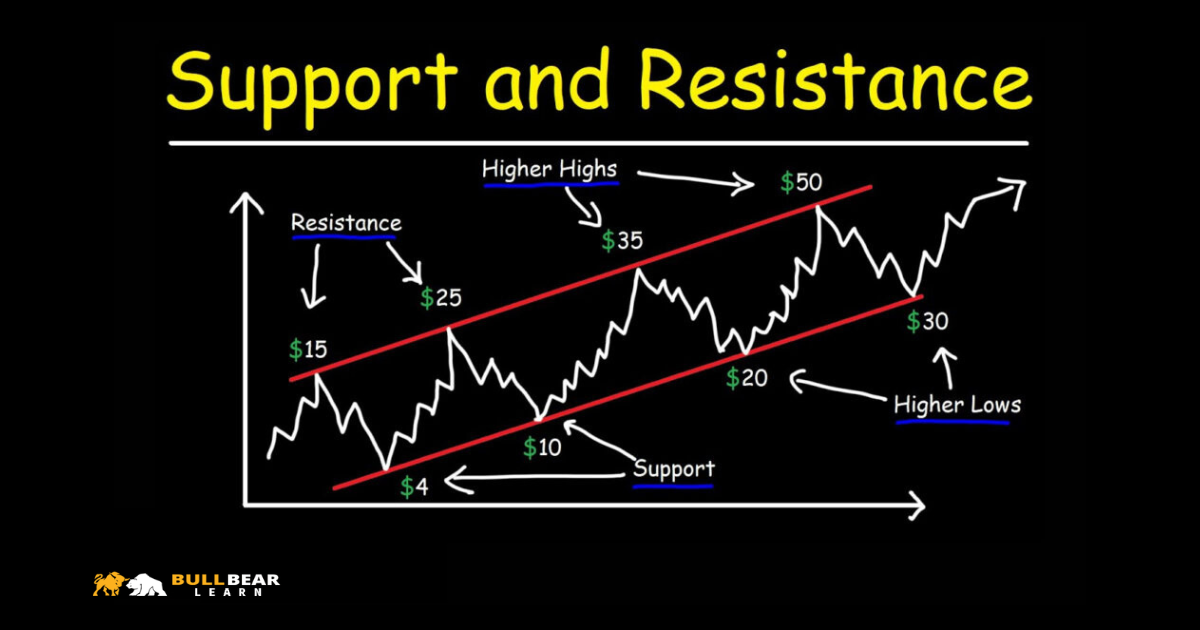
  • Support is an area where buying pressure has previously outweighed selling

  • Resistance is an area where selling pressure has previously outweighed buying

However, support and resistance are not technical tools. They are visual expressions of supply, demand, and trader psychology.

Price reacts at these areas because market participants remember them.

→ How the Market Moves: Supply, Demand & Psychology


Why Support and Resistance Exist

Levels exist due to collective memory.

Traders remember:

  • Where price reversed sharply

  • Where losses occurred

  • Where profits were missed

  • Where large moves began

When price returns to these areas:

  • Emotions resurface

  • Orders cluster

  • Reactions occur

Support and resistance work because people react similarly in similar situations.


Levels Are Zones, Not Lines

One of the biggest beginner mistakes is drawing razor-thin lines.

In reality:

  • Orders are distributed, not precise

  • Institutions do not enter with single prices

  • Liquidity exists across ranges

This is why price often:

  • Overshoots a level

  • Spikes through it

  • Reacts slightly above or below

Professional traders think in zones, not exact prices.


How Support and Resistance Form

Levels form through repeated interaction.

Common formation types:

  • Strong rejection from a price area

  • Consolidation before a large move

  • Previous highs and lows

  • Areas where structure changed

The more meaningful the reaction, the more relevant the level becomes.

→ Market Structure in Price Action


Support and Resistance Within Trends

Levels behave differently depending on context.

1. In an uptrend:

  • Old resistance often becomes new support

  • Pullbacks stall near higher lows

  • Buyers defend structure

2. In a downtrend:

  • Old support often becomes new resistance

  • Pullbacks fail near lower highs

  • Sellers remain in control

This role reversal is one of the most powerful Price Action concepts.


Why Levels Sometimes Fail

Support and resistance are not barriers—they are areas of interest.

Levels fail when:

  • Order flow overwhelms them

  • Trend momentum is strong

  • Liquidity is consumed

  • Context changes

A broken level does not mean the concept failed—it means market conditions shifted.


Support and Resistance vs Market Structure

Support and resistance do not exist independently.

Structure defines:

  • Which levels matter

  • Which reactions are meaningful

  • Which breaks are significant

A level against strong structure has lower probability than a level aligned with structure.

Context always comes first.


Common Mistakes With Support and Resistance

Avoid these errors:

  • Drawing levels everywhere

  • Expecting exact reversals

  • Ignoring timeframe hierarchy

  • Trading levels without context

  • Treating breaks as failures

Less is more when marking levels.


Higher Timeframe vs Lower Timeframe Levels

Not all levels carry equal weight.

1. Higher timeframe levels:

  • Reflect institutional interest

  • Hold more liquidity

  • Create stronger reactions

2. Lower timeframe levels:

  • Are more fragile

  • Break more easily

  • Useful mainly for refinement

Price Action traders prioritize higher timeframe levels first.


False Breaks and Stop Hunts

Price often moves beyond a level before reversing.

This happens because:

  • Stops cluster near obvious levels

  • Liquidity is needed for large orders

  • Emotional traders react prematurely

False breaks are not manipulation—they are liquidity events.

Understanding this prevents emotional reactions.


Why Support and Resistance Are Not Entry Signals

Levels do not tell you:

  • When to enter

  • Where to place stops

  • How much to risk

They tell you:

  • Where reactions are likely

  • Where decisions occur

  • Where context changes

Execution comes later. Levels provide location, not action.


How Support and Resistance Fit Into the Price Action Framework

Support and resistance connect:

  • Market structure

  • Trends

  • Supply and demand

  • Risk management (later)

Without understanding levels:

  • Entries feel random

  • Stops feel arbitrary

  • Losses feel unfair

With level awareness, traders gain patience and clarity.


How to Practice Identifying Levels

To train your eye:

  1. Start on higher timeframes

  2. Mark only obvious reaction areas

  3. Use zones, not lines

  4. Limit the number of levels

  5. Observe price behavior near them

The goal is recognition, not perfection.


Final Thoughts

Support and resistance are not magic lines on a chart.

They are psychological battlegrounds where buyers and sellers make decisions. When you understand how levels form and why reactions occur, price behavior becomes more logical and less emotional.

In the next article, we will transition from foundation to application by introducing Price Action Execution Concepts, explaining how traders combine structure, trends, and levels to make decisions—without turning Price Action into rigid rules.

→ Price Action Execution Concepts

Tags: Core Conceptsprice action
Share76Tweet48
Previous Post

Trends in Price Action: Trend Strength, Pullbacks, and Continuation

Next Post

Timeframes in Price Action: How to Use Top-Down Analysis Correctly

Related Posts

price action range trading

Price Action Strategy #5: Range Trading & Market Consolidation – How to Trade Sideways Markets Effectively

by Baby Bull
June 4, 2026
0

1. What Is a Range Market? A range market occurs when price moves sideways between a clear support and resistance...

price action reversal trading

Price Action Strategy #4: Reversal Trading – How to Catch Market Turning Points Like Smart Money

by Baby Bull
June 3, 2026
0

1. What Is Reversal Trading? A market reversal occurs when price changes direction after an existing trend. Examples: Uptrend →...

pullback trading strategy

Price Action Strategy #3: Pullback & Trend Continuation – Enter Trends Like a Professional

by Baby Bull
June 3, 2026
0

1. What Is a Pullback in Trading? A pullback is a temporary retracement of price against the main trend before...

breakout forex strategy

Price Action Strategy #2: Breakout & False Breakout – How Smart Money Traps Retail Traders

by Baby Bull
June 3, 2026
0

1. What Is a Breakout in Price Action? A breakout occurs when price moves beyond a significant level such as:...

price action trading strategy

Price Action Strategy #1: Price Action Trading Strategy: A Complete Framework for Consistent Decisions

by Baby Bull
June 3, 2026
0

Introduction: Why Most Trading Strategies Fail Most traders spend their time searching for: the best indicator the perfect entry a...

Load More
  • Trending
  • Comments
  • Latest
exness review

Exness Review 2026: Is Exness a Safe and Reliable Forex Broker?

June 16, 2026
Exness Account Types Explained

Exness Account Types Explained (2026): Which Exness Account Is Right for You?

July 13, 2026
Price Action Execution

Price Action Execution: A Professional Framework for Decision-Making

March 16, 2026
how to choose a forex broker

How to Choose a Forex Broker for Beginners: A Complete Guide

June 29, 2026
market order vs limit order

Market Order vs Limit Order: What’s the Difference in Crypto Trading?

0
Exness Pro Account

Exness Pro Account Review (2026): Is It Worth Upgrading?

0
Exness Standard Account

Exness Standard Account Review (2026): Is It the Best Choice for Most Traders?

0
Exness Account Types Explained

Exness Account Types Explained (2026): Which Exness Account Is Right for You?

0
market order vs limit order

Market Order vs Limit Order: What’s the Difference in Crypto Trading?

July 17, 2026
Exness Pro Account

Exness Pro Account Review (2026): Is It Worth Upgrading?

July 17, 2026
Exness Standard Account

Exness Standard Account Review (2026): Is It the Best Choice for Most Traders?

July 14, 2026
Exness Account Types Explained

Exness Account Types Explained (2026): Which Exness Account Is Right for You?

July 13, 2026

BullBearLearn.com is an independent educational platform covering Forex, Cryptocurrency, trading, and investing. We create practical guides, market analysis, broker and exchange reviews, and educational resources that help traders and investors navigate financial markets with greater confidence.

Categories
  • Bitcoin & Ethereum
  • Broker Reviews
  • Buying & Trading Crypto
  • Core Concepts
  • Core Strategies
  • Crypto Basics
  • Crypto Exchange
  • Execution
  • Forex Basic
  • Major Altcoins
  • Market Analysis
  • Market Condition
  • News
  • Platform Guides
  • Price Action
  • Psychology
  • Risk Management
  • Strategy
  • Technical Analysis
  • Tools
  • Trading Strategies
  • Wallets & Security
Tags
Beginner best Binance Review bitcoin breakout Broker Reviews BTC Bybit review calculator Core Concepts cost cpi crypto exchange crypto wallet ETH Ethereum Execution Exness Review fees fomc forex basic gold guide Leverage lot Margin mistake nfp nonfarm OKX review pip position size price action Psychology risk risk reward Spread strategy swap Swing wallet XM Review xtb review

Disclaimer: Content on BullBearLearn.com is for educational purposes only and not intended as financial advice. Trading involves risk.​

  • About
  • Privacy Policy
  • Terms of Service
  • Disclaimer
  • Cookie Policy
  • Affiliate Disclosure
  • Contact Us

© 2025 BullBearLearn.com — Learn to Trade, Bull or Bear.

Welcome Back!

Login to your account below

Forgotten Password?

Retrieve your password

Please enter your username or email address to reset your password.

Log In

Session expired

Please log in again. The login page will open in a new tab. After logging in you can close it and return to this page.

Add New Playlist

>

Table of Contents

×
  • What Are Support and Resistance?
  • Why Support and Resistance Exist
  • Levels Are Zones, Not Lines
  • How Support and Resistance Form
  • Support and Resistance Within Trends
    • 1. In an uptrend:
    • 2. In a downtrend:
  • Why Levels Sometimes Fail
  • Support and Resistance vs Market Structure
  • Common Mistakes With Support and Resistance
  • Higher Timeframe vs Lower Timeframe Levels
    • 1. Higher timeframe levels:
    • 2. Lower timeframe levels:
  • False Breaks and Stop Hunts
  • Why Support and Resistance Are Not Entry Signals
  • How Support and Resistance Fit Into the Price Action Framework
  • How to Practice Identifying Levels
  • Final Thoughts
→ Index
No Result
View All Result
  • Home
  • Learn Forex
    • Forex Basic
    • Trading Strategies
    • Price Action
    • Risk Management
  • Learn Crypto
    • Crypto Basics
    • Bitcoin & Ethereum
    • Major Altcoins
    • Wallets & Security
    • Buying & Trading Crypto
  • Trading Platform
    • Recommended
    • Reviews
    • Platform Guides
  • Tools
    • Tools Free
    • How to use
  • Blog
    • Market Analysis
      • Technical Analysis
    • News
START

© 2025 BullBearLearn.com — Learn to Trade, Bull or Bear.