

1. What Is a Breakout in Price Action?
A breakout occurs when price moves beyond a significant level such as:
- Support or Resistance
- Consolidation range
- Trendline
- Key psychological levels
This movement often signals:
- A potential shift in market structure
- The beginning of a new trend
- Increased participation from institutional traders
However, most traders misunderstand one critical point:
Not every breakout leads to a strong trend.
2. The Truth About Breakouts (What Most Traders Get Wrong)
Retail traders typically believe:
“Once price breaks a level, it will continue in that direction.”
This assumption is dangerously incomplete.
In reality, a breakout is often:
👉 A liquidity event, not a directional confirmation
Here’s what actually happens:
- Retail traders enter on breakout
- Stop losses accumulate around key levels
- Smart Money uses this liquidity to fill large orders
Which leads to an important insight:
Breakouts are not signals — they are setups.
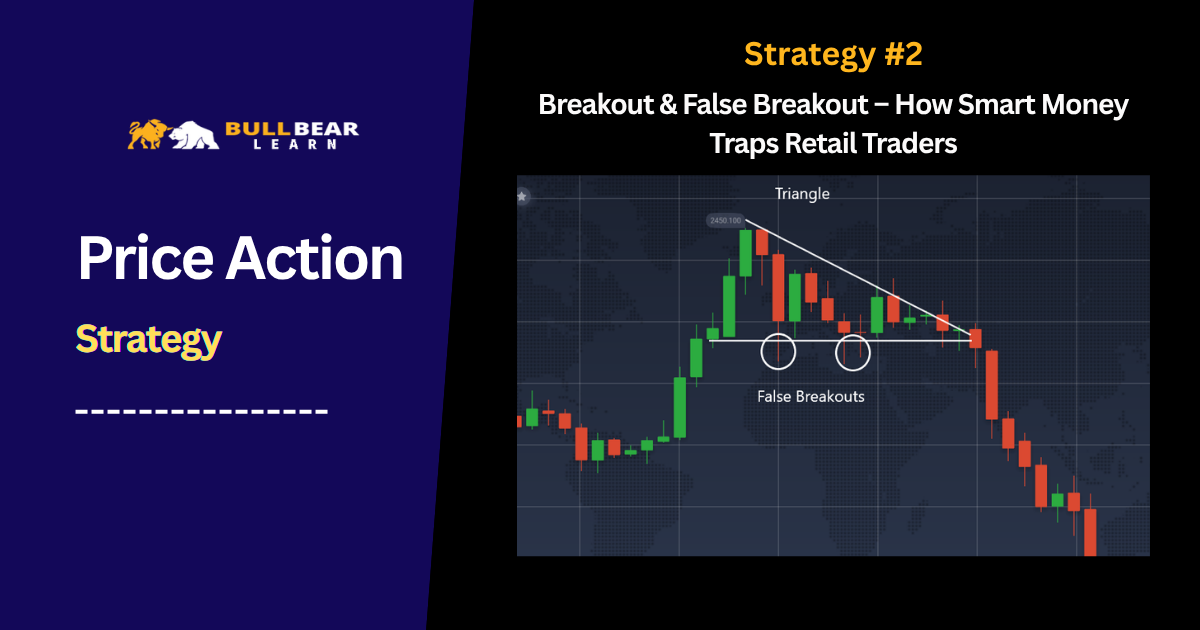
3. What Is a False Breakout (Fakeout)?
A false breakout happens when:
- Price breaks a key level
- Fails to sustain momentum
- Quickly reverses direction
This is one of the most common traps in trading.
Simple Example:
- Price breaks above resistance
- Traders enter BUY positions
- Stop losses are placed below the breakout level
- Price suddenly drops
- Stops get triggered
- Then price moves in the original direction (or continues down)
4. Why False Breakouts Happen (Smart Money Perspective)
Institutional traders (Smart Money) operate differently:
They need:
- Large liquidity
- Opposite orders to execute positions
But in a quiet market:
👉 There aren’t enough sellers for them to buy from
So they create a scenario:
- Push price above resistance
- Retail traders buy
- Then reverse the market
- Trigger stop losses and panic selling
- Use that liquidity to enter large positions
This process is known as:
Liquidity engineering
5. How to Identify a Real Breakout vs a False Breakout
Characteristics of a Valid Breakout
- Strong momentum candle (large body)
- Minimal wick (low rejection)
- Clear close beyond the level
- Follow-through price action
- Successful retest of the level
The most important factor:
👉 The retest holds
Characteristics of a False Breakout
- Long wick through the level
- Weak close (back inside the range)
- Immediate rejection
- No continuation
The key signal:
Rejection after breakout = warning sign
6. 3 High-Probability Breakout Trading Strategies
Strategy 1: Breakout Retest (Conservative Approach)
This is the safest and most consistent method.
Steps:
- Wait for a breakout
- Do NOT enter immediately
- Wait for price to retest the broken level
- Enter after confirmation
Entry Confirmation:
- Pin bar
- Engulfing candle
- Micro structure break
Stop Loss:
- Below/above the retest zone
Take Profit:
- Based on structure
- Minimum RR: 1:2
Strategy 2: Momentum Breakout (Aggressive Approach)
Best used in:
- Strong trending markets
- High volatility sessions (London/New York)
- News-driven moves
Conditions:
- Large breakout candle
- Strong momentum
- No significant wick
Entry:
- Immediately after breakout
Risk:
- Higher probability of false breakout
Strategy 3: Trading the False Breakout (Advanced Setup)
This is how professional traders exploit retail behavior.
Setup Structure:
- Price breaks a key level
- Traders enter in breakout direction
- Price sharply reverses
- A new micro structure forms
Entry:
- After confirmation of reversal
Stop Loss:
- Above/below the fakeout high/low
Take Profit:
- Opposite liquidity zone
7. Classic False Breakout Patterns
1. Liquidity Grab
- Price sweeps previous highs/lows
- Triggers stop losses
- Reverses strongly
This is one of the clearest Smart Money signals.
2. Swing Failure Pattern (SFP)
- Price breaks previous high
- Fails to close above it
- Closes back below
Highly reliable reversal signal.
3. Range Fakeout
- Market is ranging
- Price breaks one side
- Fails and returns to range
This often leads to:
👉 Strong move toward the opposite side of the range
8. Common Mistakes When Trading Breakouts
1. Entering Too Early
Jumping in at the breakout moment:
👉 Makes you liquidity for Smart Money
2. Ignoring Confirmation
Breakout alone is not enough.
3. Trading Every Breakout
Not all levels are equal.
4. Ignoring Market Context
Breakouts behave differently in:
- Trending markets
- Ranging markets
9. Golden Rules for Breakout Trading
To improve consistency, follow these rules:
- Trade only key levels
- Always wait for confirmation
- Prioritize retests
- Think in terms of liquidity
10. Conclusion
Breakouts are powerful — but also deceptive.
The difference between losing and winning traders lies in understanding:
- Market intention
- Liquidity flow
- Trader behavior
Retail traders react to price
Smart Money manipulates price
If you want to master Price Action at a deeper level:
👉 Continue with the next article:
Price Action Strategy #3: Pullback & Trend Continuation
If you want to practice breakout and retest setups in real market conditions,
👉 open a trading account here →/go/demo