

Introduction: Why Results Can Be Misleading
Most traders judge their performance based on one thing:
- Did I make money or lose money?
At first glance, this seems logical. Profit means success. Loss means failure.
But in trading, this way of thinking is deeply flawed.
A profitable trade can be a mistake.
A losing trade can be perfectly executed.
This is where most traders get trapped.
They focus on outcomes instead of process, which leads to:
- emotional reactions
- inconsistent behavior
- long-term failure
Professional traders think differently.
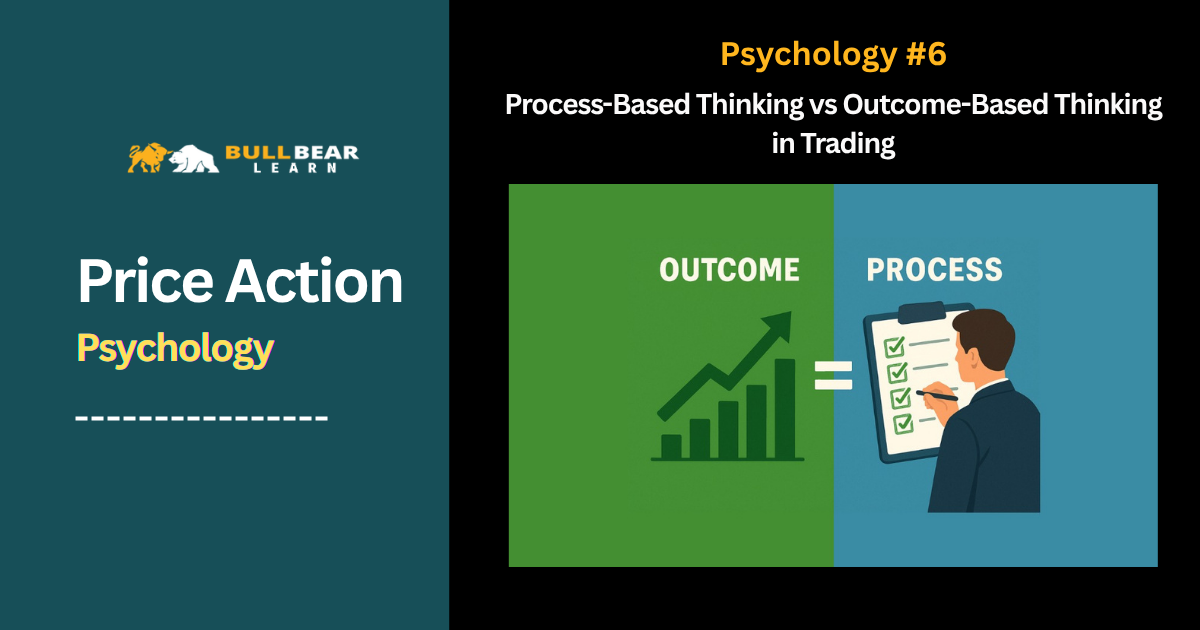
They focus on process over outcome.
This shift in mindset is what separates consistent traders from those who constantly struggle.
1. What Is Outcome-Based Thinking?
Outcome-based thinking means evaluating decisions based on results.
Examples:
- “This was a good trade because I made money.”
- “This strategy doesn’t work because I lost.”
This mindset creates dangerous distortions.
The Problem with Outcome-Based Thinking
Markets are probabilistic.
That means:
- good decisions can lead to losses
- bad decisions can lead to profits
When traders judge decisions by outcome:
- they reinforce bad habits
- they abandon good strategies
- they become inconsistent
2. What Is Process-Based Thinking?
Process-based thinking focuses on:
- decision quality
- rule-following
- execution consistency
Instead of asking:
“Did I win or lose?”
Professional traders ask:
“Did I follow my system correctly?”
Examples:
- Losing trade + correct execution → good trade
- Winning trade + rule-breaking → bad trade
This mindset aligns with:
Because consistency is built on repeating correct behavior, not chasing outcomes.
3. Why Outcome Thinking Leads to Emotional Trading
Outcome-based thinking directly fuels emotional reactions.
After a Winning Trade:
- Overconfidence increases
- Risk increases
- Rules are ignored
After a Losing Trade:
- Fear increases
- Confidence drops
- Strategy is questioned
This leads to:
- overtrading
- hesitation
- revenge trading
As explained in:
Outcome focus amplifies emotional instability.
4. The Role of Probability in Process Thinking
Trading is not about certainty.
It is about probability.
A single trade means nothing.
A series of trades defines performance.
This is why:
- professionals think in samples (50–100 trades)
- beginners think in single outcomes
Process-based thinking aligns with:
- statistical reality
- long-term expectancy
It reinforces principles from:
5. Process Thinking and Losing Streaks
During losing streaks, outcome-based traders:
- panic
- change strategies
- increase risk
Process-based traders:
- review execution
- maintain discipline
- continue following rules
This is critical for surviving:
- drawdowns
- losing streaks
As discussed in:
Without process thinking, losing streaks become destructive.
6. The Illusion of Control and Outcome Addiction
Outcome-based traders believe:
- more effort = better results
- more analysis = more control
This creates:
- overanalysis
- emotional attachment to trades
- frustration when outcomes don’t match expectations
But in reality:
- outcomes cannot be controlled
- only behavior can be controlled
This illusion traps traders in a cycle of:
expectation → disappointment → emotional reaction
7. How Process-Based Thinking Improves Consistency
Process-based traders:
- follow routines
- apply the same rules
- execute without hesitation
This creates:
- stable performance
- predictable risk
- controlled drawdowns
It connects directly to:
Because journaling tracks:
- behavior
- decision quality
- consistency
Not just profit and loss.
8. Practical Shift: From Outcome to Process
Changing mindset requires deliberate effort.
Step 1: Redefine Success
Success = following your system
Not profit per trade
Step 2: Evaluate Execution, Not Results
After each trade, ask:
- Did I follow my rules?
- Was my decision logical?
Step 3: Track Process Metrics
Instead of only tracking profit:
- track rule adherence
- track emotional control
- track consistency
Step 4: Think in Series, Not Individual Trades
Focus on:
- 20 trades
- 50 trades
- 100 trades
This reduces emotional impact of single outcomes.
9. The Professional Mindset
At the highest level, trading becomes:
- rule-based execution
- probability management
- emotional neutrality
Professionals do not chase:
- perfect entries
- perfect outcomes
They focus on:
- consistent behavior
- controlled risk
- long-term edge
The goal is not to win every trade.
The goal is to execute correctly every time.
Conclusion: Process Creates Long-Term Profitability
Outcome-based thinking feels natural — but it leads to failure.
Process-based thinking feels unnatural — but it leads to consistency.
The difference is simple:
- Outcome thinking reacts
- Process thinking executes
When traders shift focus from:
- “Did I win?”
to - “Did I follow my system?”
Everything changes:
- emotions stabilize
- discipline improves
- performance becomes consistent