
• About
  • Crypto Exchange
Bullbearlearn
Advertisement
  • Home
  • Learn Forex
    • Forex Basic
    • Trading Strategies
    • Price Action
  • Learn Crypto
  • Broker Reviews
  • Tools FREE
  • Blog
Start
No Result
View All Result
Bullbearlearn
No Result
View All Result
Home Price Action

Risk Management #4: Risk-Reward Ratio: The Math Behind Long-Term Profitability

Baby Bull by Baby Bull
March 16, 2026
in Price Action, Risk Management
58 0
0
risk reward ratio forex

risk reward ratio forex

190
SHARES
1.5k
VIEWS
Share on FacebookShare on Twitter

Many traders believe that a high risk-reward ratio (R:R) guarantees profitability.
They aim for 1:3, 1:5, or even higher, assuming bigger winners will solve their problems.

This assumption is incomplete—and often dangerous.

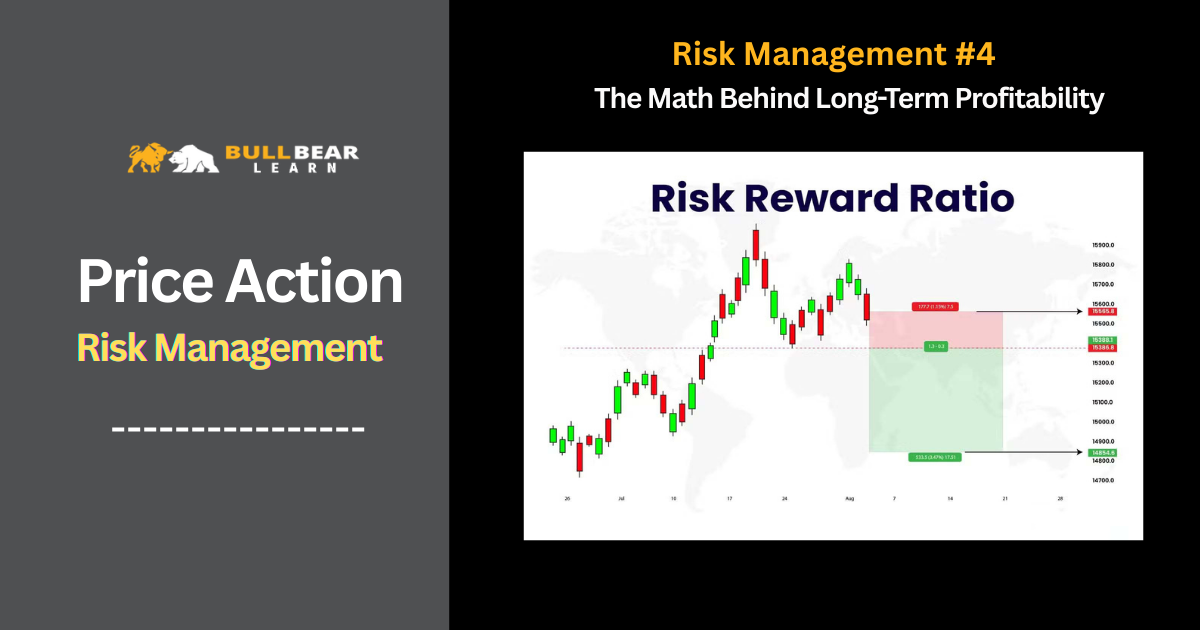
Risk-reward ratio does not determine profitability by itself.
It only works when combined with realistic win rates, disciplined execution, and proper risk control.

In this article, you will learn how risk-reward actually works, how to use it correctly, and why chasing high R:R without context often leads to frustration and losses.


Table of Contents

Toggle
  • What Is Risk-Reward Ratio?
  • Risk-Reward Alone Does Not Create an Edge
  • The Math Behind Risk-Reward and Expectancy
  • Why Higher Risk-Reward Often Lowers Win Rate
  • Risk-Reward Must Respect Market Structure
  • The Role of Execution in Real Risk-Reward
  • Risk-Reward and Drawdowns
  • Practical Guidelines for Using Risk-Reward
  • Risk-Reward Is a Planning Tool, Not a Promise
  • What Comes Next
  • Final Thoughts

What Is Risk-Reward Ratio?

Risk-reward ratio compares:

  • Risk: how much you are willing to lose if the trade fails

  • Reward: how much you expect to gain if the trade succeeds

Example:

  • Risk: 1 unit

  • Reward: 2 units

  • Risk-Reward Ratio: 1:2

On the surface, this looks simple.
In practice, it is deeply connected to probability and execution.


Risk-Reward Alone Does Not Create an Edge

A common misconception is:

“As long as my R:R is high, I don’t need to win often.”

Reality is more nuanced.

A trader risking 1 to make 3 still needs:

  • Adequate win rate

  • Consistent execution

  • Acceptable drawdowns

A 1:3 R:R with a 20% win rate is not profitable.
A 1:1.5 R:R with a 60% win rate can be.

Risk-reward must be evaluated together with win rate, not in isolation.


The Math Behind Risk-Reward and Expectancy

Expectancy is the average amount you expect to gain or lose per trade.

A simplified expectancy formula:

Expectancy = (Win Rate × Average Win) − (Loss Rate × Average Loss)

Risk-reward defines the size of wins and losses.
Win rate defines how often they occur.

Without positive expectancy, no risk-reward ratio will save a trader long term.


Why Higher Risk-Reward Often Lowers Win Rate

As reward targets increase:

  • Trades require larger price movements

  • Market noise becomes more significant

  • Trades fail more frequently

This trade-off is unavoidable.

Many traders experience:

  • Long losing streaks

  • Psychological stress

  • Abandoning valid strategies prematurely

This is why risk-reward must match market conditions and trade type, not personal preference.


Risk-Reward Must Respect Market Structure

Targets should not be placed arbitrarily.

Logical reward targets consider:

  • Previous highs and lows

  • Supply and demand zones

  • Trend structure

Targeting 1:5 when the next major resistance is nearby is unrealistic and reduces win probability.

This concept ties directly to:

  • Risk Management #3: Stop Loss Placement – Logic, Structure & Common Mistakes

Stops and targets must be designed together as a single structure-based plan.


The Role of Execution in Real Risk-Reward

Theoretical R:R often differs from real results due to:

  • Slippage

  • Spread widening

  • Partial fills

A planned 1:2 trade can become 1:1.6 in reality.

This reinforces the importance of understanding:

  • Execution #3: Trading Costs in Forex – Spread, Commission, Swap & Hidden Costs

Ignoring execution leads to inflated expectations and flawed performance analysis.


Risk-Reward and Drawdowns

Higher R:R strategies often produce:

  • Longer losing streaks

  • Deeper temporary drawdowns

Without proper risk control, traders abandon strategies during normal variance.

This connects directly to:

  • Risk Management #5: Drawdown, Losing Streaks & Capital Survival

Understanding drawdowns helps traders stick to statistically valid systems.


Practical Guidelines for Using Risk-Reward

Rather than chasing extreme ratios, professionals focus on:

  • Consistency

  • Realistic targets

  • Stable equity curves

General guidelines:

  • Lower timeframes → lower R:R, higher win rate

  • Higher timeframes → higher R:R, lower win rate

  • Strong trends → allow larger rewards

  • Ranging markets → accept smaller targets

Risk-reward should adapt, not remain fixed.


Risk-Reward Is a Planning Tool, Not a Promise

Risk-reward ratio helps traders:

  • Filter poor trades

  • Compare opportunities objectively

  • Maintain discipline

It does not guarantee outcomes.

Markets remain probabilistic.
Risk management exists to survive that uncertainty.


What Comes Next

Risk-reward defines potential profitability.
The final threat to survival is capital erosion during bad periods.

That is the focus of:

  • Risk Management #5: Drawdown, Losing Streaks & Capital Survival


Final Thoughts

Risk-reward ratio is powerful—but only when used correctly.

Chasing high R:R without context is no different from gambling.
Used wisely, it becomes a mathematical compass that guides disciplined decision-making.

Tags: price actionrisk
Share76Tweet48
Previous Post

Risk Management #3: Stop Loss Placement: Logic, Structure & Common Mistakes

Next Post

Risk Management #1: Why Risk Management Matters More Than Your Trading Strategy?

Related Posts

breakout forex strategy

Strategy #2: Breakout & False Breakout – How Smart Money Traps Retail Traders

by Baby Bull
March 23, 2026
0

1. What Is a Breakout in Price Action? A breakout occurs when price moves beyond a significant level such as:...

price action trading strategy

Strategy #1: Price Action Trading Strategy: A Complete Framework for Consistent Decisions

by Baby Bull
March 23, 2026
0

Introduction: Why Most Trading Strategies Fail Most traders spend their time searching for: the best indicator the perfect entry a...

trading mindset

Psychology #6: Process-Based Thinking vs Outcome-Based Thinking in Trading

by Baby Bear
March 21, 2026
0

Introduction: Why Results Can Be Misleading Most traders judge their performance based on one thing: Did I make money or...

trading journal

Psychology #5: Trading Routine, Journaling & Mental Process: How Professionals Build Consistency

by Baby Bull
March 22, 2026
0

Introduction: Consistency Is Built, Not Natural Most traders struggle with: inconsistency emotional decisions lack of discipline They believe the solution...

losing streaks in trading

Psychology #4: Losing Streaks, Tilt & Psychological Recovery in Trading

by Baby Bull
March 21, 2026
0

Introduction: Losing Streaks Are Inevitable — Breakdown Is Optional Every trader experiences losing streaks. Even the best strategies, with solid...

Load More
  • Trending
  • Comments
  • Latest
Market Structure in Price Action

Market Structure in Price Action: Higher Highs, Lower Lows Explained

February 27, 2026
exness review

Exness Review 2026: Is It Safe, Legit & Worth It for Beginners?

March 23, 2026
Discipline & Consistency in Trading

Psychology #3: Discipline & Consistency in Trading: How Professionals Actually Follow Rules

March 21, 2026
trading psychology basics

Psychology #1: Trading Psychology Basics: Why Most Traders Fail Despite Good Strategies

March 20, 2026
breakout forex strategy

Strategy #2: Breakout & False Breakout – How Smart Money Traps Retail Traders

0
price action trading strategy

Strategy #1: Price Action Trading Strategy: A Complete Framework for Consistent Decisions

0
trading mindset

Psychology #6: Process-Based Thinking vs Outcome-Based Thinking in Trading

0
trading journal

Psychology #5: Trading Routine, Journaling & Mental Process: How Professionals Build Consistency

0
breakout forex strategy

Strategy #2: Breakout & False Breakout – How Smart Money Traps Retail Traders

March 23, 2026
price action trading strategy

Strategy #1: Price Action Trading Strategy: A Complete Framework for Consistent Decisions

March 23, 2026
trading mindset

Psychology #6: Process-Based Thinking vs Outcome-Based Thinking in Trading

March 21, 2026
trading journal

Psychology #5: Trading Routine, Journaling & Mental Process: How Professionals Build Consistency

March 22, 2026

BullBearLearn.com is an independent educational website on Forex and financial trading, offering knowledge, strategies, and tools to help traders understand and navigate markets—whether bullish or bearish.

Categories
  • Broker Reviews
  • Core Concepts
  • Core Strategies
  • Crypto Exchange
  • Execution
  • Forex Basic
  • Learn Forex
  • Market Condition
  • Price Action
  • Psychology
  • Risk Management
  • Strategy
  • Tools
  • Trading Strategies
Tags
Beginner Binance Review breakout Broker Reviews Bybit review calculator Core Concepts cost crypto exchange Execution Exness Review fees forex basic guide Leverage lot Margin mistake OKX review pip position size price action Psychology risk risk reward Spread swap Swing XM Review xtb review

Disclaimer: Content on BullBearLearn.com is for educational purposes only and not intended as financial advice. Trading involves risk.​

  • About
  • Privacy Policy
  • Terms of Service
  • Disclaimer
  • Cookie Policy
  • Affiliate Disclosure
  • Contact Us

© 2025 BullBearLearn.com — Learn to Trade, Bull or Bear.

Welcome Back!

Login to your account below

Forgotten Password?

Retrieve your password

Please enter your username or email address to reset your password.

Log In

Session expired

Please log in again. The login page will open in a new tab. After logging in you can close it and return to this page.

Add New Playlist

>

Table of Contents

×
  • What Is Risk-Reward Ratio?
  • Risk-Reward Alone Does Not Create an Edge
  • The Math Behind Risk-Reward and Expectancy
  • Why Higher Risk-Reward Often Lowers Win Rate
  • Risk-Reward Must Respect Market Structure
  • The Role of Execution in Real Risk-Reward
  • Risk-Reward and Drawdowns
  • Practical Guidelines for Using Risk-Reward
  • Risk-Reward Is a Planning Tool, Not a Promise
  • What Comes Next
  • Final Thoughts
→ Index
No Result
View All Result
  • Home
  • Learn Forex
    • Forex Basic
    • Trading Strategies
    • Price Action
  • Learn Crypto
  • Broker Reviews
  • Tools FREE
  • Blog
START

© 2025 BullBearLearn.com — Learn to Trade, Bull or Bear.