

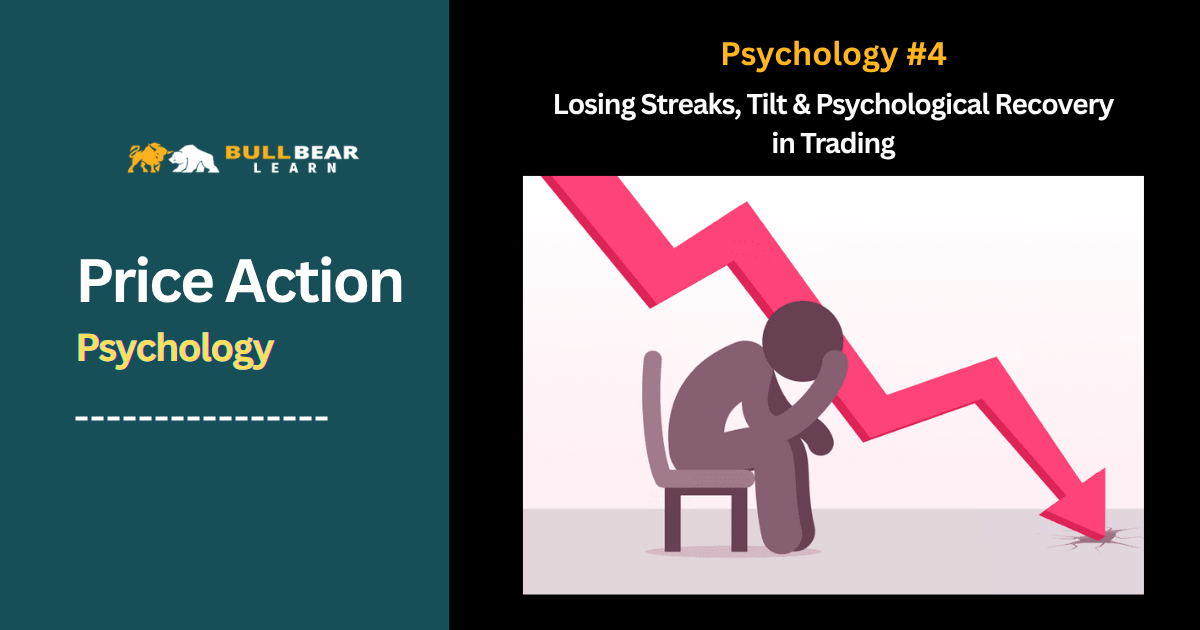
Introduction: Losing Streaks Are Inevitable — Breakdown Is Optional
Every trader experiences losing streaks.
Even the best strategies, with solid risk management and proven edge, will go through periods where multiple trades fail in a row.
Yet most traders are not prepared for this reality.
Instead of accepting losing streaks as part of the process, they react emotionally:
- increasing risk
- abandoning strategy
- overtrading
- trying to recover losses quickly
This is where the real damage begins.
Losing streaks do not destroy accounts.
Emotional reactions to losing streaks do.
In this article, you will learn:
- why losing streaks happen
- what “tilt” is and why it is dangerous
- how professional traders recover psychologically
- how to protect both capital and discipline during difficult periods
1. Why Losing Streaks Are Normal in Trading
Trading is a probabilistic environment.
Even with a profitable system:
- outcomes are random in the short term
- losses can cluster together
For example:
- A strategy with a 55% win rate can still produce 8–10 consecutive losses
This is not a flaw.
It is statistical reality.
This concept connects directly to:
If traders do not understand this, they will:
- lose confidence in their system
- change strategies prematurely
- create inconsistency
2. What Is “Tilt” in Trading?
Tilt is a psychological state where:
emotions override logic and discipline completely.
The term comes from poker, but it applies perfectly to trading.
Signs of Tilt
- Entering trades impulsively
- Increasing position size irrationally
- Ignoring stop losses
- Chasing losses
- Trading without clear setups
Tilt usually appears after:
- consecutive losses
- missed opportunities
- large unexpected drawdowns
It is the point where trading shifts from decision-making → emotional reaction.
3. The Transition from Losses to Tilt
Losing streaks alone do not cause failure.
The transition into tilt does.
The typical sequence:
- Normal losses (within expectation)
- Emotional discomfort increases
- Doubt about strategy appears
- Urge to “fix” or “recover” losses
- Rules are broken
- Tilt begins
Once tilt starts:
- risk increases
- discipline disappears
- losses accelerate
Understanding this transition is critical for prevention.
4. Why Traders Try to “Recover Quickly”
After losses, traders often feel the need to:
- get back to breakeven
- prove they are right
- regain confidence
This creates urgency.
Urgency leads to:
- overtrading
- larger position sizes
- poor-quality setups
This behavior directly contradicts:
The desire to recover quickly is one of the most dangerous psychological traps.
5. The Psychological Impact of Drawdown
Drawdowns affect more than capital.
They affect perception and behavior.
As drawdown increases:
- confidence decreases
- fear increases
- decision quality declines
This creates a feedback loop:
Drawdown → Emotional pressure → Poor decisions → More drawdown
Without control, this loop leads to account destruction.
This is why understanding:
- drawdown and capital preservation
(from Risk Management #5)
is essential for psychological stability.
6. How Professional Traders Handle Losing Streaks
Professional traders do not avoid losing streaks.
They prepare for them.
Key Behaviors:
1. Accept Losses as Part of the System
They understand that:
- losses do not invalidate the strategy
- short-term outcomes are random
2. Maintain Consistent Risk
They do not increase risk to recover losses.
They often reduce risk during difficult periods.
3. Reduce Trading Activity
They focus only on:
- high-quality setups
- optimal market conditions
4. Follow Predefined Rules
They rely on:
- structured processes
- disciplined execution
Not emotions.
7. Practical Strategies for Psychological Recovery
Recovery is not about “winning back money.”
It is about restoring stability.
Step 1: Reduce Risk Exposure
Lower position size temporarily to:
- protect capital
- reduce emotional pressure
Step 2: Pause If Necessary
Taking a break helps:
- reset mental state
- avoid impulsive decisions
Step 3: Review Trades Objectively
Ask:
- Did I follow my rules?
- Were losses within expectation?
- Was execution consistent?
Step 4: Focus on Process, Not Outcome
Return to:
- rule-based execution
- structured decision-making
Step 5: Rebuild Confidence Gradually
Confidence comes from:
- consistent behavior
- not from quick wins
8. The Role of Discipline During Recovery
Recovery depends on discipline.
As explained in:
Without discipline:
- recovery attempts become revenge trading
- losses accelerate
With discipline:
- drawdown stabilizes
- performance gradually improves
9. Losing Streaks Are a Test of Professionalism
Anyone can trade well during winning periods.
The real test is:
how you behave during losing periods.
Losing streaks reveal:
- emotional control
- discipline level
- risk management strength
They are not obstacles —
they are part of the development process.
Conclusion: Control the Reaction, Not the Outcome
You cannot control:
- how many trades will lose
- when losing streaks will occur
But you can control:
- how you respond
- how much you risk
- whether you follow your system
Professional traders are not those who avoid losses,
but those who remain stable during them.
Mastering this stage prepares you for the next step:
→ Psychology #5: Trading Routine, Journaling & Mental Process