
• About
  • Crypto Exchange
Bullbearlearn
Advertisement
  • Home
  • Learn Forex
    • Forex Basic
    • Trading Strategies
    • Price Action
  • Learn Crypto
  • Broker Reviews
  • Tools FREE
  • Blog
Start
No Result
View All Result
Bullbearlearn
No Result
View All Result
Home Price Action

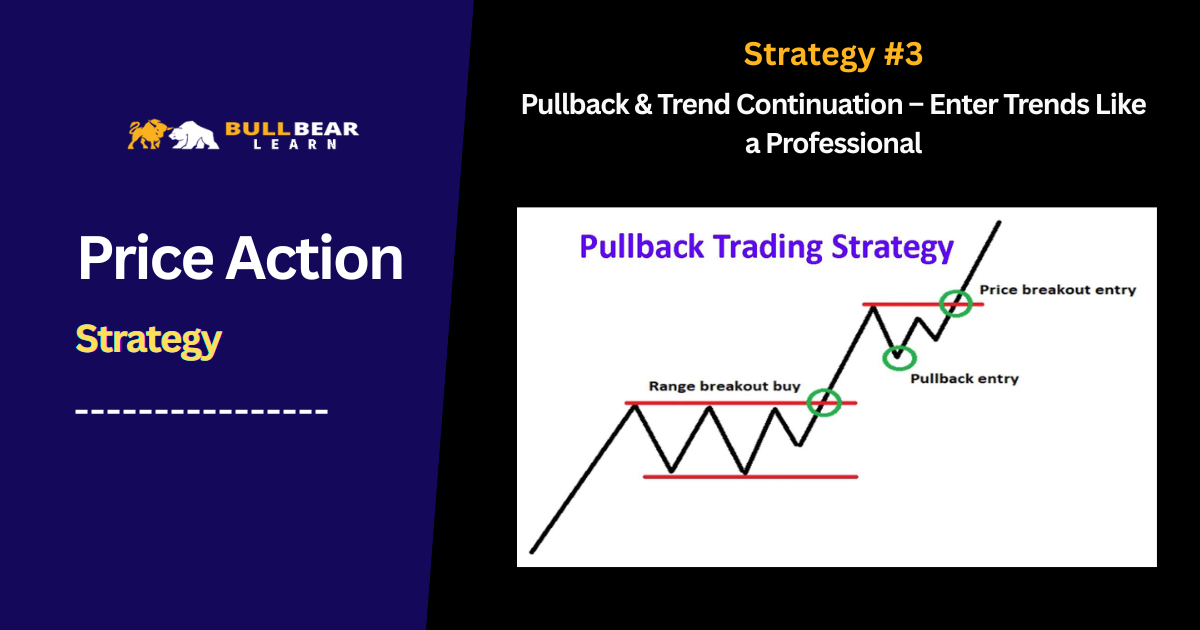
Price Action Strategy #3: Pullback & Trend Continuation – Enter Trends Like a Professional

Baby Bull by Baby Bull
June 3, 2026
in Price Action, Strategy
56 2
0
pullback trading strategy

pullback trading strategy

189
SHARES
1.5k
VIEWS
Share on FacebookShare on Twitter

Table of Contents

Toggle
  • 1. What Is a Pullback in Trading?
  • 2. Pullback vs Reversal (Critical Difference)
    • Pullback
    • Reversal
  • 3. Why Pullback Trading Works
  • 4. Ideal Conditions for Pullback Trading
    • ✅ High-Probability Conditions:
  • 5. Types of Pullbacks
    • 1. Shallow Pullback
    • 2. Deep Pullback
    • 3. Complex Pullback
  • 6. The Pullback Entry Strategy (Step-by-Step)
    • Step 1: Identify the Trend
    • Step 2: Wait for Pullback
    • Step 3: Mark Key Zone
    • Step 4: Wait for Confirmation
    • Step 5: Execute Trade
  • 7. Advanced Pullback Concept: “Continuation Trap”
    • Scenario:
    • Solution:
  • 8. Best Timeframes for Pullback Trading
  • 9. Common Mistakes
    • ❌ Entering too early
    • ❌ Trading against the trend
    • ❌ Ignoring structure
    • ❌ Overtrading
  • 10. Risk Management for Pullback Trades
  • 11. Tools to Improve Pullback Trading
  • 12. Real Market Logic (What Professionals Do)
  • 13. Conclusion
  • Next Step

1. What Is a Pullback in Trading?

A pullback is a temporary retracement of price against the main trend before it continues in the original direction.

In a trending market:

  • Uptrend → price makes higher highs and higher lows
  • Downtrend → price makes lower highs and lower lows

If you’re not fully confident with trend structure, start here:
👉 Market Structure Guide → /market-structure/

Pullbacks are essential because:

They offer the best risk-to-reward entries in trending markets


2. Pullback vs Reversal (Critical Difference)

One of the biggest mistakes traders make is confusing a pullback with a reversal.

Pullback

  • Temporary pause
  • Occurs within a trend
  • Followed by continuation

Reversal

  • Change in market direction
  • Breaks structure
  • Forms a new trend

👉 Understanding this distinction is key to avoiding false entries.


3. Why Pullback Trading Works

Pullbacks exist because of market mechanics and liquidity:

  • Early traders take profit
  • Late traders enter
  • Smart Money re-enters positions

This creates a temporary counter-move.

If you’ve read about breakouts, you’ll notice the connection:
👉 Breakout & False Breakout Strategy → /breakout-strategy/


4. Ideal Conditions for Pullback Trading

Not every pullback is tradable.

✅ High-Probability Conditions:

  • Strong, clear trend
  • Clean market structure
  • No major resistance/support nearby
  • Momentum before pullback

👉 Avoid choppy or sideways markets.
If market is ranging, use:
👉 /range-trading-strategy/ (future supporting article)


5. Types of Pullbacks


1. Shallow Pullback

  • Small retracement
  • Strong trend continuation

👉 Indicates strong market momentum


2. Deep Pullback

  • Larger retracement (often 50–70%)
  • Still respects structure

👉 Offers better RR but higher risk


3. Complex Pullback

  • Multiple small retracements
  • Sideways correction

👉 Requires patience and confirmation


6. The Pullback Entry Strategy (Step-by-Step)

This is the core of professional trend trading.


Step 1: Identify the Trend

Use:

  • Higher highs / higher lows
  • Lower highs / lower lows

Step 2: Wait for Pullback

Do NOT chase price.

If you missed the move, wait — the market always pulls back


Step 3: Mark Key Zone

Look for confluence:

  • Previous support/resistance
  • Trendline
  • Supply/Demand zone

👉 You can improve accuracy by mastering:
→ /support-resistance/


Step 4: Wait for Confirmation

Entry signals:

  • Pin bar
  • Engulfing candle
  • Rejection wick
  • Micro structure break

Step 5: Execute Trade

  • Entry: after confirmation
  • Stop Loss: below/above pullback
  • Take Profit: next structure level

7. Advanced Pullback Concept: “Continuation Trap”

This is where most traders fail.


Scenario:

  1. Market is trending
  2. Pullback begins
  3. Traders enter early
  4. Price goes deeper
  5. Stop losses get hit
  6. Then trend continues

👉 This is a liquidity trap


Solution:

  • Wait for confirmation
  • Avoid blind entries
  • Understand liquidity

👉 Combine with:
→ /liquidity-concepts/


8. Best Timeframes for Pullback Trading

  • H1 → Intraday traders
  • H4 → Swing trading
  • D1 → Position trading

👉 Lower timeframes = more noise
👉 Higher timeframes = more reliable


9. Common Mistakes

❌ Entering too early

❌ Trading against the trend

❌ Ignoring structure

❌ Overtrading

👉 If you struggle with discipline:
→ /trading-psychology/


10. Risk Management for Pullback Trades

Even the best setups fail.

Always:

  • Risk 1–2% per trade
  • Use proper stop loss
  • Maintain RR ≥ 1:2

👉 Full guide here:
→ /risk-management/


11. Tools to Improve Pullback Trading

To execute this strategy effectively, you need:

  • Clean charts
  • Reliable execution
  • Fast order placement

👉 You can use a professional platform here:
→ /go/broker

For charting and analysis:
→ /go/tradingview


12. Real Market Logic (What Professionals Do)

Professional traders don’t chase breakouts.

They:

  • Wait for pullbacks
  • Enter with confirmation
  • Manage risk precisely

Amateurs chase price
Professionals wait for price to come to them


13. Conclusion

Pullback trading is one of the most consistent and scalable strategies in Price Action.

It allows you to:

  • Enter trends with low risk
  • Avoid emotional trading
  • Trade like institutional players

Next Step

👉 Continue with:
Price Action Strategy #4: Reversal Trading & Market Turning Points

Tags: price action
Share76Tweet47
Previous Post

Price Action Strategy #2: Breakout & False Breakout – How Smart Money Traps Retail Traders

Next Post

Price Action Strategy #4: Reversal Trading – How to Catch Market Turning Points Like Smart Money

Related Posts

breakout forex strategy

Price Action Strategy #2: Breakout & False Breakout – How Smart Money Traps Retail Traders

by Baby Bull
March 23, 2026
0

1. What Is a Breakout in Price Action? A breakout occurs when price moves beyond a significant level such as:...

price action trading strategy

Price Action Strategy #1: Price Action Trading Strategy: A Complete Framework for Consistent Decisions

by Baby Bull
March 23, 2026
0

Introduction: Why Most Trading Strategies Fail Most traders spend their time searching for: the best indicator the perfect entry a...

trading mindset

Psychology #6: Process-Based Thinking vs Outcome-Based Thinking in Trading

by Baby Bear
March 21, 2026
0

Introduction: Why Results Can Be Misleading Most traders judge their performance based on one thing: Did I make money or...

trading journal

Psychology #5: Trading Routine, Journaling & Mental Process: How Professionals Build Consistency

by Baby Bull
March 22, 2026
0

Introduction: Consistency Is Built, Not Natural Most traders struggle with: inconsistency emotional decisions lack of discipline They believe the solution...

losing streaks in trading

Psychology #4: Losing Streaks, Tilt & Psychological Recovery in Trading

by Baby Bull
March 21, 2026
0

Introduction: Losing Streaks Are Inevitable — Breakdown Is Optional Every trader experiences losing streaks. Even the best strategies, with solid...

Load More
  • Trending
  • Comments
  • Latest
Pullback Trading Strategy

Pullback Trading Strategy: How to Trade Retracements with Precision and Control

March 17, 2026
forex account types

Forex Account Types Explained: Standard, Raw, ECN & More

December 15, 2025
Market Structure in Price Action

Market Structure in Price Action: Higher Highs, Lower Lows Explained

February 27, 2026
Low Volatility Market Trading

Low Volatility Market Trading Strategies: Best Ways to Trade Sideways Markets

March 7, 2026
breakout forex strategy

Price Action Strategy #2: Breakout & False Breakout – How Smart Money Traps Retail Traders

0
price action trading strategy

Price Action Strategy #1: Price Action Trading Strategy: A Complete Framework for Consistent Decisions

0
trading mindset

Psychology #6: Process-Based Thinking vs Outcome-Based Thinking in Trading

0
trading journal

Psychology #5: Trading Routine, Journaling & Mental Process: How Professionals Build Consistency

0
breakout forex strategy

Strategy #2: Breakout & False Breakout – How Smart Money Traps Retail Traders

March 23, 2026
price action trading strategy

Strategy #1: Price Action Trading Strategy: A Complete Framework for Consistent Decisions

March 23, 2026
trading mindset

Psychology #6: Process-Based Thinking vs Outcome-Based Thinking in Trading

March 21, 2026
trading journal

Psychology #5: Trading Routine, Journaling & Mental Process: How Professionals Build Consistency

March 22, 2026

BullBearLearn.com is an independent educational website on Forex and financial trading, offering knowledge, strategies, and tools to help traders understand and navigate markets—whether bullish or bearish.

Categories
  • Broker Reviews
  • Core Concepts
  • Core Strategies
  • Crypto Exchange
  • Execution
  • Forex Basic
  • Learn Forex
  • Market Condition
  • Price Action
  • Psychology
  • Risk Management
  • Strategy
  • Tools
  • Trading Strategies
Tags
Beginner Binance Review breakout Broker Reviews Bybit review calculator Core Concepts cost crypto exchange Execution Exness Review fees forex basic guide Leverage lot Margin mistake OKX review pip position size price action Psychology risk risk reward Spread strategy swap Swing XM Review xtb review

Disclaimer: Content on BullBearLearn.com is for educational purposes only and not intended as financial advice. Trading involves risk.​

  • About
  • Privacy Policy
  • Terms of Service
  • Disclaimer
  • Cookie Policy
  • Affiliate Disclosure
  • Contact Us

© 2025 BullBearLearn.com — Learn to Trade, Bull or Bear.

Welcome Back!

Login to your account below

Forgotten Password?

Retrieve your password

Please enter your username or email address to reset your password.

Log In

Session expired

Please log in again. The login page will open in a new tab. After logging in you can close it and return to this page.

Add New Playlist

>

Table of Contents

×
  • 1. What Is a Pullback in Trading?
  • 2. Pullback vs Reversal (Critical Difference)
    • Pullback
    • Reversal
  • 3. Why Pullback Trading Works
  • 4. Ideal Conditions for Pullback Trading
    • ✅ High-Probability Conditions:
  • 5. Types of Pullbacks
    • 1. Shallow Pullback
    • 2. Deep Pullback
    • 3. Complex Pullback
  • 6. The Pullback Entry Strategy (Step-by-Step)
    • Step 1: Identify the Trend
    • Step 2: Wait for Pullback
    • Step 3: Mark Key Zone
    • Step 4: Wait for Confirmation
    • Step 5: Execute Trade
  • 7. Advanced Pullback Concept: “Continuation Trap”
    • Scenario:
    • Solution:
  • 8. Best Timeframes for Pullback Trading
  • 9. Common Mistakes
    • ❌ Entering too early
    • ❌ Trading against the trend
    • ❌ Ignoring structure
    • ❌ Overtrading
  • 10. Risk Management for Pullback Trades
  • 11. Tools to Improve Pullback Trading
  • 12. Real Market Logic (What Professionals Do)
  • 13. Conclusion
  • Next Step
→ Index
No Result
View All Result
  • Home
  • Learn Forex
    • Forex Basic
    • Trading Strategies
    • Price Action
  • Learn Crypto
  • Broker Reviews
  • Tools FREE
  • Blog
START

© 2025 BullBearLearn.com — Learn to Trade, Bull or Bear.