

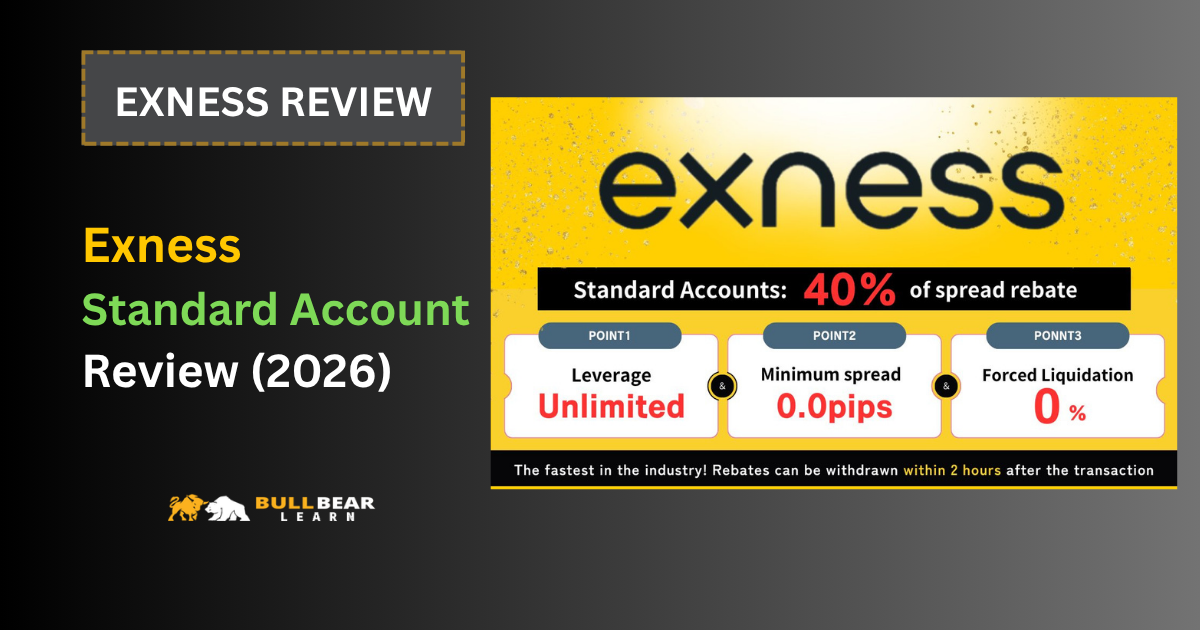
For most people opening an account with Exness, the Standard Account is the default choice—and for good reason.
It offers a straightforward pricing model, no trading commissions, flexible trading conditions, and access to the same markets and platforms available to more advanced account types. Whether you’re placing your first forex trade or have several years of experience, the Standard Account is designed to provide a balance between simplicity and performance.
However, just because it’s the most popular account doesn’t necessarily mean it’s the right one for every trader.
If you scalp dozens of times a day, use automated trading systems, or require institutional-style pricing, one of Exness’s Professional accounts may be a better fit.
In this review, we’ll explain exactly how the Exness Standard Account works, its key features, trading costs, advantages, limitations, and who should choose it over the other available account types.
Before looking at this account in detail, it’s worth noting that Exness offers several account types designed for different trading styles. If you’d like to compare them side by side, see our Exness Account Types guide.
What Is the Exness Standard Account?
The Exness Standard Account is a commission-free retail trading account designed for traders who want a simple and transparent trading experience.
Unlike the Raw Spread or Zero accounts, which separate spreads and commissions, the Standard Account includes the broker’s trading cost within the spread. This makes it much easier for beginners to understand how much they are paying on each trade.
Despite its simplicity, the Standard Account still gives traders access to professional-grade infrastructure, including:
- MetaTrader 4 (MT4)
- MetaTrader 5 (MT5)
- Market execution
- Automated trading with Expert Advisors (EAs)
- Mobile, desktop, and web trading
- A wide range of forex pairs, commodities, indices, cryptocurrencies, and other available instruments (subject to region)
For many retail traders, it provides everything needed to trade efficiently without the added complexity of commission-based pricing.
Exness Standard Account at a Glance
| Feature | Details |
|---|---|
| Account Type | Standard |
| Best For | Beginners, swing traders, general retail traders |
| Commission | None |
| Spread | Floating |
| Trading Platforms | MT4 & MT5 |
| Expert Advisors | Supported |
| Hedging | Supported |
| Demo Version | Available |
| Mobile Trading | Yes |
| Market Execution | Yes |
This combination of accessibility and functionality is one reason why the Standard Account remains the most widely used account type on Exness.
Key Features of the Exness Standard Account
1. Commission-Free Trading
One of the biggest advantages of the Standard Account is its simple pricing structure.
Instead of paying a separate commission on every trade, all trading costs are built into the spread.
For beginners, this makes it much easier to calculate potential trading costs and understand the impact of spreads on profitability.
It also simplifies record-keeping and performance analysis because there are fewer variables affecting each trade.
2. Flexible Leverage
The Standard Account provides access to Exness’s flexible leverage options, subject to account settings, instrument, regulatory jurisdiction, and current trading conditions.
Rather than focusing solely on maximum leverage, traders should choose a level that aligns with their risk management strategy.
Used responsibly, leverage can improve capital efficiency. Used recklessly, it can significantly increase losses.
3. Access to MT4 and MT5
The Standard Account supports both MetaTrader platforms.
This allows traders to choose the platform that best matches their workflow.
MT4 remains popular among traders using older Expert Advisors and custom indicators, while MT5 offers additional order types, more timeframes, an integrated economic calendar, and enhanced strategy testing.
Regardless of the platform you choose, the Standard Account delivers the same core trading conditions.
4. Wide Range of Trading Instruments
Standard Account holders can trade a broad selection of markets available through Exness, including:
- Major, minor, and exotic forex pairs
- Precious metals such as gold and silver
- Popular global indices
- Energy products
- Cryptocurrencies (where available)
- Other CFDs supported in their jurisdiction
Having access to multiple asset classes allows traders to diversify strategies without opening separate brokerage accounts.
5. Suitable for Multiple Trading Styles
Unlike some beginner accounts that limit functionality, the Exness Standard Account supports a variety of trading approaches.
It is commonly used for:
- Swing trading
- Position trading
- Day trading
- Trend following
- Breakout trading
- Manual trading
- Beginner algorithmic trading with Expert Advisors
Although professional scalpers may prefer tighter-spread accounts, the Standard Account remains versatile enough for most retail traders.
Trading Costs: How Expensive Is the Exness Standard Account?
One of the first questions traders ask before opening any trading account is simple:
“How much will it cost me to trade?”
With the Exness Standard Account, the pricing model is intentionally straightforward. Instead of charging a separate commission on each trade, Exness incorporates its fee into the spread. This means the spread is the primary trading cost you’ll pay when opening and closing positions.
For beginners, this approach is much easier to understand than commission-based pricing because there is only one visible trading cost.
However, experienced traders should look beyond the spread alone. Your total trading cost may also be influenced by factors such as overnight swap charges, market volatility, and the instrument you’re trading.
Understanding Floating Spreads
The Exness Standard Account uses floating spreads, which means spreads change according to market conditions.
During periods of high liquidity—such as the overlap between the London and New York trading sessions—spreads are generally tighter.
When volatility increases, such as during major economic announcements or unexpected geopolitical events, spreads may widen temporarily.
This pricing model is common among leading forex brokers because it reflects actual market liquidity rather than fixed pricing.
For most retail traders, floating spreads provide competitive trading conditions without requiring commission payments.
Trading Costs Beyond the Spread
Although the Standard Account is commission-free, traders should still understand other potential costs.
Overnight Swap Fees
If you keep a position open overnight, swap charges may apply depending on:
- The instrument being traded
- Trade direction (buy or sell)
- Market interest rates
- Current trading conditions
Some instruments or account configurations may qualify for swap-free trading where available, but eligibility depends on Exness policies and your region.
Slippage
Slippage occurs when an order is executed at a different price than requested.
This can happen during:
- High-impact news events
- Low-liquidity market conditions
- Rapid price movements
Slippage is a market phenomenon rather than a fee charged by the broker.
Currency Conversion
If your account currency differs from the quoted trading instrument or withdrawal currency, conversion fees from payment providers or currency exchange rates may affect the final amount received.
Is the Standard Account Suitable for Scalping?
The answer depends on your trading frequency.
If you occasionally scalp during active market sessions, the Standard Account can perform well.
However, traders executing dozens or even hundreds of trades per day often prioritize the lowest possible spreads.
In those cases, Professional accounts such as Raw Spread or Zero may offer lower overall transaction costs despite charging commissions.
For the majority of retail traders, however, the difference is relatively small.
Unless you’re trading at very high frequency, the simplicity of the Standard Account often outweighs the potential savings of a commission-based account.
Standard Account vs Standard Cent Account
Although both accounts are commission-free, they serve different purposes.
| Feature | Standard | Standard Cent |
|---|---|---|
| Commission | None | None |
| Trading Balance | Standard Currency | Cents |
| Best For | Everyday Trading | Learning & Practice |
| Long-Term Use | Excellent | Limited |
| Psychology Training | Good | Excellent |
The Standard Cent Account is designed primarily as a bridge between demo trading and a full-sized live account.
If you already understand risk management and position sizing, the Standard Account is generally the better long-term choice.
Standard Account vs Pro Account
This comparison is where many traders become uncertain.
Should you choose the Standard Account or upgrade to the Pro Account immediately?
Here’s a simple comparison.
| Feature | Standard | Pro |
|---|---|---|
| Commission | None | None |
| Typical Spread | Moderate | Lower |
| Beginner Friendly | Excellent | Good |
| Active Trading | Good | Better |
| Simplicity | Excellent | Very Good |
The Pro Account generally offers lower spreads, making it more attractive for experienced traders.
However, if you’re still developing consistency or trading only a few times each week, the Standard Account usually provides better overall value.
Advantages of the Exness Standard Account
1. Simple Pricing
The commission-free structure makes trading costs easy to understand.
This is particularly valuable for beginners who are still learning how spreads affect profitability.
2. Beginner-Friendly
Few brokers manage to combine professional infrastructure with a beginner-friendly experience as effectively as Exness.
The Standard Account provides access to advanced trading platforms without overwhelming new traders with complex pricing models.
3. Excellent Platform Support
Whether you prefer MT4 or MT5, the Standard Account supports both platforms.
This allows traders to continue using the same account even as their experience grows.
4. Suitable for Long-Term Growth
Many traders never need to upgrade from the Standard Account.
Unless your strategy specifically benefits from lower spreads or institutional-style pricing, the Standard Account can remain suitable for years.
5. Fast Funding and Withdrawals
One of the biggest advantages of trading with Exness is the efficiency of its payment infrastructure.
Depending on your payment method and region, deposits and withdrawals can be processed quickly, allowing traders to manage capital more conveniently than with many competing brokers.
Potential Drawbacks
No trading account is perfect.
The Standard Account also has a few limitations.
Wider Spreads Than Professional Accounts
Professional traders executing high trading volumes may reduce overall costs by choosing Raw Spread or Zero Accounts.
Not Optimized for High-Frequency Trading
Scalpers who rely on capturing very small price movements often benefit more from lower-spread Professional accounts.
Floating Spreads Can Widen
Like most market-based pricing models, floating spreads increase during periods of heightened volatility.
This is not unique to Exness but is something traders should expect when trading around major economic announcements.
Who Should Choose the Exness Standard Account?
The Standard Account is ideal if you:
- Are opening your first live trading account.
- Prefer commission-free pricing.
- Trade manually rather than algorithmically.
- Hold positions for several hours or days.
- Want access to both MT4 and MT5.
- Prefer a simple and transparent fee structure.
It offers one of the best balances between ease of use and professional trading conditions in the retail forex industry.
Who Should Consider Another Account?
You may want to consider an alternative account if you:
- Execute a large number of trades every day.
- Use high-frequency scalping strategies.
- Require the lowest possible spreads.
- Fully understand commission-based pricing.
- Trade primarily using automated systems where transaction costs have a greater impact.
In these situations, the Pro, Raw Spread, or Zero Account may provide better value.
Final Verdict
For most retail traders, the Exness Standard Account remains the best starting point within the Exness ecosystem.
Its commission-free pricing, flexible trading conditions, support for MT4 and MT5, and beginner-friendly structure make it suitable for a wide range of trading styles.
While professional traders may eventually transition to lower-spread account types, the Standard Account offers an excellent combination of simplicity, transparency, and reliability.
If you’re unsure which account to open, this is the option that will meet the needs of the majority of forex traders.
Frequently Asked Questions
Is the Exness Standard Account good for beginners?
Yes. It is specifically designed to provide a simple, commission-free trading experience while still offering access to professional trading platforms.
Does the Standard Account charge commissions?
No. Trading costs are included within the floating spread.
Can I use MT5 with the Standard Account?
Yes. The Standard Account supports both MetaTrader 4 and MetaTrader 5.
Is the Standard Account better than the Pro Account?
Not necessarily. The Standard Account is generally better for beginners and casual traders, while the Pro Account is better suited to experienced traders who want lower spreads.
Can I switch to another Exness account later?
You can’t convert an existing account type, but you can open additional account types within your Exness Personal Area and transfer funds between them, subject to Exness’s current policies.