

The spread is one of the first costs traders look at when comparing Forex brokers.
A broker may advertise spreads from a very low level, but the actual spread you receive can change depending on the instrument, account type, market conditions, liquidity, and time of day.
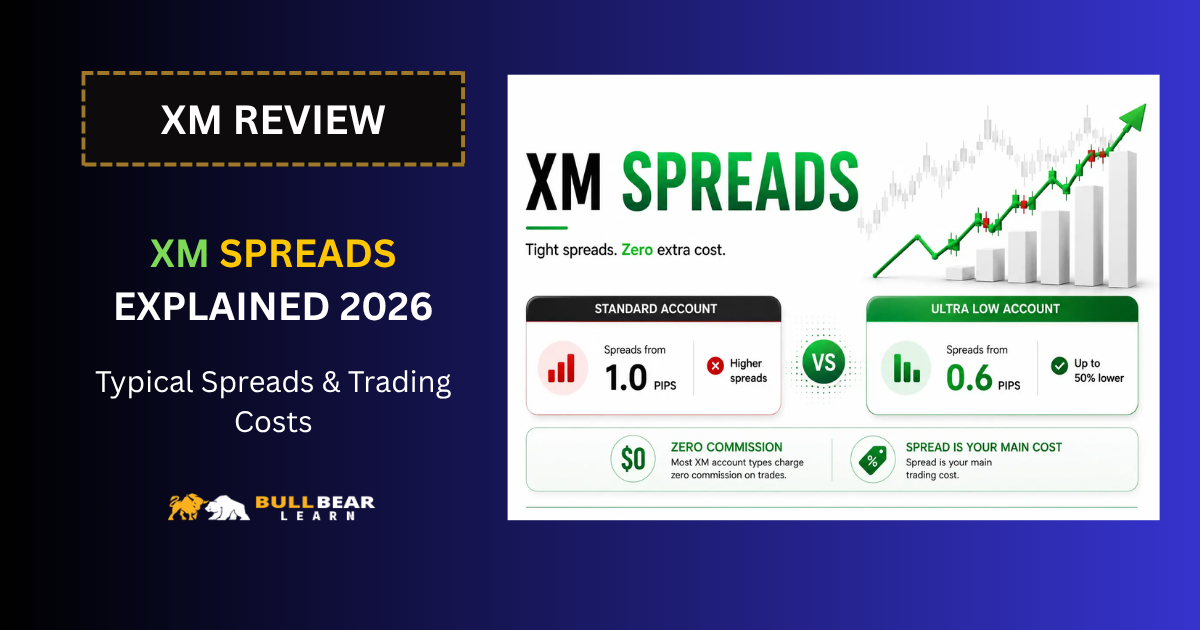
XM uses variable spreads, meaning the spread can change as market conditions change. Its current account offering includes spread-based accounts such as Standard and Ultra Low in several markets, while account availability and exact conditions can vary depending on the XM entity serving your country.
This guide explains XM spreads in 2026, how spreads work, what affects them, how Standard and Ultra Low accounts differ, and why the advertised minimum spread should not be treated as the spread you will receive on every trade.
What Is a Forex Spread?
Before looking at XM specifically, it is important to understand what a spread actually represents.
In Forex trading, you normally see two prices:
- Bid: The price at which you can sell
- Ask: The price at which you can buy
The difference between these two prices is called the spread.
For example:
| Price | Example |
|---|---|
| Bid | 1.1000 |
| Ask | 1.1002 |
| Spread | 0.0002 |
| Equivalent | 2 pips |
When you open a trade, the spread is one of the immediate costs you need to overcome before the position becomes profitable.
If the market does not move and you immediately close the position, the spread is one of the main reasons the resulting trade can show a loss.
This makes the spread particularly important for short-term traders.
Does XM Have Fixed or Variable Spreads?
XM uses variable spreads.
This means the spread is not guaranteed to remain at one fixed level throughout the trading day.
Instead, it can change depending on market conditions.
Spreads can become tighter when:
- Market liquidity is high
- Major currency pairs are actively traded
- Several major financial centers are open
- Normal market conditions prevail
Spreads can become wider when:
- Major economic announcements are released
- Market volatility increases
- Liquidity falls
- Markets are opening or closing
- Unusual market conditions occur
XM’s documentation states that spreads are variable and can widen during certain market conditions.
This distinction is important because a broker’s minimum spread and your actual trading spread are not necessarily the same thing.
XM Minimum Spreads
XM advertises minimum spreads on its account pages, but traders should understand what the word “minimum” means.
A minimum spread represents the lowest spread that may be available under suitable market conditions.
It does not mean:
“This is the spread you will receive every time you trade.”
For example, if an account advertises spreads from 0.8 pips, the spread may be close to that level under certain conditions but wider at other times.
This is normal for variable-spread Forex trading.
When comparing brokers, it is therefore better to ask:
What spread can I reasonably expect during the hours and instruments I actually trade?
rather than:
What is the lowest spread the broker advertises?
This difference becomes particularly important for scalpers and high-frequency traders.
Because spread conditions differ by account, it is useful to understand the full range of XM Account Types before comparing individual spreads
XM Standard Account Spreads
The XM Standard Account uses a spread-based pricing model.
This means the spread is the primary transaction cost for the account rather than a separate trading commission.
The simplicity of this structure can be useful for traders who want to understand their trading costs without calculating a separate commission on every position.
However, the actual spread will still depend on:
- Currency pair
- Market conditions
- Trading session
- Liquidity
- Volatility
- Account conditions
Major currency pairs such as EUR/USD generally tend to have deeper liquidity than less frequently traded currency pairs.
This can result in different spread behavior between instruments.
For a full analysis of the account itself, see our XM Standard Account Review.
XM Ultra Low Account Spreads
The XM Ultra Low Account is designed around lower-cost trading conditions.
XM currently promotes the Ultra Low Account as one of its main account options in several markets, with spreads starting from a lower level than its traditional Standard structure.
The important point is that the Ultra Low Account should not be evaluated only by its minimum advertised spread.
You should also consider:
- Typical spread
- Instruments available
- Swap conditions
- Trading frequency
- Position size
- Execution
- Your overall trading strategy
For an active trader who executes many trades, even a small difference in spread can accumulate over time.
For a trader who only makes a few trades each month, the difference may be much less significant.
See our XM Ultra Low Account Review for a detailed analysis of the account.
XM Zero Account Spreads
XM Zero uses a different pricing model from the Standard and Ultra Low accounts.
The basic concept is:
Tighter spread + separate commission
This means a trader should not compare the Zero spread directly with the Standard spread without accounting for commission.
For example:
Standard:
Wider spread + no separate trading commission
Zero:
Tighter spread + commission
The correct comparison is therefore the all-in trading cost.
There is also an important availability issue.
XM’s current account offering varies by entity, and some official XM documentation indicates that new Zero Accounts are no longer available in certain jurisdictions.
Therefore, traders should verify whether the Zero Account is actually available to them before using historical spread or commission figures found online.
For a detailed discussion, see our XM Zero Account Review.
XM Spreads by Currency Pair
Different currency pairs can have very different spread characteristics.
EUR/USD
EUR/USD is one of the most liquid currency pairs in the Forex market.
Because of its high trading volume, it generally tends to have tighter spreads than many exotic or less-liquid pairs.
This makes EUR/USD particularly popular with:
- Scalpers
- Day traders
- Beginners
- Algorithmic traders
However, spreads can still widen during major economic announcements.
GBP/USD
GBP/USD is also highly liquid, but it can experience greater volatility than EUR/USD.
This means traders should pay attention to both spread and price movement.
A tight spread does not eliminate the risks associated with fast market movements.
USD/JPY
USD/JPY is another heavily traded major pair.
Its spread behavior is generally influenced by liquidity across Asian, European, and U.S. trading sessions.
Exotic Currency Pairs
Exotic and less-liquid currency pairs generally require more caution.
They can have wider spreads because liquidity is lower and market-making costs can be higher.
If your strategy depends on very small price movements, trading instruments with wider spreads can make the strategy more difficult to execute profitably.
XM Gold Spreads
Gold is one of the most popular instruments among retail traders.
XM offers gold trading through XAU/USD, subject to the instruments available for the relevant account and jurisdiction.
However, traders should not assume that Forex spread conditions apply directly to gold.
Gold can experience:
- Higher volatility
- Larger price movements
- Wider spreads during market stress
- Significant spread changes around major news
- Different overnight financing conditions
This is particularly relevant if you trade gold around events such as:
- U.S. inflation data
- Federal Reserve interest-rate decisions
- Employment reports
- Major geopolitical developments
For gold traders, the relevant question is not simply:
“What is XM’s gold spread?”
It is:
“What is the typical all-in cost of trading gold with my account during the conditions in which I trade?”
This is a much more useful way to evaluate the broker.
When Are XM Spreads Usually Tightest?
There is no universal time when XM spreads will always be at their minimum.
However, spreads in major Forex pairs generally benefit from periods of stronger liquidity.
The overlap between major trading sessions can provide significant market activity.
For example, the period when European and U.S. markets are both active is typically one of the most liquid periods for major USD currency pairs.
By contrast, spreads can become less favorable during:
- Very late trading hours
- Weekend market closures
- Major news releases
- Market reopenings
- Sudden volatility
The exact conditions vary from one instrument and trading day to another.
XM Spreads During News Events
Economic news can have a major impact on Forex spreads.
Suppose a major U.S. economic report is scheduled for release.
Before the announcement, the market may be relatively stable.
Immediately after the announcement:
- Prices can move rapidly
- Liquidity can temporarily change
- Orders can be executed at different prices
- Spreads can widen
This matters particularly for traders using:
- Scalping strategies
- Pending orders
- Breakout strategies
- Expert Advisors
- High leverage
A strategy that works well during normal market conditions can behave very differently during major news.
For this reason, traders should not evaluate XM spreads using only screenshots taken during quiet market periods.
Why Do XM Spreads Change?
Several factors can influence the spread you see.
Market Liquidity
Greater liquidity generally supports tighter spreads.
Volatility
Rapid price movements can lead to wider spreads.
Economic News
Important economic releases can temporarily change liquidity and pricing conditions.
Trading Session
Spreads can behave differently during Asian, European, and U.S. trading hours.
Instrument
Major Forex pairs, minor pairs, exotic pairs, metals, indices, and other instruments can have very different pricing characteristics.
Market Conditions
Unexpected geopolitical or financial events can affect liquidity and spreads.
This is why variable spreads are normal in modern Forex markets.
XM Spread vs Commission
One of the most common mistakes when comparing trading accounts is to compare only spreads.
Consider two hypothetical accounts.
Account A
- Spread: 1.0 pip
- Commission: $0
Account B
- Spread: 0.2 pips
- Commission: additional fee
At first glance, Account B appears cheaper.
But that conclusion cannot be made until the commission is converted into an equivalent trading cost.
The proper comparison is:
Total transaction cost = spread cost + commission
This is particularly important when comparing XM Standard, Ultra Low, and Zero-style pricing structures.
A trader should calculate the cost for the exact lot size and instrument they normally trade.
How Much Does the XM Spread Cost?
The monetary cost of a spread depends on:
- Spread size
- Position size
- Instrument
- Pip value
- Account currency
For a standard Forex position, a wider spread means a larger initial transaction cost.
For example, if the spread is 1 pip, the cost for a 1-lot position will be different from the cost for a 0.10-lot position.
This is why simply saying “XM has a 1-pip spread” does not tell you the actual dollar cost.
The correct calculation is based on your trade size.
Simple Concept
Spread cost = spread in pips × pip value × position size
The exact calculation becomes more complex for instruments where the standard pip convention differs, so traders should always check the contract specifications for the instrument they are trading.
XM Spreads and Scalping
Scalpers are among the traders who should pay the most attention to spreads.
Imagine a strategy that targets a relatively small price movement.
If the spread consumes a significant portion of the expected profit, the strategy becomes much harder to execute efficiently.
For example, a trader targeting a 5-pip gross move will be much more sensitive to a 2-pip spread than a swing trader targeting a 200-pip move.
This is why scalpers should evaluate:
- Average spread
- Spread consistency
- Commission
- Slippage
- Execution speed
- News-event conditions
The lowest advertised spread alone is not enough.
XM Spreads for Beginners
Beginners often focus heavily on finding the broker with the smallest spread.
That is understandable, but it should not be the only consideration.
For a new trader, other factors may be equally important:
- Regulation
- Platform stability
- Risk management
- Account simplicity
- Educational resources
- Execution
- Customer support
- Deposit and withdrawal options
A difference of a fraction of a pip may matter much less than poor risk management.
For this reason, beginners should first learn how spreads work and then consider whether a lower-spread account actually fits their trading strategy.
If you are new to XM, start with our XM Review 2026 before comparing individual account costs.
XM Spread Comparison: Standard vs Ultra Low vs Zero
| Feature | Standard | Ultra Low | Zero |
|---|---|---|---|
| Pricing model | Spread-based | Lower-spread structure | Spread + commission |
| Separate commission | Generally no | Generally no | Yes, where applicable |
| Spread focus | Standard | Lower | Very tight |
| Cost calculation | Simple | Simple | More complex |
| Scalping | Possible | Potentially suitable | Potentially suitable |
| Beginner-friendly | High | High/Moderate | Moderate |
| Availability | Depends on entity | Depends on entity | More restricted in some entities |
The important point is that the three account structures should not be ranked simply by their minimum advertised spread.
The right account depends on:
- Trading frequency
- Position size
- Instruments
- Holding period
- Commission
- Swap
- Actual spread during your trading hours
XM Spreads vs Other Brokers
When comparing XM with another broker, use the same methodology for both.
Do not compare:
XM minimum spread
against:
Broker B typical spread
because these are different measurements.
Instead, compare:
- Typical spread
- Same currency pair
- Same trading session
- Same account type
- Same position size
- Same market conditions
- Commission
- Swap
- Execution quality
For example, if you mainly trade EUR/USD during the London-New York overlap, compare the conditions you are likely to receive during that period.
If you trade XAU/USD during the U.S. session, compare gold rather than EUR/USD.
This produces a much more meaningful broker comparison.
How to Reduce Your XM Spread Costs
You cannot completely eliminate the spread when trading through a spread-based account, but you can manage its impact.
Trade liquid instruments
Major currency pairs generally have more liquidity than exotic pairs.
Trade during active sessions
Trading when major markets are active can provide more favorable liquidity conditions.
Avoid unnecessary news trading
Major economic releases can cause sudden spread changes.
Choose the appropriate account
If you trade frequently, compare Standard and Ultra Low based on your actual trading costs.
Avoid overtrading
The more positions you open and close, the more often you pay transaction costs.
Monitor actual spreads
Instead of relying only on advertised figures, observe the spreads on your preferred instruments during your normal trading hours.
Are XM Spreads Competitive?
XM currently advertises competitive spreads, including spreads starting from 0.8 pips on its global website, while exact conditions depend on the account, instrument, and market conditions.
However, “competitive” should be evaluated in context.
A trader who makes five trades per month may have very different requirements from a scalper making fifty trades per day.
Similarly, a EUR/USD trader and a gold trader should not evaluate spreads using the same benchmark.
The most useful approach is to compare the actual trading cost relevant to your strategy.
Pros and Cons of XM Spreads
Pros
- Variable pricing reflects changing market conditions
- Standard and Ultra Low account structures provide different cost options
- Major currency pairs can offer relatively tight spreads during liquid periods
- Traders can compare spread-based and commission-based structures
- Suitable account choices depend on different trading styles
Cons
- Spreads are not fixed
- Minimum advertised spreads are not guaranteed continuously
- Spreads can widen during major news
- Less-liquid instruments can have wider spreads
- Gold and other CFDs require separate cost analysis
- Actual conditions vary by XM entity and jurisdiction
Final Verdict: Understanding XM Spreads
XM’s spread structure is relatively straightforward once you understand the difference between minimum spreads and actual spreads.
The most important thing to remember is that XM’s advertised minimum spread is not a guarantee of the spread you will receive on every trade.
Your actual spread can change depending on:
- Instrument
- Account type
- Market liquidity
- Volatility
- Trading session
- Economic news
- XM entity and jurisdiction
For beginners, the Standard Account offers a relatively simple spread-based structure.
For traders looking for lower spread costs, the Ultra Low Account deserves closer consideration.
For traders researching the Zero Account, the spread should always be evaluated together with the applicable commission and account availability.
Ultimately, the most useful question is not:
“Does XM have low spreads?”
It is:
“What will my total trading cost be for the instruments, position sizes, and trading hours I actually use?”
That is the number that matters.
Frequently Asked Questions
What are XM spreads?
XM spreads are the difference between the bid and ask price of a trading instrument. XM uses variable spreads, meaning the spread can change depending on market conditions.
What is the minimum spread at XM?
XM currently advertises spreads starting from around 0.8 pips on its global website, but the actual spread depends on the account, instrument, market conditions, and applicable entity.
Does XM have fixed spreads?
XM’s standard pricing is based on variable spreads rather than permanently fixed spreads.
Does XM charge commission on top of the spread?
It depends on the account. Standard and Ultra Low accounts are primarily spread-based, while applicable Zero Account structures can combine tighter spreads with a separate commission.
Are XM spreads good for scalping?
They can be suitable, but scalpers should evaluate average spread, commission, slippage, and execution rather than focusing only on the minimum advertised spread.
Does XM widen spreads during news?
Variable spreads can widen during periods of high volatility, reduced liquidity, and major economic announcements.
Does XM have low gold spreads?
Gold spreads depend on market conditions, account type, and the applicable XM entity. Gold should be evaluated separately from major Forex pairs because its volatility and trading conditions can be different.
Is XM Standard or Ultra Low better for spreads?
The answer depends on your trading activity. Compare the actual spread and total trading cost for your preferred instruments rather than choosing based solely on the advertised minimum.
How can I check XM’s current spreads?
Check the current trading conditions and contract specifications available through the XM entity serving your country. You can also observe live spreads on your trading platform during your normal trading hours.
Related XM Guides
Continue building your understanding of XM with these guides:
- XM Review 2026
- XM Account Types 2026
- XM Fees Explained
- XM Standard Account Review
- XM Ultra Low Account Review
- XM Zero Account Review
- XM Minimum Deposit
- XM MT4 vs MT5
Check XM’s Current Spreads
XM spreads vary by instrument, account type, market conditions, and jurisdiction. Before opening an account, check the current trading conditions available for your country and compare the total cost with your trading strategy.