
• About
  • Crypto Exchange
Bullbearlearn
Advertisement
  • Home
  • Learn Forex
    • Forex Basic
    • Trading Strategies
    • Price Action
    • Risk Management
  • Learn Crypto
    • Crypto Basics
    • Bitcoin & Ethereum
    • Major Altcoins
    • Wallets & Security
    • Buying & Trading Crypto
  • Trading Platform
    • Recommended
    • Reviews
    • Platform Guides
  • Tools
    • Tools Free
    • How to use
  • Blog
    • Market Analysis
      • Technical Analysis
    • News
Start
No Result
View All Result
Bullbearlearn
No Result
View All Result
Home Price Action Core Concepts

Trends in Price Action: Trend Strength, Pullbacks, and Continuation

Baby Bull by Baby Bull
March 17, 2026
in Core Concepts, Price Action
58 1
0
Trends in Price Action

Trends in Price Action

191
SHARES
1.5k
VIEWS
Share on FacebookShare on Twitter

Trends are the most profitable environment in trading—yet most traders struggle to stay aligned with them.

The problem is not identifying trends. It is understanding their behavior.

This article explains:

  • What a trend really is in Price Action

  • How to assess trend strength and weakness

  • The difference between pullbacks and reversals

  • Why trends end gradually, not suddenly

Before thinking about entries, you must learn how trends develop, breathe, and persist.


Table of Contents

Toggle
  • What Is a Trend in Price Action?
  • Why Trends Are Difficult for Beginners
  • Trend Strength: How to Read Momentum Without Indicators
    • Signs of a strong trend:
    • Signs of a weakening trend:
  • Impulse vs Pullback: The Rhythm of Trends
    • Impulse phase
    • Pullback phase
  • What Makes a Pullback Healthy?
  • Pullback vs Reversal: How to Tell the Difference
    • Pullback characteristics:
    • Reversal characteristics:
  • Trend Continuation: Why Trends Last Longer Than Expected
  • Multiple Timeframe Trends
  • Trend Exhaustion: How Trends End
  • Common Trend Trading Mistakes
  • Why Trends Matter in the Price Action Framework
  • How to Study Trends Effectively
  • Final Thoughts

What Is a Trend in Price Action?

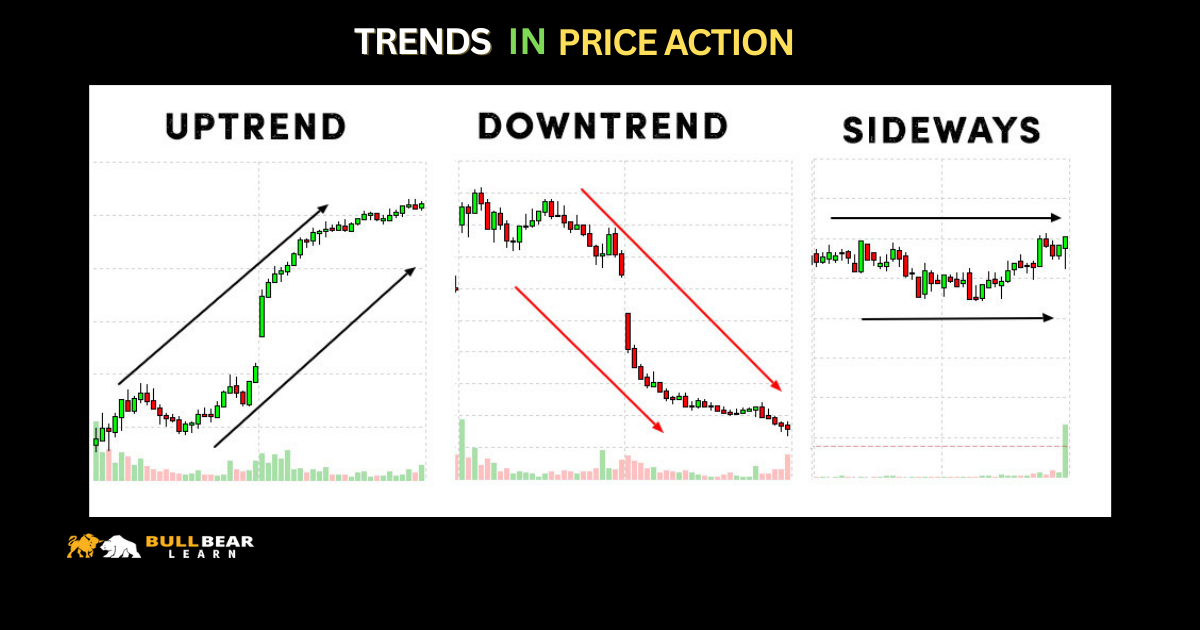
In Price Action terms, a trend is not a moving average or a slope. It is consistent directional control confirmed by market structure.

  • Uptrend: Higher highs (HH) and higher lows (HL)

  • Downtrend: Lower highs (LH) and lower lows (LL)

Trends exist because one side—buyers or sellers—continues to defend territory and push price forward.

→ Market Structure in Price Action


Why Trends Are Difficult for Beginners

Beginners often:

  • Enter late due to fear

  • Exit early due to uncertainty

  • Trade against the trend searching for reversals

This happens because they confuse normal pullbacks with trend failure.

Understanding trend behavior eliminates this confusion.


Trend Strength: How to Read Momentum Without Indicators

Trend strength is visible directly in price behavior.

Signs of a strong trend:

  • Impulsive moves are large and decisive

  • Pullbacks are shallow

  • Price respects previous swing levels

  • Breaks of structure occur cleanly

Signs of a weakening trend:

  • Impulses shrink

  • Pullbacks deepen

  • Structure becomes less clear

  • Momentum stalls near key levels

Trend strength is about how price moves, not how fast it moves.


Impulse vs Pullback: The Rhythm of Trends

Trends move in cycles:

  1. Impulse (expansion in trend direction)

  2. Pullback (temporary counter-move)

Healthy trends require both.

Impulse phase

  • Dominant side is aggressive

  • Price moves quickly

  • Minimal overlap

Pullback phase

  • Profit-taking occurs

  • Opposing side tests control

  • Price slows or retraces

Pullbacks are necessary, not dangerous.


What Makes a Pullback Healthy?

A healthy pullback:

  • Respects previous structure

  • Shows reduced momentum

  • Does not break key swing levels

In an uptrend:

  • Pullbacks hold above the last higher low

In a downtrend:

  • Pullbacks stay below the last lower high

When structure holds, the trend remains intact.


Pullback vs Reversal: How to Tell the Difference

This distinction defines trader success.

Pullback characteristics:

  • Occurs after impulse

  • Lacks strong follow-through

  • Stalls near prior structure

  • Does not break structure decisively

Reversal characteristics:

  • Breaks key structure

  • Shows strong counter-impulse

  • Alters swing sequence

  • Changes market behavior

Reversals begin with structure damage, not emotion.

→ How the Market Moves: Supply, Demand & Psychology


Trend Continuation: Why Trends Last Longer Than Expected

Trends persist because:

  • Institutions build positions over time

  • New participants join on pullbacks

  • Late traders fuel continuation

This is why:

  • Trends often feel “overextended”

  • Yet continue far longer than expected

Price Action traders trust structure, not feelings.


Multiple Timeframe Trends

Trends are hierarchical.

  • Higher timeframe trends define direction

  • Lower timeframe trends provide detail

You may see:

  • A pullback on H1

  • Within a strong daily uptrend

This is not conflict—it is fractal structure.

Top-down analysis prevents misalignment.


Trend Exhaustion: How Trends End

Trends do not end randomly.

Common signs of exhaustion:

  • Momentum divergence (in price behavior)

  • Failure to create new structure

  • Deeper pullbacks

  • Increased volatility or compression

The first sign is usually loss of structure, not a reversal candle.


Common Trend Trading Mistakes

Avoid these errors:

  • Trading against the dominant trend

  • Expecting every pullback to reverse

  • Overreacting to single candles

  • Ignoring higher timeframe context

Trends reward patience and punish impatience.


Why Trends Matter in the Price Action Framework

Trends connect:

  • Market structure

  • Supply and demand

  • Support and resistance

  • Trade execution (later)

Without understanding trends:

  • Pullbacks feel threatening

  • Continuations feel random

  • Decisions feel emotional

With trend clarity, traders gain confidence and restraint.


How to Study Trends Effectively

Practice deliberately:

  1. Remove indicators

  2. Identify dominant timeframe trend

  3. Mark impulse and pullback phases

  4. Observe structure preservation

  5. Journal trend behavior, not entries

The goal is interpretation, not prediction.


Final Thoughts

Trends are the market’s natural state.

They reflect sustained imbalance, participation, and conviction. When you learn to read trend strength, pullbacks, and continuation correctly, you stop fighting the market—and start aligning with it.

In the next article, we will move into Support and Resistance in Price Action, explaining why levels matter, how they form, and how traders misuse them.

→ Support and Resistance in Price Action

Tags: Core Conceptsprice action
Share76Tweet48
Previous Post

Market Structure in Price Action: Higher Highs, Lower Lows Explained

Next Post

Support and Resistance in Price Action: How Levels Really Work

Related Posts

price action range trading

Price Action Strategy #5: Range Trading & Market Consolidation – How to Trade Sideways Markets Effectively

by Baby Bull
June 4, 2026
0

1. What Is a Range Market? A range market occurs when price moves sideways between a clear support and resistance...

price action reversal trading

Price Action Strategy #4: Reversal Trading – How to Catch Market Turning Points Like Smart Money

by Baby Bull
June 3, 2026
0

1. What Is Reversal Trading? A market reversal occurs when price changes direction after an existing trend. Examples: Uptrend →...

pullback trading strategy

Price Action Strategy #3: Pullback & Trend Continuation – Enter Trends Like a Professional

by Baby Bull
June 3, 2026
0

1. What Is a Pullback in Trading? A pullback is a temporary retracement of price against the main trend before...

breakout forex strategy

Price Action Strategy #2: Breakout & False Breakout – How Smart Money Traps Retail Traders

by Baby Bull
June 3, 2026
0

1. What Is a Breakout in Price Action? A breakout occurs when price moves beyond a significant level such as:...

price action trading strategy

Price Action Strategy #1: Price Action Trading Strategy: A Complete Framework for Consistent Decisions

by Baby Bull
June 3, 2026
0

Introduction: Why Most Trading Strategies Fail Most traders spend their time searching for: the best indicator the perfect entry a...

Load More
  • Trending
  • Comments
  • Latest
exness review

Exness Review 2026: Is Exness a Safe and Reliable Forex Broker?

June 16, 2026
Exness Account Types Explained

Exness Account Types Explained (2026): Which Exness Account Is Right for You?

July 13, 2026
Price Action Execution

Price Action Execution: A Professional Framework for Decision-Making

March 16, 2026
how to choose a forex broker

How to Choose a Forex Broker for Beginners: A Complete Guide

June 29, 2026
market order vs limit order

Market Order vs Limit Order: What’s the Difference in Crypto Trading?

0
Exness Pro Account

Exness Pro Account Review (2026): Is It Worth Upgrading?

0
Exness Standard Account

Exness Standard Account Review (2026): Is It the Best Choice for Most Traders?

0
Exness Account Types Explained

Exness Account Types Explained (2026): Which Exness Account Is Right for You?

0
market order vs limit order

Market Order vs Limit Order: What’s the Difference in Crypto Trading?

July 17, 2026
Exness Pro Account

Exness Pro Account Review (2026): Is It Worth Upgrading?

July 17, 2026
Exness Standard Account

Exness Standard Account Review (2026): Is It the Best Choice for Most Traders?

July 14, 2026
Exness Account Types Explained

Exness Account Types Explained (2026): Which Exness Account Is Right for You?

July 13, 2026

BullBearLearn.com is an independent educational platform covering Forex, Cryptocurrency, trading, and investing. We create practical guides, market analysis, broker and exchange reviews, and educational resources that help traders and investors navigate financial markets with greater confidence.

Categories
  • Bitcoin & Ethereum
  • Broker Reviews
  • Buying & Trading Crypto
  • Core Concepts
  • Core Strategies
  • Crypto Basics
  • Crypto Exchange
  • Execution
  • Forex Basic
  • Major Altcoins
  • Market Analysis
  • Market Condition
  • News
  • Platform Guides
  • Price Action
  • Psychology
  • Risk Management
  • Strategy
  • Technical Analysis
  • Tools
  • Trading Strategies
  • Wallets & Security
Tags
Beginner best Binance Review bitcoin breakout Broker Reviews BTC Bybit review calculator Core Concepts cost cpi crypto exchange crypto wallet ETH Ethereum Execution Exness Review fees fomc forex basic gold guide Leverage lot Margin mistake nfp nonfarm OKX review pip position size price action Psychology risk risk reward Spread strategy swap Swing wallet XM Review xtb review

Disclaimer: Content on BullBearLearn.com is for educational purposes only and not intended as financial advice. Trading involves risk.​

  • About
  • Privacy Policy
  • Terms of Service
  • Disclaimer
  • Cookie Policy
  • Affiliate Disclosure
  • Contact Us

© 2025 BullBearLearn.com — Learn to Trade, Bull or Bear.

Welcome Back!

Login to your account below

Forgotten Password?

Retrieve your password

Please enter your username or email address to reset your password.

Log In

Session expired

Please log in again. The login page will open in a new tab. After logging in you can close it and return to this page.

Add New Playlist

>

Table of Contents

×
  • What Is a Trend in Price Action?
  • Why Trends Are Difficult for Beginners
  • Trend Strength: How to Read Momentum Without Indicators
    • Signs of a strong trend:
    • Signs of a weakening trend:
  • Impulse vs Pullback: The Rhythm of Trends
    • Impulse phase
    • Pullback phase
  • What Makes a Pullback Healthy?
  • Pullback vs Reversal: How to Tell the Difference
    • Pullback characteristics:
    • Reversal characteristics:
  • Trend Continuation: Why Trends Last Longer Than Expected
  • Multiple Timeframe Trends
  • Trend Exhaustion: How Trends End
  • Common Trend Trading Mistakes
  • Why Trends Matter in the Price Action Framework
  • How to Study Trends Effectively
  • Final Thoughts
→ Index
No Result
View All Result
  • Home
  • Learn Forex
    • Forex Basic
    • Trading Strategies
    • Price Action
    • Risk Management
  • Learn Crypto
    • Crypto Basics
    • Bitcoin & Ethereum
    • Major Altcoins
    • Wallets & Security
    • Buying & Trading Crypto
  • Trading Platform
    • Recommended
    • Reviews
    • Platform Guides
  • Tools
    • Tools Free
    • How to use
  • Blog
    • Market Analysis
      • Technical Analysis
    • News
START

© 2025 BullBearLearn.com — Learn to Trade, Bull or Bear.