
• About
  • Crypto Exchange
Bullbearlearn
Advertisement
  • Home
  • Learn Forex
    • Forex Basic
    • Trading Strategies
    • Price Action
  • Learn Crypto
  • Broker Reviews
  • Tools FREE
  • Blog
Start
No Result
View All Result
Bullbearlearn
No Result
View All Result
Home Trading Strategies Core Strategies

Risk–Reward Strategy: The Foundation of All Profitable Trading

Baby Bear by Baby Bear
March 16, 2026
in Core Strategies, Trading Strategies
58 0
0
risk reward strategy

risk reward strategy

190
SHARES
1.5k
VIEWS
Share on FacebookShare on Twitter

Many traders spend years searching for the “perfect entry.”
In reality, entries matter far less than risk–reward.

A trader can be wrong more often than right and still make money—if the risk–reward strategy is correct. On the other hand, even a high win rate becomes meaningless when losses are larger than wins.

This article explains risk–reward strategy from first principles, without hype or shortcuts. It is the most important concept in this entire Trading Strategies series and the foundation upon which every other strategy depends.


Table of Contents

Toggle
  • What Is a Risk–Reward Strategy?
    • Example:
  • Why Risk–Reward Matters More Than Win Rate
    • Example A: High Win Rate, Poor Risk–Reward
    • Example B: Low Win Rate, Strong Risk–Reward
  • The Concept of Trading Expectancy
  • Common Risk–Reward Ratios in Trading
    • 1:1 Risk–Reward
    • 1:2 Risk–Reward
    • 1:3 and Higher
  • Risk–Reward vs. Strategy Type
    • Swing Trading
    • Day Trading
    • Scalping
  • How Risk–Reward Is Defined in a Trade
  • Why Traders Struggle With Risk–Reward
    • Common reasons include:
  • Risk–Reward and Position Sizing
  • Risk–Reward Is a Filter, Not a Guarantee
  • Risk–Reward Across Different Markets
    • Forex
    • Crypto
    • Gold & Indices
  • How Risk–Reward Connects to Other Trading Strategies
  • Conclusion

What Is a Risk–Reward Strategy?

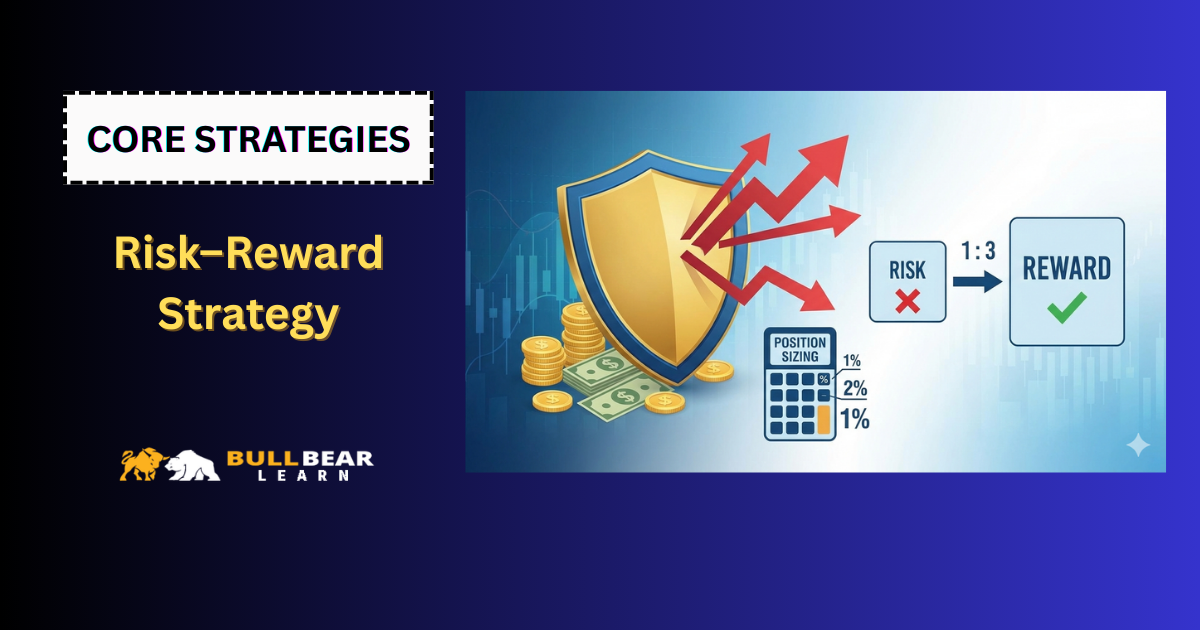
A risk–reward strategy defines the relationship between:

  • Risk: how much you are willing to lose on a trade

  • Reward: how much you expect to gain if the trade succeeds

This relationship is expressed as a risk–reward ratio (R:R).

Example:

  • Risk: $100

  • Potential reward: $300

  • Risk–Reward Ratio: 1:3

This means you are risking one unit to potentially gain three units.

Risk–reward strategy is not about predicting price direction.
It is about controlling downside before thinking about upside.


Why Risk–Reward Matters More Than Win Rate

One of the most common misconceptions in trading is that a high win rate equals profitability.

This is false.

Example A: High Win Rate, Poor Risk–Reward

  • Win rate: 70%

  • Risk–Reward: 1:0.5

After 10 trades:

  • 7 wins × $50 = +$350

  • 3 losses × $100 = –$300
    Net result: +$50

One mistake can wipe out weeks of effort.


Example B: Low Win Rate, Strong Risk–Reward

  • Win rate: 40%

  • Risk–Reward: 1:3

After 10 trades:

  • 4 wins × $300 = +$1,200

  • 6 losses × $100 = –$600
    Net result: +$600

This is why professional traders focus on expectancy, not win rate.


The Concept of Trading Expectancy

Trading expectancy answers one question:

“If I repeat this strategy many times, what is the average outcome per trade?”

The formula is simple:

Expectancy = (Win Rate × Average Win) – (Loss Rate × Average Loss)

Risk–reward directly affects expectancy.
Without a positive expectancy, no strategy can survive long-term.


Common Risk–Reward Ratios in Trading

There is no single “best” risk–reward ratio, but some are used more frequently than others.

1:1 Risk–Reward

  • Break-even before costs

  • Requires very high accuracy

  • Rarely sustainable long-term

1:2 Risk–Reward

  • Balanced approach

  • Can be profitable with ~40% win rate

  • Common among swing traders

1:3 and Higher

  • Strong asymmetric payoff

  • Lower win rate acceptable

  • Requires patience and discipline

For most traders, 1:2 or 1:3 provides the best balance between realism and profitability.


Risk–Reward vs. Strategy Type

Different trading strategies naturally support different risk–reward profiles.

Swing Trading

  • Favors higher risk–reward ratios

  • More room for price movement

  • Lower emotional pressure

→ Works well with 1:2 to 1:4


Day Trading

  • Shorter moves

  • Faster execution

  • More sensitive to costs

→ Commonly 1:1 to 1:2


Scalping

  • Extremely tight stops

  • Small targets

  • Execution-dependent

→ Often below 1:1, but compensated by high frequency
(Not suitable for most traders)


How Risk–Reward Is Defined in a Trade

Every trade must answer three questions before execution:

  1. Where is the entry?

  2. Where is the stop loss?

  3. Where is the take profit?

Risk–reward is determined before the trade is placed, not adjusted emotionally afterward.

If you do not know these three levels clearly, you do not have a strategy.


Why Traders Struggle With Risk–Reward

Risk–reward sounds simple, yet most traders fail to apply it consistently.

Common reasons include:

  • Fear of taking losses

  • Moving stop loss to “give the trade more room”

  • Closing winners too early

  • FOMO after missing a move

These behaviors destroy risk–reward symmetry and turn trading into gambling.


Risk–Reward and Position Sizing

Risk–reward does not exist in isolation.
It must be combined with position sizing.

Professional traders typically risk:

  • 0.5% – 2% per trade

  • Never more, regardless of confidence

This ensures:

  • Drawdowns are survivable

  • Emotional stability

  • Long-term consistency

Risk–reward defines how much you can make.
Position sizing defines how long you can stay in the game.


Risk–Reward Is a Filter, Not a Guarantee

A good risk–reward setup does not guarantee success.

Instead, it acts as a filter:

  • It eliminates low-quality trades

  • It forces discipline

  • It protects capital during losing streaks

Many trades should be rejected solely because the risk–reward is not favorable, even if the setup “looks good.”


Risk–Reward Across Different Markets

Forex

  • Stable liquidity

  • Predictable execution

  • Well-suited for structured risk–reward models

Crypto

  • Higher volatility

  • Larger slippage risk

  • Requires wider stops and adjusted targets

Gold & Indices

  • Strong directional moves

  • Session-dependent behavior

  • Risk–reward varies by time of day

The principle remains the same, but execution must adapt to market characteristics.


How Risk–Reward Connects to Other Trading Strategies

Risk–reward is the common denominator across all strategies:

  • Swing Trading uses it to survive drawdowns

  • Breakout Strategy relies on asymmetric payoffs

  • Pullback Strategy maximizes reward relative to risk

  • ICT-based approaches collapse without strict risk control

Every strategy in this series assumes that risk–reward rules are already in place.


Conclusion

Risk–reward strategy is not optional.
It is the difference between speculation and professional trading.

You do not need to win often.
You do need to control how much you lose when you are wrong and how much you make when you are right.

Before searching for new indicators, new setups, or new strategies, master risk–reward. Without it, no trading strategy can succeed over the long term.

Tags: risk reward
Share76Tweet48
Previous Post

Risk Management #6: Scaling Risk, Drawdown Control & When to Reduce Size

Next Post

Swing Trading Strategy: A Practical Approach for Consistent Traders

Related Posts

News-Driven Market Trading Strategies

News-Driven Market Trading Strategies: How to Trade Economic News Safely

by Baby Bull
March 12, 2026
0

Financial markets are heavily influenced by economic news and major announcements. Events such as central bank decisions, inflation reports, employment...

What is Choppy Market

Choppy Market Trading Strategies: How to Trade or Avoid Unstable Markets

by Baby Bull
March 12, 2026
0

Not every market offers clear opportunities. Sometimes price moves in a stable trend, while other times it moves within predictable...

Low Volatility Market Trading

Low Volatility Market Trading Strategies: Best Ways to Trade Sideways Markets

by Baby Bull
March 7, 2026
0

Financial markets do not always move in strong trends. In many situations, the market enters a phase of low volatility,...

High Volatility Market Trading Strategies

High Volatility Market Trading Strategies: How to Trade Fast Markets Safely

by Baby Bear
March 9, 2026
0

High volatility markets attract traders for one simple reason: opportunity.Large price movements can generate significant profits in a short period...

Ranging Market Trading Strategies

Ranging Market Trading Strategies: How to Trade Sideways Markets

by Baby Bear
March 9, 2026
0

Many traders struggle with ranging markets.Strategies that perform well in trending environments often fail completely when price moves sideways. Ranging...

Load More
  • Trending
  • Comments
  • Latest
Market Structure in Price Action

Market Structure in Price Action: Higher Highs, Lower Lows Explained

February 27, 2026
exness review

Exness Review 2026: Is It Safe, Legit & Worth It for Beginners?

March 23, 2026
Discipline & Consistency in Trading

Psychology #3: Discipline & Consistency in Trading: How Professionals Actually Follow Rules

March 21, 2026
trading psychology basics

Psychology #1: Trading Psychology Basics: Why Most Traders Fail Despite Good Strategies

March 20, 2026
breakout forex strategy

Strategy #2: Breakout & False Breakout – How Smart Money Traps Retail Traders

0
price action trading strategy

Strategy #1: Price Action Trading Strategy: A Complete Framework for Consistent Decisions

0
trading mindset

Psychology #6: Process-Based Thinking vs Outcome-Based Thinking in Trading

0
trading journal

Psychology #5: Trading Routine, Journaling & Mental Process: How Professionals Build Consistency

0
breakout forex strategy

Strategy #2: Breakout & False Breakout – How Smart Money Traps Retail Traders

March 23, 2026
price action trading strategy

Strategy #1: Price Action Trading Strategy: A Complete Framework for Consistent Decisions

March 23, 2026
trading mindset

Psychology #6: Process-Based Thinking vs Outcome-Based Thinking in Trading

March 21, 2026
trading journal

Psychology #5: Trading Routine, Journaling & Mental Process: How Professionals Build Consistency

March 22, 2026

BullBearLearn.com is an independent educational website on Forex and financial trading, offering knowledge, strategies, and tools to help traders understand and navigate markets—whether bullish or bearish.

Categories
  • Broker Reviews
  • Core Concepts
  • Core Strategies
  • Crypto Exchange
  • Execution
  • Forex Basic
  • Learn Forex
  • Market Condition
  • Price Action
  • Psychology
  • Risk Management
  • Strategy
  • Tools
  • Trading Strategies
Tags
Beginner Binance Review breakout Broker Reviews Bybit review calculator Core Concepts cost crypto exchange Execution Exness Review fees forex basic guide Leverage lot Margin mistake OKX review pip position size price action Psychology risk risk reward Spread swap Swing XM Review xtb review

Disclaimer: Content on BullBearLearn.com is for educational purposes only and not intended as financial advice. Trading involves risk.​

  • About
  • Privacy Policy
  • Terms of Service
  • Disclaimer
  • Cookie Policy
  • Affiliate Disclosure
  • Contact Us

© 2025 BullBearLearn.com — Learn to Trade, Bull or Bear.

Welcome Back!

Login to your account below

Forgotten Password?

Retrieve your password

Please enter your username or email address to reset your password.

Log In

Session expired

Please log in again. The login page will open in a new tab. After logging in you can close it and return to this page.

Add New Playlist

>

Table of Contents

×
  • What Is a Risk–Reward Strategy?
    • Example:
  • Why Risk–Reward Matters More Than Win Rate
    • Example A: High Win Rate, Poor Risk–Reward
    • Example B: Low Win Rate, Strong Risk–Reward
  • The Concept of Trading Expectancy
  • Common Risk–Reward Ratios in Trading
    • 1:1 Risk–Reward
    • 1:2 Risk–Reward
    • 1:3 and Higher
  • Risk–Reward vs. Strategy Type
    • Swing Trading
    • Day Trading
    • Scalping
  • How Risk–Reward Is Defined in a Trade
  • Why Traders Struggle With Risk–Reward
    • Common reasons include:
  • Risk–Reward and Position Sizing
  • Risk–Reward Is a Filter, Not a Guarantee
  • Risk–Reward Across Different Markets
    • Forex
    • Crypto
    • Gold & Indices
  • How Risk–Reward Connects to Other Trading Strategies
  • Conclusion
→ Index
No Result
View All Result
  • Home
  • Learn Forex
    • Forex Basic
    • Trading Strategies
    • Price Action
  • Learn Crypto
  • Broker Reviews
  • Tools FREE
  • Blog
START

© 2025 BullBearLearn.com — Learn to Trade, Bull or Bear.