

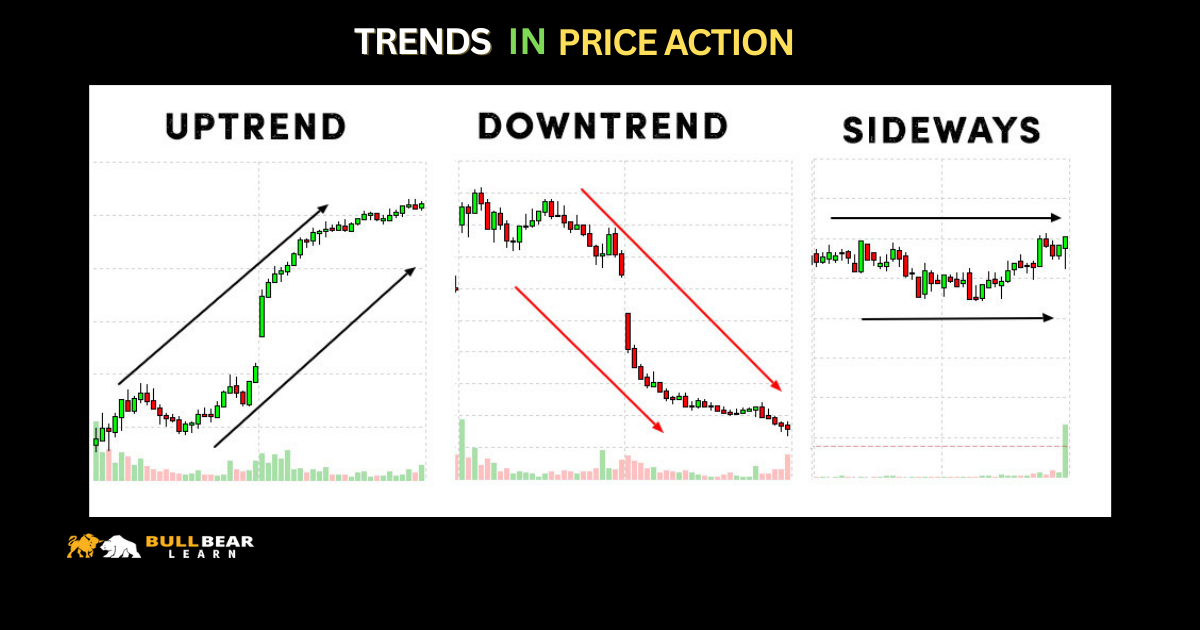
Trends are the most profitable environment in trading—yet most traders struggle to stay aligned with them.
The problem is not identifying trends. It is understanding their behavior.
This article explains:
-
What a trend really is in Price Action
-
How to assess trend strength and weakness
-
The difference between pullbacks and reversals
-
Why trends end gradually, not suddenly
Before thinking about entries, you must learn how trends develop, breathe, and persist.
What Is a Trend in Price Action?
In Price Action terms, a trend is not a moving average or a slope. It is consistent directional control confirmed by market structure.
-
Uptrend: Higher highs (HH) and higher lows (HL)
-
Downtrend: Lower highs (LH) and lower lows (LL)
Trends exist because one side—buyers or sellers—continues to defend territory and push price forward.
→ Market Structure in Price Action
Why Trends Are Difficult for Beginners
Beginners often:
-
Enter late due to fear
-
Exit early due to uncertainty
-
Trade against the trend searching for reversals
This happens because they confuse normal pullbacks with trend failure.
Understanding trend behavior eliminates this confusion.
Trend Strength: How to Read Momentum Without Indicators
Trend strength is visible directly in price behavior.
Signs of a strong trend:
-
Impulsive moves are large and decisive
-
Pullbacks are shallow
-
Price respects previous swing levels
-
Breaks of structure occur cleanly
Signs of a weakening trend:
-
Impulses shrink
-
Pullbacks deepen
-
Structure becomes less clear
-
Momentum stalls near key levels
Trend strength is about how price moves, not how fast it moves.
Impulse vs Pullback: The Rhythm of Trends
Trends move in cycles:
-
Impulse (expansion in trend direction)
-
Pullback (temporary counter-move)
Healthy trends require both.
Impulse phase
-
Dominant side is aggressive
-
Price moves quickly
-
Minimal overlap
Pullback phase
-
Profit-taking occurs
-
Opposing side tests control
-
Price slows or retraces
Pullbacks are necessary, not dangerous.
What Makes a Pullback Healthy?
A healthy pullback:
-
Respects previous structure
-
Shows reduced momentum
-
Does not break key swing levels
In an uptrend:
-
Pullbacks hold above the last higher low
In a downtrend:
-
Pullbacks stay below the last lower high
When structure holds, the trend remains intact.
Pullback vs Reversal: How to Tell the Difference
This distinction defines trader success.
Pullback characteristics:
-
Occurs after impulse
-
Lacks strong follow-through
-
Stalls near prior structure
-
Does not break structure decisively
Reversal characteristics:
-
Breaks key structure
-
Shows strong counter-impulse
-
Alters swing sequence
-
Changes market behavior
Reversals begin with structure damage, not emotion.
→ How the Market Moves: Supply, Demand & Psychology
Trend Continuation: Why Trends Last Longer Than Expected
Trends persist because:
-
Institutions build positions over time
-
New participants join on pullbacks
-
Late traders fuel continuation
This is why:
-
Trends often feel “overextended”
-
Yet continue far longer than expected
Price Action traders trust structure, not feelings.
Multiple Timeframe Trends
Trends are hierarchical.
-
Higher timeframe trends define direction
-
Lower timeframe trends provide detail
You may see:
-
A pullback on H1
-
Within a strong daily uptrend
This is not conflict—it is fractal structure.
Top-down analysis prevents misalignment.
Trend Exhaustion: How Trends End
Trends do not end randomly.
Common signs of exhaustion:
-
Momentum divergence (in price behavior)
-
Failure to create new structure
-
Deeper pullbacks
-
Increased volatility or compression
The first sign is usually loss of structure, not a reversal candle.
Common Trend Trading Mistakes
Avoid these errors:
-
Trading against the dominant trend
-
Expecting every pullback to reverse
-
Overreacting to single candles
-
Ignoring higher timeframe context
Trends reward patience and punish impatience.
Why Trends Matter in the Price Action Framework
Trends connect:
-
Market structure
-
Supply and demand
-
Support and resistance
-
Trade execution (later)
Without understanding trends:
-
Pullbacks feel threatening
-
Continuations feel random
-
Decisions feel emotional
With trend clarity, traders gain confidence and restraint.
How to Study Trends Effectively
Practice deliberately:
-
Remove indicators
-
Identify dominant timeframe trend
-
Mark impulse and pullback phases
-
Observe structure preservation
-
Journal trend behavior, not entries
The goal is interpretation, not prediction.
Final Thoughts
Trends are the market’s natural state.
They reflect sustained imbalance, participation, and conviction. When you learn to read trend strength, pullbacks, and continuation correctly, you stop fighting the market—and start aligning with it.
In the next article, we will move into Support and Resistance in Price Action, explaining why levels matter, how they form, and how traders misuse them.