
• About
  • Crypto Exchange
Bullbearlearn
Advertisement
  • Home
  • Learn Forex
    • Forex Basic
    • Trading Strategies
    • Price Action
    • Risk Management
  • Learn Crypto
    • Crypto Basics
    • Bitcoin & Ethereum
    • Major Altcoins
    • Wallets & Security
    • Buying & Trading Crypto
  • Trading Platform
    • Recommended
    • Reviews
    • Platform Guides
  • Tools
    • Tools Free
    • How to use
  • Blog
    • Market Analysis
      • Technical Analysis
    • News
Start
No Result
View All Result
Bullbearlearn
No Result
View All Result
Home Trading Strategies Core Strategies

Day Trading Strategy: A Practical Guide to Trading Intraday with Consistency

Baby Bear by Baby Bear
March 17, 2026
in Core Strategies, Trading Strategies
57 1
0
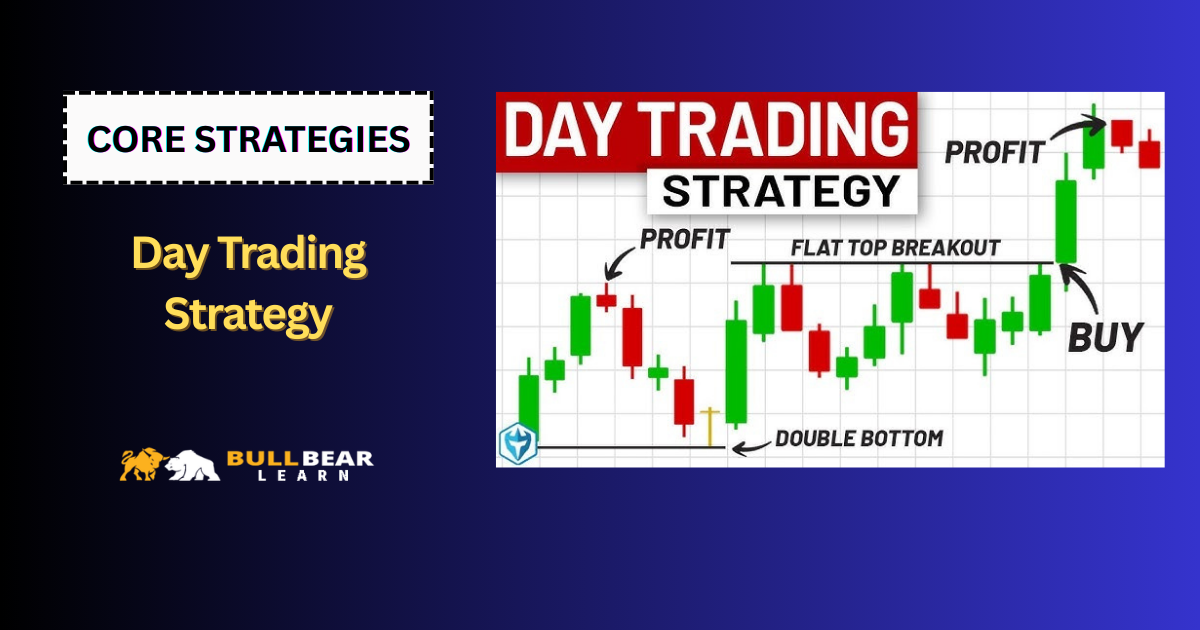
Day Trading Strategy

Day Trading Strategy

190
SHARES
1.5k
VIEWS
Share on FacebookShare on Twitter

Table of Contents

Toggle
  • 1. What Is Day Trading?
  • 2. Who Is Day Trading Suitable For?
  • 3. Markets Best Suited for Day Trading
    • Most Popular Day Trading Markets:
  • 4. Trading Sessions and Timing (Critical Factor)
    • Best Trading Sessions:
  • 5. Core Structure of a Day Trading Strategy
    • 1. Market Bias (Directional Context)
    • 2. Trading Setup
    • 3. Entry Criteria
    • 4. Risk Management
    • 5. Exit Rules
  • 6. Example: Simple Forex Day Trading Strategy (Conceptual)
    • Strategy Logic:
    • Timeframes:
    • Rules:
  • 7. Risk Management for Day Trading
    • Professional Guidelines:
  • 8. Common Day Trading Mistakes
  • 9. Day Trading vs Other Trading Styles
  • 10. Is Day Trading Profitable?
  • 11. Final Thoughts

1. What Is Day Trading?

Day trading is a trading strategy where all positions are opened and closed within the same trading day. No trades are held overnight, meaning day traders avoid swap fees, overnight gaps, and unexpected news risks.

A day trading strategy focuses on capturing short- to medium-term price movements using structured rules, strict risk control, and precise execution.

Unlike scalping, day trading does not aim for a few pips. Unlike swing trading, it does not hold trades for days. It sits in the middle—fast enough to require focus, but structured enough to allow planning.


2. Who Is Day Trading Suitable For?

Day trading is best suited for traders who:

  • Can dedicate specific trading hours daily

  • Prefer active decision-making

  • Are comfortable with fast-paced markets

  • Want to avoid overnight exposure

  • Can follow rules strictly without emotional trading

Day trading is not ideal for:

  • Traders with very limited screen time

  • People who prefer slow decision-making

  • Traders who struggle with discipline or overtrading


3. Markets Best Suited for Day Trading

Not all markets are suitable for intraday trading. Liquidity and volatility are essential.

Most Popular Day Trading Markets:

  • Forex: EUR/USD, GBP/USD, USD/JPY, XAU/USD

  • Indices: NASDAQ, S&P 500, DAX

  • Crypto (advanced traders): BTC, ETH during high-volume sessions

For beginners, Forex day trading is often the safest starting point due to high liquidity and predictable sessions.


4. Trading Sessions and Timing (Critical Factor)

A successful day trading strategy depends heavily on when you trade.

Best Trading Sessions:

  • London Session: High liquidity, strong trends

  • New York Session: Volatility + continuation moves

  • London–New York Overlap: Best intraday opportunities

Avoid trading during:

  • Low-liquidity Asian session (unless specialized)

  • Major news releases if you lack experience

  • Random hours without volume

⛔ Trading all day is a common beginner mistake.


5. Core Structure of a Day Trading Strategy

A professional intraday trading strategy always includes five components:

1. Market Bias (Directional Context)

  • Bullish, bearish, or ranging

  • Defined using higher timeframes (H1–H4)

  • Avoid trading against clear momentum

2. Trading Setup

  • Breakout, pullback, or range continuation

  • One setup only (avoid mixing strategies)

  • Repeatable conditions

3. Entry Criteria

  • Clear trigger (not guessing)

  • Defined execution timeframe (M5–M15)

  • No chasing price

4. Risk Management

  • Fixed risk per trade (usually 0.5%–1%)

  • Predefined stop-loss

  • Consistent position sizing

5. Exit Rules

  • Target based on risk–reward

  • Partial close (optional)

  • Time-based exit if setup fails


6. Example: Simple Forex Day Trading Strategy (Conceptual)

This is a strategy framework, not a signal system.

Strategy Logic:

  • Trade in the direction of the dominant intraday trend

  • Enter after a controlled pullback

  • Exit at logical intraday targets

Timeframes:

  • Bias: H1

  • Execution: M15

  • Entry refinement: M5

Rules:

  • Trade only London or New York session

  • Maximum 2 trades per day

  • Minimum Risk–Reward: 1:2

  • Stop trading after 2 losses

This structure prevents overtrading and emotional decisions.


7. Risk Management for Day Trading

Risk management is the core edge of any profitable day trading strategy.

Professional Guidelines:

  • Risk per trade: 0.5%–1%

  • Daily max loss: 2%–3%

  • Weekly drawdown limit

  • Never move stop-loss emotionally

A day trader survives by protecting capital first, profits come second.


8. Common Day Trading Mistakes

Avoid these frequent errors:

  • Overtrading due to boredom

  • Trading outside planned sessions

  • Increasing lot size after losses

  • Chasing price instead of waiting for setups

  • Ignoring higher-timeframe context

Most losing day traders do not fail because of strategy—but because of discipline breakdown.


9. Day Trading vs Other Trading Styles

Style Holding Time Frequency Stress Level
Scalping Seconds–minutes Very high Extreme
Day Trading Minutes–hours Moderate High
Swing Trading Days–weeks Low Moderate

Day trading is demanding but rewarding only if rules are respected.


10. Is Day Trading Profitable?

Yes—but only for traders who:

  • Follow a structured strategy

  • Control risk relentlessly

  • Accept losses as part of the process

  • Avoid emotional trading

Day trading is not gambling when done professionally. It is a rule-based execution business.


11. Final Thoughts

A successful day trading strategy is not about indicators or signals. It is about:

  • Timing

  • Discipline

  • Risk control

  • Repetition

If you cannot trade the same setup 100 times with consistency, you are not ready for day trading.

Share76Tweet48
Previous Post

Swing Trading Strategy: A Practical Approach for Consistent Traders

Next Post

Breakout Trading Strategy: How to Trade High-Momentum Market Moves Professionally

Related Posts

News-Driven Market Trading Strategies

News-Driven Market Trading Strategies: How to Trade Economic News Safely

by Baby Bull
March 12, 2026
0

Financial markets are heavily influenced by economic news and major announcements. Events such as central bank decisions, inflation reports, employment...

What is Choppy Market

Choppy Market Trading Strategies: How to Trade or Avoid Unstable Markets

by Baby Bull
March 12, 2026
0

Not every market offers clear opportunities. Sometimes price moves in a stable trend, while other times it moves within predictable...

Low Volatility Market Trading

Low Volatility Market Trading Strategies: Best Ways to Trade Sideways Markets

by Baby Bull
March 7, 2026
0

Financial markets do not always move in strong trends. In many situations, the market enters a phase of low volatility,...

High Volatility Market Trading Strategies

High Volatility Market Trading Strategies: How to Trade Fast Markets Safely

by Baby Bear
March 9, 2026
0

High volatility markets attract traders for one simple reason: opportunity.Large price movements can generate significant profits in a short period...

Ranging Market Trading Strategies

Ranging Market Trading Strategies: How to Trade Sideways Markets

by Baby Bear
March 9, 2026
0

Many traders struggle with ranging markets.Strategies that perform well in trending environments often fail completely when price moves sideways. Ranging...

Load More
  • Trending
  • Comments
  • Latest
exness review

Exness Review 2026: Is Exness a Safe and Reliable Forex Broker?

June 16, 2026
Exness Account Types Explained

Exness Account Types Explained (2026): Which Exness Account Is Right for You?

July 13, 2026
Price Action Execution

Price Action Execution: A Professional Framework for Decision-Making

March 16, 2026
how to choose a forex broker

How to Choose a Forex Broker for Beginners: A Complete Guide

June 29, 2026
market order vs limit order

Market Order vs Limit Order: What’s the Difference in Crypto Trading?

0
Exness Pro Account

Exness Pro Account Review (2026): Is It Worth Upgrading?

0
Exness Standard Account

Exness Standard Account Review (2026): Is It the Best Choice for Most Traders?

0
Exness Account Types Explained

Exness Account Types Explained (2026): Which Exness Account Is Right for You?

0
market order vs limit order

Market Order vs Limit Order: What’s the Difference in Crypto Trading?

July 17, 2026
Exness Pro Account

Exness Pro Account Review (2026): Is It Worth Upgrading?

July 17, 2026
Exness Standard Account

Exness Standard Account Review (2026): Is It the Best Choice for Most Traders?

July 14, 2026
Exness Account Types Explained

Exness Account Types Explained (2026): Which Exness Account Is Right for You?

July 13, 2026

BullBearLearn.com is an independent educational platform covering Forex, Cryptocurrency, trading, and investing. We create practical guides, market analysis, broker and exchange reviews, and educational resources that help traders and investors navigate financial markets with greater confidence.

Categories
  • Bitcoin & Ethereum
  • Broker Reviews
  • Buying & Trading Crypto
  • Core Concepts
  • Core Strategies
  • Crypto Basics
  • Crypto Exchange
  • Execution
  • Forex Basic
  • Major Altcoins
  • Market Analysis
  • Market Condition
  • News
  • Platform Guides
  • Price Action
  • Psychology
  • Risk Management
  • Strategy
  • Technical Analysis
  • Tools
  • Trading Strategies
  • Wallets & Security
Tags
Beginner best Binance Review bitcoin breakout Broker Reviews BTC Bybit review calculator Core Concepts cost cpi crypto exchange crypto wallet ETH Ethereum Execution Exness Review fees fomc forex basic gold guide Leverage lot Margin mistake nfp nonfarm OKX review pip position size price action Psychology risk risk reward Spread strategy swap Swing wallet XM Review xtb review

Disclaimer: Content on BullBearLearn.com is for educational purposes only and not intended as financial advice. Trading involves risk.​

  • About
  • Privacy Policy
  • Terms of Service
  • Disclaimer
  • Cookie Policy
  • Affiliate Disclosure
  • Contact Us

© 2025 BullBearLearn.com — Learn to Trade, Bull or Bear.

Welcome Back!

Login to your account below

Forgotten Password?

Retrieve your password

Please enter your username or email address to reset your password.

Log In

Session expired

Please log in again. The login page will open in a new tab. After logging in you can close it and return to this page.

Add New Playlist

>

Table of Contents

×
  • 1. What Is Day Trading?
  • 2. Who Is Day Trading Suitable For?
  • 3. Markets Best Suited for Day Trading
    • Most Popular Day Trading Markets:
  • 4. Trading Sessions and Timing (Critical Factor)
    • Best Trading Sessions:
  • 5. Core Structure of a Day Trading Strategy
    • 1. Market Bias (Directional Context)
    • 2. Trading Setup
    • 3. Entry Criteria
    • 4. Risk Management
    • 5. Exit Rules
  • 6. Example: Simple Forex Day Trading Strategy (Conceptual)
    • Strategy Logic:
    • Timeframes:
    • Rules:
  • 7. Risk Management for Day Trading
    • Professional Guidelines:
  • 8. Common Day Trading Mistakes
  • 9. Day Trading vs Other Trading Styles
  • 10. Is Day Trading Profitable?
  • 11. Final Thoughts
→ Index
No Result
View All Result
  • Home
  • Learn Forex
    • Forex Basic
    • Trading Strategies
    • Price Action
    • Risk Management
  • Learn Crypto
    • Crypto Basics
    • Bitcoin & Ethereum
    • Major Altcoins
    • Wallets & Security
    • Buying & Trading Crypto
  • Trading Platform
    • Recommended
    • Reviews
    • Platform Guides
  • Tools
    • Tools Free
    • How to use
  • Blog
    • Market Analysis
      • Technical Analysis
    • News
START

© 2025 BullBearLearn.com — Learn to Trade, Bull or Bear.