
• About
  • Crypto Exchange
Bullbearlearn
Advertisement
  • Home
  • Learn Forex
    • Forex Basic
    • Trading Strategies
    • Price Action
  • Learn Crypto
  • Broker Reviews
  • Tools FREE
  • Blog
Start
No Result
View All Result
Bullbearlearn
No Result
View All Result
Home Trading Strategies Market Condition

Trending Market Trading Strategies: How to Trade Strong Market Trends

Baby Bear by Baby Bear
March 9, 2026
in Market Condition, Trading Strategies
57 1
0
Trending Market Trading Strategies

Trending Market Trading Strategies

190
SHARES
1.5k
VIEWS
Share on FacebookShare on Twitter

Trending markets are often described as the most profitable trading environments. When price moves consistently in one direction, traders can capitalize on momentum rather than fighting against it.

However, many traders misunderstand trending markets. They either enter too late, exit too early, or attempt to fade trends that are still strong.

This article explains how trending markets behave, which trading strategies work best in trending conditions, and how to avoid the most common trend-trading mistakes.


Table of Contents

Toggle
  • 1. What Is a Trending Market?
    • Key characteristics of a trending market:
  • 2. Why Trending Markets Are Trader-Friendly
  • 3. Best Types of Trading Strategies for Trending Markets
    • 3.1 Trend Following Strategies
    • 3.2 Pullback-Based Trend Strategies
    • 3.3 Breakout Continuation Strategies
    • 3.4 Moving Average–Based Trend Strategies
  • 4. How to Confirm a Trending Market Before Trading
    • Confirmation checklist:
  • 5. Common Mistakes When Trading Trending Markets
    • 5.1 Counter-Trend Trading
    • 5.2 Over-Leveraging During Trends
    • 5.3 Assuming Trends Last Forever
  • 6. Risk Management in Trending Markets
  • 7. Trending Markets vs Other Market Conditions
  • 8. Final Thoughts

1. What Is a Trending Market?

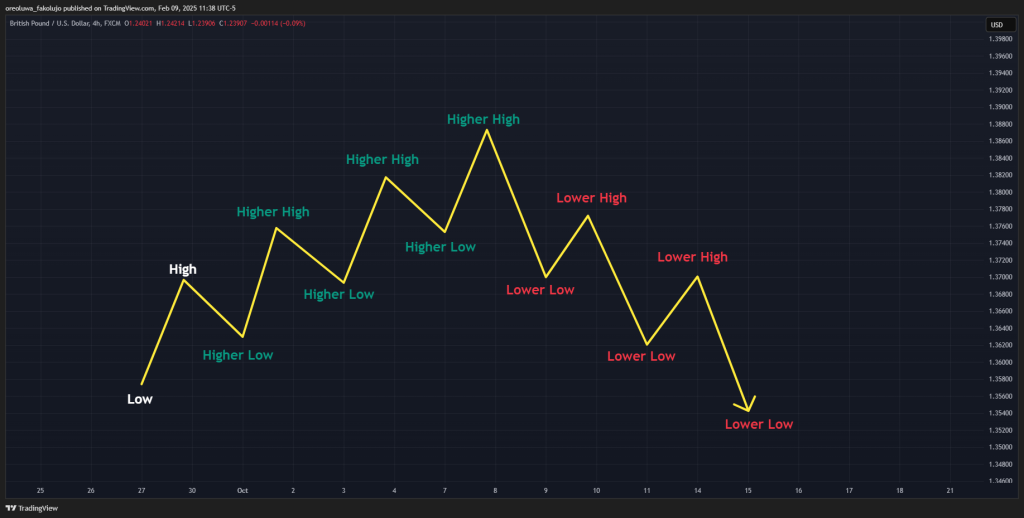
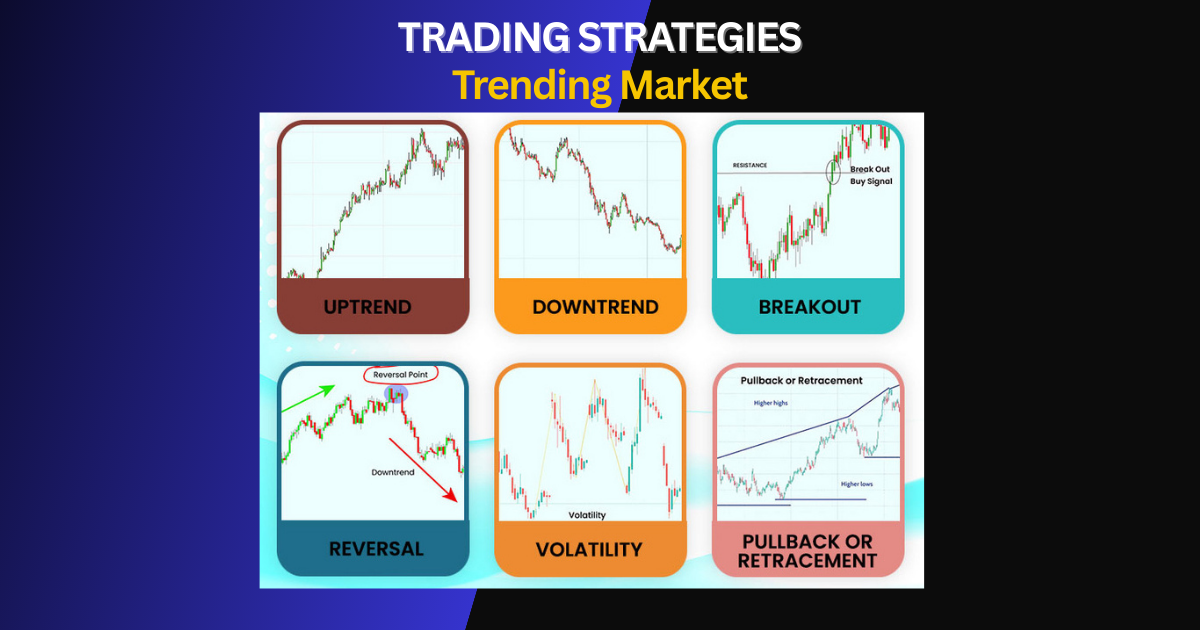
A trending market occurs when price moves predominantly in one direction over time, forming a clear directional bias.
https://26693533.fs1.hubspotusercontent-eu1.net/hubfs/26693533/Folie13.png
https://bpcdn.co/images/2020/05/20185640/price-downtrend.png
https://howtotrade.com/wp-content/uploads/2025/02/How-to-Identify-Trends-with-Market-Structure-1024x518.png

Key characteristics of a trending market:

  • Directional price movement (uptrend or downtrend)

  • Higher highs and higher lows (uptrend)

  • Lower highs and lower lows (downtrend)

  • Pullbacks that fail to break overall structure

  • Momentum remains intact

A trend does not mean price moves in a straight line. Trends progress through impulses and corrections, which is what creates trading opportunities.


2. Why Trending Markets Are Trader-Friendly

Trending markets reduce complexity.

Instead of guessing direction, traders align with the dominant flow of price. This alignment creates three advantages:

  1. Higher probability setups

  2. Clear directional bias

  3. Simpler trade management

Most long-term profitable traders generate the majority of their returns from trending phases rather than ranging or choppy markets.


3. Best Types of Trading Strategies for Trending Markets

Trending markets favor continuation-based strategies, not reversal-based ones.

Below are the most effective categories of trending market trading strategies.


3.1 Trend Following Strategies

Trend following strategies aim to stay aligned with the dominant market direction for as long as the trend remains intact.

Core logic:

  • Trade in the direction of the trend

  • Ignore counter-trend signals

  • Focus on continuation rather than prediction

Trend following works because trends often persist longer than traders expect.

➡️ Common mistake: exiting trades too early due to fear of reversals.


3.2 Pullback-Based Trend Strategies

Pullbacks are temporary retracements within a larger trend.

Instead of chasing breakouts, pullback strategies wait for price to retrace before entering in the direction of the trend.

Why pullbacks matter in trending markets:

  • Offer better risk-to-reward ratios

  • Reduce emotional chasing

  • Allow tighter invalidation points

Pullbacks are not reversals; they are pauses within momentum.


3.3 Breakout Continuation Strategies

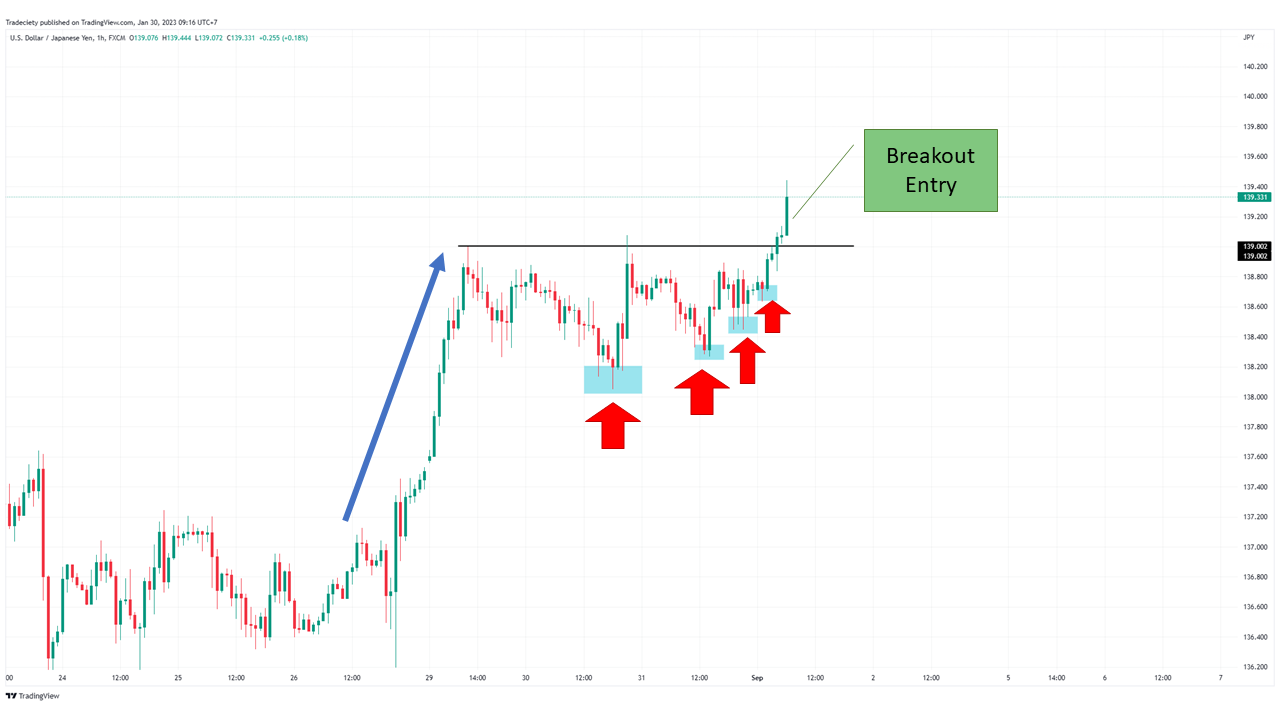
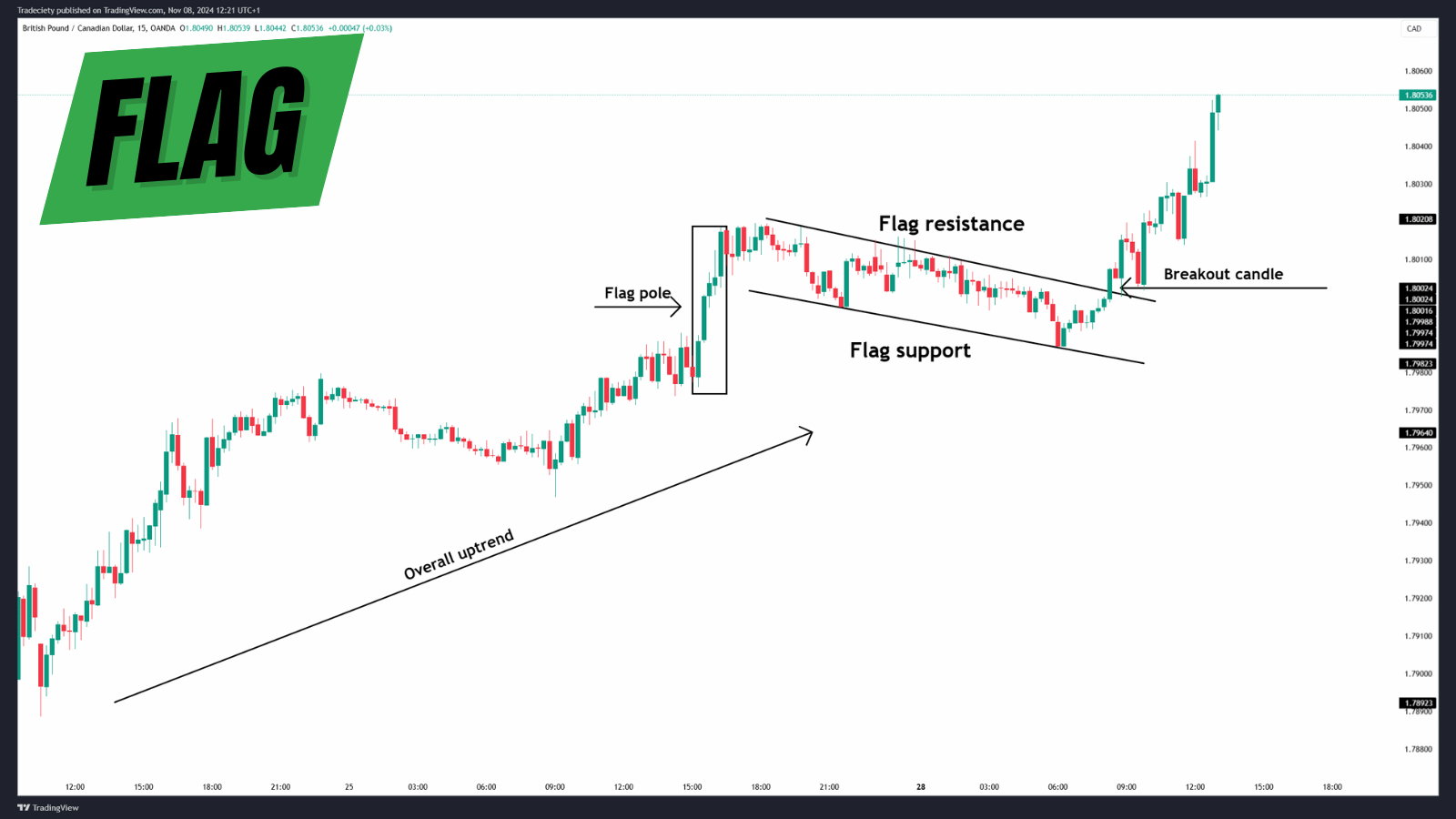
Not all breakouts signal reversals. In trending markets, breakouts often represent trend continuation.

Breakout continuation strategies focus on:

  • Breaks of consolidation within trends

  • Momentum expansion after compression

  • Trend acceleration phases

➡️ Trending markets increase the success rate of breakout strategies significantly.


3.4 Moving Average–Based Trend Strategies

Moving averages are widely used to define trend direction and filter trades.

In trending markets:

  • Price respects key moving averages

  • Pullbacks often stall near dynamic support or resistance

  • Trend bias remains clear

The purpose of moving averages here is context, not precise entry timing.


4. How to Confirm a Trending Market Before Trading

Before applying any trend-based strategy, traders must confirm that the market is actually trending.

https://trendspider.com/blog/wp-content/uploads/2023/10/Market-structure-blog-1.png
https://tradeciety.com/hs-fs/hubfs/Flag.png?height=900&name=Flag.png&width=1600

Confirmation checklist:

  • Clear directional structure

  • Consistent swing progression

  • Momentum favors one side

  • Pullbacks remain shallow

  • No prolonged sideways consolidation

If price begins to overlap excessively, the trend may be weakening or transitioning into another market condition.


5. Common Mistakes When Trading Trending Markets

Trending markets are profitable, but only if traders avoid these errors.

5.1 Counter-Trend Trading

Many traders attempt to sell tops or buy bottoms in strong trends.

This approach:

  • Increases stop-loss frequency

  • Fights market momentum

  • Relies on prediction instead of alignment


5.2 Over-Leveraging During Trends

Trends feel “easy,” which often leads traders to increase position size irresponsibly.

Strong trends still contain pullbacks. Without proper risk management, even correct directional bias can result in losses.


5.3 Assuming Trends Last Forever

All trends eventually end.

Failing to recognize weakening momentum or structural changes can turn winning trades into losses.

Trending strategies require ongoing reassessment, not blind commitment.


6. Risk Management in Trending Markets

Risk management is especially important during trends because traders often hold positions longer.

Key principles:

  • Use trailing exits instead of fixed targets

  • Avoid tightening stops prematurely

  • Adjust position size to volatility

  • Accept partial retracements as normal behavior

Trending markets reward patience more than precision.


7. Trending Markets vs Other Market Conditions

Market Condition Strategy Fit
Trending Trend-following, pullback, breakout
Ranging Mean reversion
Choppy Avoid trading
High Volatility Reduced size, adaptive strategies

Applying trending strategies outside of trending markets leads to frustration and inconsistency.


8. Final Thoughts

Trending markets provide some of the best opportunities in trading—but only for traders who respect market context.

The goal is not to predict reversals or capture every pip.
The goal is to align with momentum, manage risk, and stay consistent.

Before executing any trend-based strategy, ask:

Is the market truly trending, or am I forcing a bias?

Share76Tweet48
Previous Post

Forex Heatmap – Identify Strongest & Weakest Currencies

Next Post

Ranging Market Trading Strategies: How to Trade Sideways Markets

Related Posts

News-Driven Market Trading Strategies

News-Driven Market Trading Strategies: How to Trade Economic News Safely

by Baby Bull
March 12, 2026
0

Financial markets are heavily influenced by economic news and major announcements. Events such as central bank decisions, inflation reports, employment...

What is Choppy Market

Choppy Market Trading Strategies: How to Trade or Avoid Unstable Markets

by Baby Bull
March 12, 2026
0

Not every market offers clear opportunities. Sometimes price moves in a stable trend, while other times it moves within predictable...

Low Volatility Market Trading

Low Volatility Market Trading Strategies: Best Ways to Trade Sideways Markets

by Baby Bull
March 7, 2026
0

Financial markets do not always move in strong trends. In many situations, the market enters a phase of low volatility,...

High Volatility Market Trading Strategies

High Volatility Market Trading Strategies: How to Trade Fast Markets Safely

by Baby Bear
March 9, 2026
0

High volatility markets attract traders for one simple reason: opportunity.Large price movements can generate significant profits in a short period...

Ranging Market Trading Strategies

Ranging Market Trading Strategies: How to Trade Sideways Markets

by Baby Bear
March 9, 2026
0

Many traders struggle with ranging markets.Strategies that perform well in trending environments often fail completely when price moves sideways. Ranging...

Load More
  • Trending
  • Comments
  • Latest
Market Structure in Price Action

Market Structure in Price Action: Higher Highs, Lower Lows Explained

February 27, 2026
exness review

Exness Review 2026: Is It Safe, Legit & Worth It for Beginners?

March 23, 2026
Discipline & Consistency in Trading

Psychology #3: Discipline & Consistency in Trading: How Professionals Actually Follow Rules

March 21, 2026
trading psychology basics

Psychology #1: Trading Psychology Basics: Why Most Traders Fail Despite Good Strategies

March 20, 2026
breakout forex strategy

Strategy #2: Breakout & False Breakout – How Smart Money Traps Retail Traders

0
price action trading strategy

Strategy #1: Price Action Trading Strategy: A Complete Framework for Consistent Decisions

0
trading mindset

Psychology #6: Process-Based Thinking vs Outcome-Based Thinking in Trading

0
trading journal

Psychology #5: Trading Routine, Journaling & Mental Process: How Professionals Build Consistency

0
breakout forex strategy

Strategy #2: Breakout & False Breakout – How Smart Money Traps Retail Traders

March 23, 2026
price action trading strategy

Strategy #1: Price Action Trading Strategy: A Complete Framework for Consistent Decisions

March 23, 2026
trading mindset

Psychology #6: Process-Based Thinking vs Outcome-Based Thinking in Trading

March 21, 2026
trading journal

Psychology #5: Trading Routine, Journaling & Mental Process: How Professionals Build Consistency

March 22, 2026

BullBearLearn.com is an independent educational website on Forex and financial trading, offering knowledge, strategies, and tools to help traders understand and navigate markets—whether bullish or bearish.

Categories
  • Broker Reviews
  • Core Concepts
  • Core Strategies
  • Crypto Exchange
  • Execution
  • Forex Basic
  • Learn Forex
  • Market Condition
  • Price Action
  • Psychology
  • Risk Management
  • Strategy
  • Tools
  • Trading Strategies
Tags
Beginner Binance Review breakout Broker Reviews Bybit review calculator Core Concepts cost crypto exchange Execution Exness Review fees forex basic guide Leverage lot Margin mistake OKX review pip position size price action Psychology risk risk reward Spread swap Swing XM Review xtb review

Disclaimer: Content on BullBearLearn.com is for educational purposes only and not intended as financial advice. Trading involves risk.​

  • About
  • Privacy Policy
  • Terms of Service
  • Disclaimer
  • Cookie Policy
  • Affiliate Disclosure
  • Contact Us

© 2025 BullBearLearn.com — Learn to Trade, Bull or Bear.

Welcome Back!

Login to your account below

Forgotten Password?

Retrieve your password

Please enter your username or email address to reset your password.

Log In

Session expired

Please log in again. The login page will open in a new tab. After logging in you can close it and return to this page.

Add New Playlist

>

Table of Contents

×
  • 1. What Is a Trending Market?
    • Key characteristics of a trending market:
  • 2. Why Trending Markets Are Trader-Friendly
  • 3. Best Types of Trading Strategies for Trending Markets
    • 3.1 Trend Following Strategies
    • 3.2 Pullback-Based Trend Strategies
    • 3.3 Breakout Continuation Strategies
    • 3.4 Moving Average–Based Trend Strategies
  • 4. How to Confirm a Trending Market Before Trading
    • Confirmation checklist:
  • 5. Common Mistakes When Trading Trending Markets
    • 5.1 Counter-Trend Trading
    • 5.2 Over-Leveraging During Trends
    • 5.3 Assuming Trends Last Forever
  • 6. Risk Management in Trending Markets
  • 7. Trending Markets vs Other Market Conditions
  • 8. Final Thoughts
→ Index
No Result
View All Result
  • Home
  • Learn Forex
    • Forex Basic
    • Trading Strategies
    • Price Action
  • Learn Crypto
  • Broker Reviews
  • Tools FREE
  • Blog
START

© 2025 BullBearLearn.com — Learn to Trade, Bull or Bear.