

Risk Management Course – Module 1: Foundations | Lesson 2 of 6
Introduction
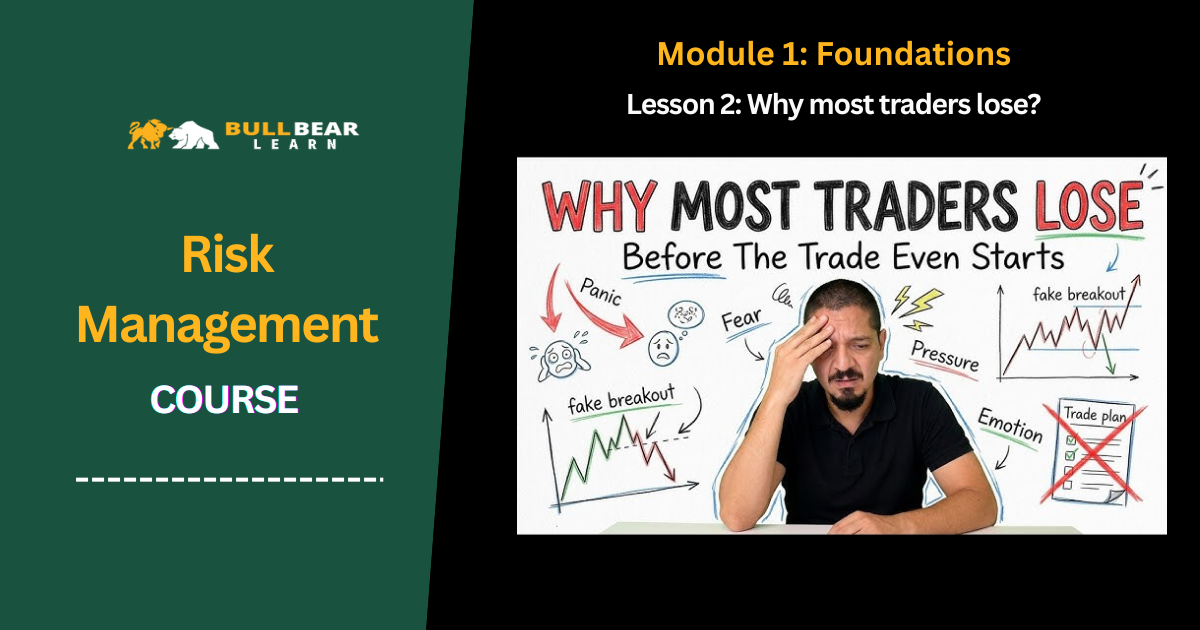
Many beginner traders believe they lose money because they haven’t found the right trading strategy.
They constantly search for better indicators, new chart patterns, or more accurate entry signals.
But if you ask experienced traders why most people fail, you’ll often hear a different answer:
They don’t manage risk.
A trader can have an excellent strategy and still lose their account if they consistently risk too much on each trade.
On the other hand, a trader with an average strategy can survive and grow over time simply by keeping losses under control.
This lesson explains why poor risk management is one of the biggest reasons traders fail and how avoiding a few common mistakes can dramatically improve your chances of long-term success.
Losing Trades Are Normal
One of the biggest misconceptions in trading is that successful traders rarely lose.
In reality, every trader experiences losing trades.
Even professional hedge funds, proprietary trading firms, and institutional traders have periods of drawdown.
The difference is not whether they lose.
The difference is how much they lose when they are wrong.
Successful traders accept that losses are part of the business and design their trading plans around that reality.
The Danger of Risking Too Much
Imagine two traders each start with a $10,000 account.
Trader A risks 10% on every trade.
Trader B risks 1%.
Both experience five consecutive losing trades.
Trader A’s account falls dramatically, making it much harder to recover.
Trader B still has most of their capital available and can continue trading with confidence.
This simple example highlights an important principle:
Small losses are easy to recover from. Large losses are not.
Protecting your capital today gives you the opportunity to profit tomorrow.
Why Chasing Big Profits Often Leads to Bigger Losses
Many beginners are attracted by stories of traders who double their accounts in a few weeks.
To achieve similar results, they increase their position size far beyond what their account can safely support.
Sometimes it works—for a while.
But eventually, a normal losing streak wipes out weeks or even months of gains.
Trading is not a sprint.
It is a long-term process of making hundreds of disciplined decisions.
Consistent growth usually outperforms aggressive risk-taking over time.
The Psychological Cost of Poor Risk Management
Poor risk management doesn’t only damage your account.
It also affects your mindset.
When you risk too much on a single trade, every price movement feels personal.
You may find yourself:
- Watching every candle.
- Moving your stop loss.
- Closing trades too early.
- Refusing to accept a loss.
- Taking revenge trades after losing.
These behaviors rarely come from the market itself.
They come from risking more money than you are emotionally comfortable losing.
Reducing your position size often leads to calmer and more objective decision-making.
Surviving Losing Streaks
Every trading strategy experiences losing streaks.
The question is not if they will happen, but when.
Without proper risk management, a losing streak can quickly become an account-ending event.
With disciplined risk management, it becomes a temporary setback.
Professional traders expect losing streaks and prepare for them before they happen.
This mindset helps them remain consistent instead of reacting emotionally after a few losses.
Risk Management Gives You More Opportunities
Every trade is only one event in a long series of trades.
If you protect your capital, you always have another opportunity.
If you lose most of your account, future opportunities no longer matter.
Think of risk management as buying yourself more chances to succeed.
The longer you stay in the game, the more likely your trading edge has time to work.
Key Takeaways
- Most traders fail because they risk too much, not because they lack a strategy.
- Losing trades are a normal part of trading.
- Small, controlled losses are easier to recover from than large losses.
- Proper risk management reduces both financial and emotional pressure.
- Long-term consistency depends on surviving losing streaks.
Conclusion
Many traders spend years searching for a better trading strategy while ignoring the factor that has the greatest influence on long-term survival.
Risk management will not eliminate losing trades.
It will not guarantee profits.
But it will help ensure that no single mistake—or even a series of mistakes—destroys your trading account.
The goal is simple:
Stay in the game long enough for your trading edge to work.
That is why every professional trader treats risk management as a necessity rather than an optional skill.
Continue Learning
Previous Lesson
Next Lesson
- Risk vs Reward Ratio Explained