

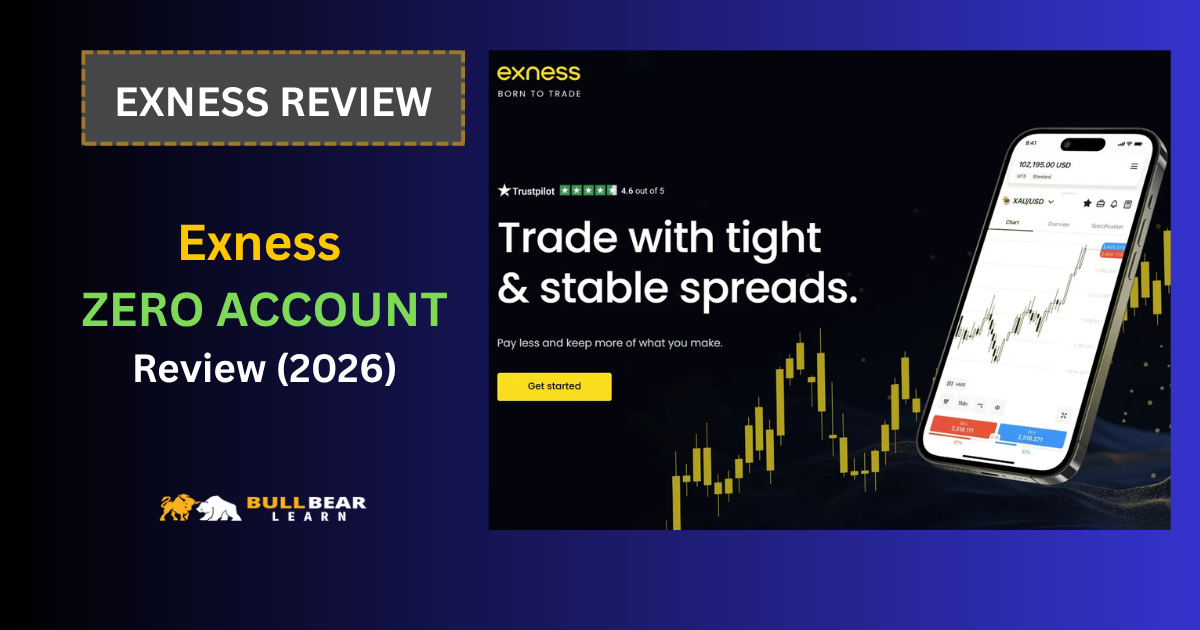
Forex traders often search for the lowest possible spread, believing it automatically leads to lower trading costs. While tight spreads are undoubtedly important, they tell only part of the story.
The Exness Zero Account is designed for traders who prioritize ultra-tight pricing on selected instruments while accepting a commission-based fee structure. Instead of combining all trading costs into the spread, this account separates spreads and commissions, providing greater pricing transparency for experienced traders.
However, the Zero Account isn’t the ideal choice for everyone.
For many retail traders, a commission-free account like the Pro Account may offer a simpler and equally cost-effective trading experience. Others, particularly scalpers and algorithmic traders, may benefit from the specialized pricing model of the Zero Account.
In this review, we’ll explain how the Exness Zero Account works, compare it with other Exness account types, and help you decide whether it matches your trading style.
If you’re new to the broker, our comprehensive Exness Review covers regulation, trading platforms, fees, account types, and everything you need to know before opening an account.
Exness Zero Account at a Glance
| Category | Details |
|---|---|
| Best For | Scalpers and professional traders |
| Trading Experience | Intermediate to Advanced |
| Spread Type | Near-zero spreads on selected instruments* |
| Commission | Yes |
| Platforms | MT4 & MT5 |
| Execution | Market Execution |
| EAs Supported | Yes |
| Our Assessment | Ideal for traders who value ultra-tight spreads more than commission-free pricing. |
*Availability depends on market conditions and instrument selection.
Pros & Cons
Pros
✅ Near-zero spreads on many popular instruments
✅ Excellent for scalping
✅ Transparent pricing
✅ Supports Expert Advisors
✅ Available on MT4 and MT5
✅ Suitable for active professional traders
Cons
❌ Commission charged per trade
❌ Not beginner-friendly
❌ Zero spreads are not available on every instrument at all times
❌ Casual traders may not benefit from the pricing model
What Is the Exness Zero Account?
The Zero Account is one of Exness’s Professional account types and is built for traders who want the tightest possible spreads on selected trading instruments.
Unlike the Standard and Pro Accounts, where trading costs are mainly incorporated into the spread, the Zero Account uses a commission-based pricing model. This allows spreads to remain extremely low under normal market conditions while charging a fixed commission separately.
For traders who execute a high volume of trades, this structure provides greater transparency and makes it easier to calculate total trading costs.
Rather than appealing to beginners, the Zero Account targets experienced traders who understand how pricing affects long-term profitability.
Not sure whether the Zero Account is the right choice? Compare every available option in our Exness Account Types guide to see the differences between the Standard, Pro, Raw Spread, and Zero Accounts.
How Does the Zero Account Work?
The pricing model is straightforward.
Instead of paying wider spreads, traders receive much tighter pricing and pay a fixed commission for each completed transaction.
This structure is common among professional forex brokers because it separates market pricing from broker compensation.
For example, if market liquidity is high, spreads may remain close to zero on supported instruments. During volatile market conditions, however, spreads can still widen temporarily, just as they do with any floating-spread account.
It’s important to evaluate the total trading cost—spread plus commission—rather than focusing on spreads alone.
Who Should Use the Exness Zero Account?
The Zero Account is best suited to traders who already have experience in the forex market.
It may be an excellent choice if you:
- Trade frequently throughout the week.
- Use scalping or high-frequency strategies.
- Depend on precise entries and exits.
- Trade around technical support and resistance levels.
- Use automated trading systems.
- Want maximum pricing transparency.
For these traders, saving even a fraction of a pip on each trade can make a noticeable difference over hundreds or thousands of transactions.
Key Features
Near-Zero Spreads
The defining characteristic of this account is its access to extremely tight spreads on selected instruments.
Although market conditions always influence pricing, the Zero Account aims to keep spreads as low as possible while applying a separate commission.
For traders whose strategies rely on capturing small market movements, this pricing structure can be advantageous.
Professional Pricing Model
Unlike commission-free accounts, the Zero Account clearly separates the cost of market access from broker fees.
This makes it easier for experienced traders to evaluate the true cost of every trade and compare performance across different brokers or account types.
Support for MT4 & MT5
The Zero Account is available on both MetaTrader 4 and MetaTrader 5.
Whether you trade manually or with Expert Advisors, both platforms provide access to advanced charting, automated trading, and extensive customization options.
Wide Range of Markets
Depending on your region, traders can access:
- Forex
- Precious metals
- Indices
- Energy
- Cryptocurrencies
This flexibility allows traders to apply the same pricing model across multiple asset classes without changing account types.
Our Take
The Exness Zero Account isn’t the best account simply because it advertises near-zero spreads.
For traders who execute only a few trades each week, paying commissions may not provide any meaningful advantage over the commission-free Pro Account.
However, if your strategy depends on frequent execution, tight spreads, and precise trade entries, the Zero Account becomes a much stronger option.
The best choice isn’t determined by the lowest advertised spread—it’s determined by which pricing model best matches your trading behavior.
Trading Costs: Is the Zero Account Actually Cheaper?
Many traders assume that an account with near-zero spreads must automatically be the cheapest option. In reality, the answer depends on your trading style.
The Exness Zero Account combines ultra-tight spreads on selected instruments with a fixed trading commission. This pricing model can reduce overall transaction costs for traders who execute a large number of trades, particularly scalpers and algorithmic traders.
However, if you only trade occasionally, the commission may outweigh the benefit of tighter spreads. In those situations, a commission-free account like the Exness Pro Account can sometimes offer similar or even lower overall costs.
If you prefer commission-free pricing with competitive spreads, our Exness Pro Account review explains why many active traders choose it instead.
Instead of comparing spreads alone, experienced traders evaluate the all-in trading cost, which includes:
- Average spread
- Trading commission
- Slippage
- Overnight swap charges (if positions are held overnight)
Looking at the complete cost gives a much more accurate picture than focusing on advertised minimum spreads.
Market Execution
The Zero Account uses Market Execution, meaning orders are filled at the best available market price.
Under normal market conditions, execution is typically fast and reliable. During periods of high volatility, such as major economic releases or central bank announcements, both spreads and execution prices may fluctuate.
Positive or negative slippage can occur, which is normal for market execution accounts across the forex industry.
Rather than expecting every order to execute at the exact requested price, traders should focus on consistent execution quality over time.
Available Trading Instruments
Like other Professional Exness accounts, the Zero Account provides access to a broad range of CFD markets.
Forex
Trade major, minor, and selected exotic currency pairs using professional trading conditions.
The Zero Account is especially attractive for active forex traders who require precise entries and exits.
Precious Metals
Gold (XAU/USD) and Silver (XAG/USD) are among the most popular instruments available.
Many traders choose the Zero Account when trading gold because even a small reduction in spread can become meaningful during periods of high trading activity.
Indices
Major stock indices allow traders to speculate on the overall direction of financial markets without purchasing individual shares.
Indices are commonly used during earnings seasons and major macroeconomic events.
Energy
Depending on your country of residence, the Zero Account may support energy CFDs such as crude oil.
Energy markets are often influenced by geopolitical developments and changes in global supply and demand.
Cryptocurrencies
Selected cryptocurrency CFDs may also be available.
Because cryptocurrencies experience significant price volatility, traders should use conservative position sizing and appropriate risk management techniques.
Advantages of the Zero Account
Extremely Competitive Spreads
The Zero Account is specifically designed to minimize spreads on selected instruments.
For traders entering and exiting positions frequently, even a small reduction in spread can contribute to lower trading costs over hundreds of transactions.
Excellent for Scalping
Scalping strategies often target relatively small price movements.
When profits are measured in only a few pips, tighter spreads become increasingly important.
The Zero Account is therefore particularly well suited to experienced scalpers who understand commission-based pricing.
Transparent Pricing
Separating commissions from spreads makes trading costs easier to evaluate.
Rather than wondering how much markup is hidden inside the spread, traders can clearly see exactly what they are paying.
This transparency is one reason why many professional traders prefer commission-based accounts.
Strong Platform Support
The Zero Account supports both MetaTrader 4 and MetaTrader 5.
It is compatible with:
- Expert Advisors (EAs)
- Custom indicators
- Automated strategies
- One-click trading
- Advanced technical analysis
Whether you trade manually or algorithmically, both platforms provide a stable trading environment.
Potential Drawbacks
Commission Adds Complexity
For traders accustomed to commission-free accounts, calculating trading costs may require a little more attention.
While experienced traders generally appreciate the transparency, beginners often find commission-free pricing easier to understand.
Zero Doesn’t Mean Completely Free
A common misconception is that the Zero Account eliminates trading costs.
In reality, “Zero” refers to the spread available on selected instruments under certain market conditions.
Commissions still apply, and spreads can widen when market liquidity decreases.
Not Ideal for Every Strategy
Long-term position traders and investors who only place occasional trades may see little benefit from near-zero spreads.
For these traders, the simplicity of the Pro Account may outweigh the potential savings offered by the Zero Account.
Exness Zero Account vs Raw Spread Account
These are the two most advanced pricing models offered by Exness, and many experienced traders compare them before opening an account.
| Feature | Zero Account | Raw Spread Account |
|---|---|---|
| Spread | Near-zero on selected instruments | Raw floating spreads |
| Commission | Yes | Yes |
| Best For | Scalpers trading selected instruments | Active traders across multiple markets |
| Pricing | Optimized for ultra-tight spreads | Balanced professional pricing |
Want a more detailed comparison? Read our full Exness Raw Spread Account review to understand how these two Professional accounts differ in spreads, commissions, and trading costs.
The Zero Account focuses on delivering the tightest possible spreads on supported instruments.
The Raw Spread Account, meanwhile, provides consistently low floating spreads across a broader range of markets.
Neither account is universally better. The right choice depends on the instruments you trade and how frequently you enter the market.
Exness Zero Account vs Pro Account
This is one of the most practical comparisons for retail traders.
| Feature | Zero | Pro |
|---|---|---|
| Commission | Yes | No |
| Spread | Near-zero* | Low floating spreads |
| Best For | Scalpers | Active retail traders |
| Pricing | Spread + Commission | Spread Only |
| Simplicity | Moderate | Excellent |
For most retail traders, the Pro Account offers the best balance between competitive spreads and straightforward pricing.
The Zero Account becomes more attractive for experienced traders who prioritize the tightest spreads and are comfortable with commission-based trading.
Who Should Choose the Exness Zero Account?
The Exness Zero Account is designed for traders who prioritize execution precision and consistently low trading costs on selected instruments.
It is a particularly strong choice if you:
- Trade actively throughout the week.
- Use scalping or high-frequency trading strategies.
- Depend on precise trade entries and exits.
- Run automated trading systems (Expert Advisors).
- Understand how commissions affect your overall trading costs.
- Prefer professional pricing over a simplified fee structure.
For these traders, the combination of near-zero spreads and transparent commissions can provide measurable long-term savings.
Who Should Avoid the Zero Account?
Although the Zero Account offers professional trading conditions, it isn’t the best option for every trader.
You may want to consider another Exness account if you:
- Are completely new to forex trading.
- Trade only a few times each month.
- Prefer commission-free pricing.
- Focus mainly on long-term swing or position trading.
- Want the simplest possible trading experience.
For beginners, the Standard Account usually offers an easier learning curve. For active traders who want competitive spreads without paying commissions, the Pro Account often provides a better balance between cost and simplicity.
Our detailed Exness Standard Account review explains why it’s often the best starting point for new forex traders.
Zero Account vs Other Exness Account Types
Choosing the right account becomes much easier when you compare all Professional account types side by side.
| Account Type | Spread Model | Commission | Best For |
|---|---|---|---|
| Standard | Floating | No | Beginners |
| Pro | Lower Floating | No | Active retail traders |
| Raw Spread | Raw Floating | Yes | Scalpers & high-frequency traders |
| Zero | Near-zero on selected instruments | Yes | Professional traders seeking the tightest spreads |
Rather than asking “Which account is best?”, ask “Which account matches my trading style?”
That’s the question experienced traders focus on.
Common Mistakes When Choosing the Zero Account
Mistake #1: Choosing It Only Because of “Zero Spreads”
The word “Zero” attracts attention, but many traders misunderstand what it means.
The account does not guarantee zero trading costs. Instead, it aims to provide near-zero spreads on selected instruments under normal market conditions while charging a trading commission.
Always evaluate the total cost of trading—not just the spread.
Mistake #2: Ignoring Commissions
Some traders compare only the spread shown on their platform.
However, commissions are part of the total transaction cost.
When comparing accounts, always calculate:
- Spread
- Commission
- Swap charges (if applicable)
- Expected trading frequency
Only then can you determine which account is actually cheaper for your strategy.
Mistake #3: Using the Wrong Account for Your Strategy
Not every strategy benefits from ultra-tight spreads.
For example:
- A trader opening three trades per month may notice almost no difference.
- A scalper opening 300 trades per week may save a significant amount over time.
Choosing the correct account type is about matching your trading behavior—not selecting the account with the most attractive marketing headline.
Our Take
The Exness Zero Account is one of the strongest choices for traders who need exceptionally tight spreads and already understand commission-based pricing.
However, we don’t recommend it simply because it advertises “zero spreads.”
For many retail traders, the Pro Account delivers a better balance between simplicity and cost-effectiveness. Likewise, beginners will usually have a smoother experience with the Standard Account.
The Zero Account truly shines when every fraction of a pip matters—particularly for scalpers, algorithmic traders, and experienced professionals who execute a high volume of trades.
Final Verdict
The Exness Zero Account is a specialized trading account built for experienced traders rather than beginners.
Its combination of near-zero spreads on selected instruments and transparent commission-based pricing makes it particularly attractive for scalping, high-frequency trading, and algorithmic strategies.
That said, it isn’t automatically the best account simply because it offers tighter spreads.
If you trade infrequently or prefer straightforward pricing without separate commissions, the Exness Pro Account or Standard Account may provide better overall value.
Ultimately, choosing the right account comes down to understanding your own trading style. The Zero Account is an excellent tool—but like any professional trading tool, it delivers the greatest benefits when used by traders whose strategies are designed to take advantage of its pricing model.
Still comparing brokers? Our guide to the Best MT5 Brokers highlights the top platforms for MetaTrader users, including Exness and other leading forex brokers.
Ready to trade with Exness? Open your Exness account today to access Professional account types, competitive trading conditions, and fast deposits and withdrawals. Choose the account that best fits your trading strategy and start trading with confidence.
Frequently Asked Questions
Is the Exness Zero Account suitable for beginners?
Not generally. Beginners usually find the Standard Account easier to understand because it uses a commission-free pricing model.
Does the Zero Account really have zero spreads?
The account is designed to provide near-zero spreads on selected instruments under normal market conditions. Spreads may still vary depending on liquidity and market volatility.
Does the Exness Zero Account charge commissions?
Yes. Trading commissions apply and are charged separately from the spread.
Which is better: Zero or Raw Spread?
Neither is universally better.
The Zero Account is ideal for traders seeking the tightest possible spreads on selected instruments, while the Raw Spread Account offers consistently low floating spreads across a broader range of markets.
Is the Zero Account good for scalping?
Yes. It is one of the best Exness account types for experienced scalpers because of its pricing structure and support for rapid trade execution.
Can I use MT4 and MT5?
Yes. The Zero Account supports both MetaTrader 4 and MetaTrader 5.
Can I use Expert Advisors?
Yes. Automated trading with Expert Advisors (EAs) is fully supported.
Can I open multiple Exness account types?
Yes. Exness allows clients to maintain multiple trading accounts under the same Personal Area, making it easy to compare account types or separate different trading strategies.
Ready to Trade with the Exness Zero Account?
If your trading strategy depends on ultra-tight spreads, fast execution, and professional pricing, the Exness Zero Account is well worth considering.
Open an Exness account today to explore the Zero Account and other Professional account types, then choose the one that best matches your trading strategy and experience level.