

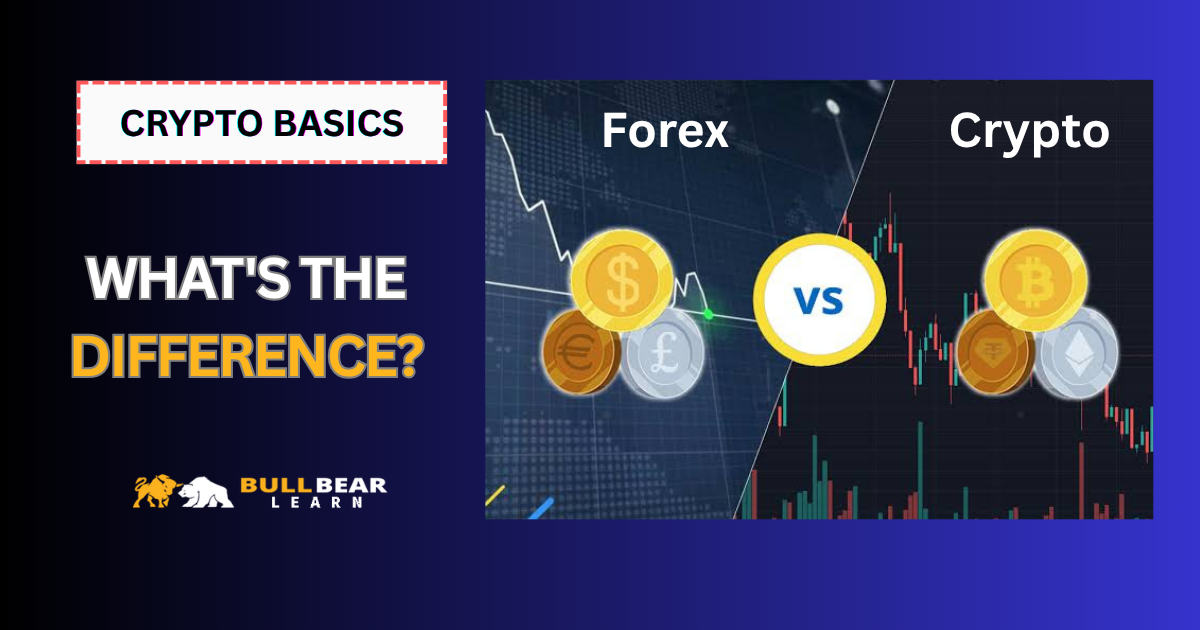
If you’re interested in financial markets, you’ve probably come across both Forex and cryptocurrency trading.
At first glance, the two markets appear very similar. Both involve price charts, technical analysis, market trends, leverage, and opportunities to profit from price movements.
However, beneath the surface, Forex and cryptocurrency are fundamentally different markets.
Understanding those differences is important because the market you choose will influence your trading style, risk exposure, learning curve, and long-term opportunities.
In this guide, we’ll compare cryptocurrency and Forex trading in detail, helping beginners understand which market may be the better fit for their goals.
What Is Forex Trading?
Forex (Foreign Exchange) trading involves buying one currency while simultaneously selling another.
Currencies are traded in pairs such as:
- EUR/USD
- GBP/USD
- USD/JPY
- AUD/USD
The Forex market is the largest financial market in the world, with trillions of dollars in daily trading volume.
Forex traders attempt to profit from fluctuations in exchange rates between currencies.
For example:
If a trader believes the Euro will strengthen against the US Dollar, they may buy EUR/USD.
If the exchange rate rises, the trader may profit.
What Is Cryptocurrency Trading?
Cryptocurrency trading involves buying and selling digital assets such as:
- Bitcoin (BTC)
- Ethereum (ETH)
- Solana (SOL)
- XRP
- BNB
Rather than trading government-issued currencies, crypto traders speculate on the price movements of blockchain-based assets.
For example:
A trader may buy Bitcoin expecting its price to increase.
If Bitcoin rises in value, the trader can potentially sell at a profit.
Unlike Forex, cryptocurrency markets operate continuously without closing.
Crypto vs Forex: Quick Comparison
| Feature | Forex | Cryptocurrency |
|---|---|---|
| Primary Assets | National currencies | Digital assets |
| Daily Volume | Extremely high | High but smaller |
| Trading Hours | 24/5 | 24/7 |
| Volatility | Moderate | High |
| Regulation | Highly regulated | Varies by country |
| Market Maturity | Decades old | Relatively new |
| Number of Assets | Limited | Thousands |
| Weekend Trading | No | Yes |
| Leverage Availability | High | Moderate to high |
| Institutional Adoption | Extensive | Growing |
Both markets offer opportunities, but the experience can be very different.
Market Size and Liquidity
One of the biggest differences between Forex and cryptocurrency is market size.
The Forex market is the largest financial market in existence.
Major currency pairs benefit from:
- Deep liquidity
- Tight spreads
- Massive institutional participation
Large orders can often be executed with minimal market impact.
Cryptocurrency markets have grown significantly, but they remain much smaller than Forex.
Liquidity varies greatly between assets.
Bitcoin and Ethereum typically offer strong liquidity.
Smaller cryptocurrencies may experience:
- Wider spreads
- Lower liquidity
- Greater slippage
For active traders, liquidity is a critical consideration.
Trading Hours
Forex operates 24 hours a day during weekdays.
The market opens on Monday and closes on Friday.
Trading activity follows major financial centers including:
- London
- New York
- Tokyo
- Sydney
Cryptocurrency markets never close.
Trading occurs:
- 24 hours per day
- 7 days per week
- 365 days per year
This continuous operation is one reason many traders find crypto attractive.
However, it can also create challenges because major market moves may occur while traders are sleeping.
Volatility Comparison
Volatility measures how much prices move over time.
This is where cryptocurrency differs significantly from Forex.
Forex Volatility
Major currency pairs often move:
- 0.5% to 2% daily
Large moves are relatively uncommon.
Price action tends to be more stable.
Cryptocurrency Volatility
Major cryptocurrencies frequently move:
- 5%
- 10%
- 15%
or more within a single day.
Smaller cryptocurrencies can experience even larger fluctuations.
Example
A 10% move in EUR/USD would be extraordinary.
A 10% move in Bitcoin is not unusual.
This increased volatility creates:
Advantages:
- More profit opportunities
- Faster growth potential
Disadvantages:
- Larger losses
- Greater emotional pressure
- Higher risk
Which Market Is Easier for Beginners?
This depends largely on personality and risk tolerance.
Forex May Be Easier Because
- Lower volatility
- Fewer tradable instruments
- More mature market structure
- Extensive educational resources
Crypto May Be Easier Because
- Lower capital requirements
- Simpler account setup
- Easier access globally
- Familiarity among younger investors
Many beginners find cryptocurrency easier to access but harder to manage emotionally due to volatility.
Fundamental Drivers
The forces driving each market are different.
Forex Drivers
Currency values are influenced by:
- Interest rates
- Inflation
- GDP growth
- Employment data
- Central bank policy
- Geopolitical events
Forex traders often monitor economic calendars closely.
Cryptocurrency Drivers
Crypto markets are influenced by:
- Adoption rates
- Network growth
- Regulatory developments
- ETF approvals
- Blockchain innovation
- Investor sentiment
Market psychology often plays a larger role in crypto.
Technical Analysis
One similarity between Forex and cryptocurrency is technical analysis.
Many tools work effectively in both markets.
Examples include:
- Support and resistance
- Trend lines
- Moving averages
- RSI
- MACD
- Price action patterns
A trader who understands chart analysis in Forex can often adapt those skills to cryptocurrency trading.
However, crypto’s higher volatility means patterns sometimes fail more aggressively.
Leverage and Margin
Both markets offer leverage.
Leverage allows traders to control larger positions using less capital.
Forex Leverage
Some brokers offer leverage levels exceeding:
- 1:50
- 1:100
- 1:500
depending on regulation.
Crypto Leverage
Many exchanges offer leverage ranging from:
- 1:2
- 1:10
- 1:20
Some platforms offer much higher levels.
While leverage can increase profits, it also magnifies losses.
Beginners should approach leverage cautiously regardless of market.
Regulation and Security
Forex is generally more regulated than cryptocurrency.
Major Forex brokers often operate under regulatory authorities such as:
- FCA
- ASIC
- CySEC
Regulatory oversight provides additional protections for traders.
Cryptocurrency regulation varies significantly between jurisdictions.
Investors should carefully evaluate:
- Exchange reputation
- Security measures
- Regulatory compliance
Choosing reputable platforms is essential.
Investment Opportunities
Forex and crypto also differ in how investors view them.
Forex
Most participants are traders.
Long-term investing opportunities are generally limited.
Currencies rarely appreciate dramatically over long periods.
Cryptocurrency
Many participants are investors.
Assets such as Bitcoin are frequently held for years.
Long-term growth is often part of the investment thesis.
This makes cryptocurrency attractive to people who want both trading and investing opportunities.
Advantages of Forex Trading
High Liquidity
Major currency pairs offer excellent liquidity.
Lower Volatility
Risk may be easier to manage.
Strong Regulation
Many jurisdictions provide trader protections.
Mature Market
Decades of historical data and educational resources exist.
Advantages of Cryptocurrency Trading
24/7 Market Access
Trade anytime without waiting for market openings.
Higher Growth Potential
Digital assets can experience significant appreciation.
Global Accessibility
Opening an account is often straightforward.
Innovation
Blockchain technology continues creating new opportunities.
Risks of Forex Trading
Forex traders face risks including:
- Leverage misuse
- Economic surprises
- Central bank interventions
- Market volatility
Although generally less volatile than crypto, losses can still occur rapidly.
Risks of Cryptocurrency Trading
Crypto traders face additional risks such as:
- Extreme volatility
- Exchange failures
- Regulatory changes
- Security threats
- Market manipulation
Risk management is especially important in crypto markets.
Which Market Should You Choose?
There is no universal answer.
Forex may be a better fit if you:
- Prefer lower volatility
- Enjoy macroeconomic analysis
- Want a highly regulated environment
- Prefer structured trading sessions
Cryptocurrency may be a better fit if you:
- Accept higher risk
- Seek larger growth potential
- Want access to innovative technologies
- Prefer 24/7 market access
Some traders eventually participate in both markets.
The skills learned in one often transfer effectively to the other.
Final Thoughts
Forex and cryptocurrency are two of the most popular markets available to modern traders.
Forex offers liquidity, regulation, and relatively stable price behavior.
Cryptocurrency offers innovation, accessibility, and potentially higher returns, but also significantly greater volatility.
For beginners, the best choice often depends on personal goals, risk tolerance, and trading style.
Regardless of which market you choose, education, discipline, and risk management remain the foundations of long-term success.
Related Articles
📘 What Is Cryptocurrency? A Beginner’s Guide to Digital Assets
📗 How Cryptocurrency Works Explained Simply for Beginners
🔗 Blockchain Explained for Beginners
Frequently Asked Questions
Is crypto better than Forex?
Neither market is inherently better. Crypto offers higher growth potential, while Forex generally provides lower volatility and stronger regulation.
Which market is more volatile?
Cryptocurrency markets are significantly more volatile than Forex markets.
Can I trade both Forex and crypto?
Yes. Many traders participate in both markets and apply similar technical analysis principles.
Is Forex safer than crypto?
Forex is generally considered more regulated and less volatile, but all trading involves risk.
Which market is better for beginners?
Many beginners find Forex easier to manage due to lower volatility, while others prefer crypto because of easier access and long-term investment opportunities.