


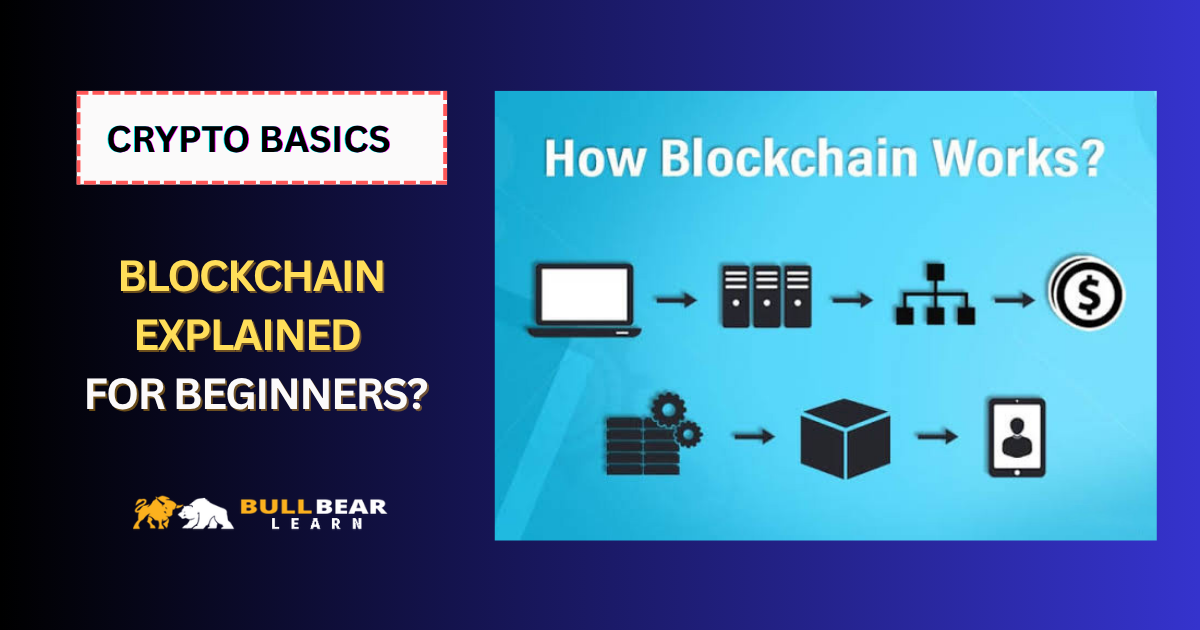
Blockchain technology is the foundation of modern cryptocurrencies. Every time someone sends Bitcoin, trades Ethereum, or interacts with a decentralized application, blockchain technology works behind the scenes to verify and record those activities.
Despite its growing popularity, blockchain remains one of the most misunderstood concepts in finance and technology. Many people associate blockchain exclusively with cryptocurrency, but the technology itself has applications far beyond digital assets.
Understanding blockchain is essential for anyone interested in cryptocurrency investing, trading, or decentralized finance (DeFi).
In this guide, we’ll explain blockchain in simple terms, how it works, why it is secure, and why it has become one of the most important technological innovations of the digital age.
What Is Blockchain?
A blockchain is a distributed digital ledger that records transactions across a network of computers.
Instead of storing information in a single database controlled by one organization, blockchain distributes copies of the same ledger to thousands of participants worldwide.
Whenever new information is added, every participant updates their copy of the ledger.
This creates a transparent and synchronized record that everyone can verify.
In simple terms:
A blockchain is a shared digital record book that nobody can secretly change and everyone can verify.
This unique structure allows people to transfer value, record ownership, and verify information without relying on a central authority.
Why Was Blockchain Created?
Before blockchain technology existed, digital transactions required trusted intermediaries.
For example:
- Banks verify money transfers.
- Governments maintain property records.
- Payment processors approve online purchases.
- Brokers facilitate financial transactions.
The challenge is that centralized systems create a single point of control.
Users must trust that the institution:
- Maintains accurate records.
- Protects sensitive information.
- Processes transactions fairly.
Blockchain was designed to reduce dependence on centralized intermediaries by allowing participants to collectively verify records.
This innovation became the foundation of Bitcoin in 2009 and later expanded into thousands of blockchain-based projects.
Understanding Blockchain Through a Simple Example
Imagine a group of ten friends sharing a notebook.
Every financial transaction between them must be recorded inside that notebook.
Instead of one person holding the notebook:
- Everyone owns an identical copy.
- Every new transaction is recorded in all copies.
- Changes must be approved by the group.
If one person attempts to alter an old transaction, their notebook no longer matches everyone else’s copy.
The fraudulent change is immediately rejected.
Blockchain works in a very similar way.
Thousands of computers maintain identical records and continuously compare information to ensure accuracy.
Why Is It Called a Blockchain?
The name comes from the way information is stored.
Transactions are grouped into blocks.
Each block contains:
- Transaction data
- A timestamp
- A unique identifier
- A reference to the previous block
These blocks are connected together sequentially.
Example:
Block 1 → Block 2 → Block 3 → Block 4
Because each block references the previous one, they form a chain.
This chain structure makes historical records extremely difficult to modify.
What Information Is Stored in a Block?
The exact contents vary by blockchain, but a block typically contains:
| Component | Purpose |
|---|---|
| Transaction Data | Records transfers or activities |
| Timestamp | Shows when the block was created |
| Previous Block Hash | Links to the previous block |
| Block Hash | Unique identifier for the block |
Think of a block as a page in a digital accounting book.
Once that page is finalized, it becomes permanently attached to all previous pages.
What Is a Hash?
A hash is one of the most important concepts in blockchain technology.
A hash is a unique digital fingerprint generated from data.
Even the smallest change produces a completely different hash.
Example:
Original Data:
Hello World
Hash:
A1B2C3
Modified Data:
Hello World!
Hash:
X9Y8Z7
The output changes dramatically despite only a tiny modification.
Blockchain uses hashes to detect tampering.
If someone alters a previous block, the hash changes immediately.
As a result, the entire chain becomes invalid.
How Blockchain Transactions Work
Let’s walk through a simplified Bitcoin transaction.
Imagine Alice wants to send 1 Bitcoin to Bob.
Step 1: Transaction Request
Alice enters Bob’s wallet address and clicks Send.
Step 2: Broadcast
The transaction is broadcast to the Bitcoin network.
Thousands of computers receive the request.
Step 3: Verification
Network participants verify:
- Alice owns the Bitcoin.
- Alice has sufficient balance.
- The Bitcoin has not already been spent.
Step 4: Block Creation
Verified transactions are grouped into a block.
Step 5: Consensus
The network agrees that the block is valid.
Step 6: Blockchain Update
The block is added permanently to the blockchain.
Bob receives the Bitcoin.
The transaction becomes part of the public ledger forever.
What Makes Blockchain Secure?
Blockchain security comes from several mechanisms working together.
Cryptography
Advanced mathematical algorithms protect transaction data and ownership records.
Decentralization
Copies of the blockchain exist across thousands of computers.
An attacker cannot simply alter one database.
Consensus Mechanisms
Network participants must agree on valid transactions.
Immutable Records
Once data is added to the blockchain, changing it becomes extremely difficult.
These characteristics make blockchain systems highly resistant to fraud and manipulation.
What Does Decentralization Mean?
Decentralization is one of blockchain’s most important features.
Traditional systems are centralized.
For example:
| System | Controlled By |
|---|---|
| Bank Account | Bank |
| PayPal Account | PayPal |
| Stock Exchange | Central Authority |
| Blockchain Network | Distributed Participants |
In a decentralized blockchain network:
- No single company controls the ledger.
- No government controls transaction approval.
- No individual can alter records unilaterally.
Instead, decisions are distributed among network participants.
This reduces reliance on a single point of failure.
What Are Consensus Mechanisms?
Consensus mechanisms help blockchain participants agree on what information is valid.
Without consensus, participants might maintain conflicting versions of the ledger.
The two most common mechanisms are:
Proof of Work (PoW)
Used by Bitcoin.
Miners solve complex mathematical puzzles.
The winner adds the next block and receives rewards.
Advantages:
- Highly secure
- Proven track record
Disadvantages:
- Energy intensive
- Slower transactions
Proof of Stake (PoS)
Used by Ethereum and many newer blockchains.
Validators lock up cryptocurrency as collateral.
The network selects validators to create new blocks.
Advantages:
- Lower energy consumption
- Faster processing
- Better scalability
Disadvantages:
- More complex governance structures
Public vs Private Blockchains
Not all blockchains operate the same way.
Public Blockchain
Anyone can join and participate.
Examples:
- Bitcoin
- Ethereum
- Solana
Characteristics:
- Open access
- High transparency
- Decentralized governance
Private Blockchain
Access is restricted.
Examples include corporate blockchain systems.
Characteristics:
- Controlled membership
- Faster performance
- Less decentralization
Most cryptocurrencies use public blockchains.
Blockchain vs Traditional Databases
Many people ask why blockchain is necessary if databases already exist.
The answer lies in trust.
| Feature | Traditional Database | Blockchain |
|---|---|---|
| Control | Centralized | Decentralized |
| Transparency | Limited | Public |
| Data Modification | Easy | Extremely Difficult |
| Single Point of Failure | Yes | No |
| Trust Requirement | High | Reduced |
Traditional databases remain more efficient for many business applications.
Blockchain becomes valuable when multiple parties need shared records without relying on a trusted intermediary.
Real-World Uses of Blockchain
Although cryptocurrency remains the most popular use case, blockchain technology supports many other applications.
Cryptocurrency
Bitcoin and Ethereum are the most well-known examples.
Smart Contracts
Programs that automatically execute when predefined conditions are met.
Decentralized Finance (DeFi)
Financial services operating without traditional banks.
Supply Chain Tracking
Monitoring products from manufacturers to consumers.
Digital Identity
Secure identity verification systems.
Asset Tokenization
Representing real-world assets on blockchain networks.
These applications continue expanding as blockchain adoption grows.
Common Misconceptions About Blockchain
Blockchain and Bitcoin Are the Same Thing
Bitcoin uses blockchain technology.
However, blockchain itself is the underlying technology.
Many blockchains exist beyond Bitcoin.
Blockchain Is Completely Anonymous
Most public blockchains are transparent.
Transactions can often be viewed publicly.
Blockchain Cannot Be Hacked
Individual wallets, exchanges, and applications can be compromised.
Blockchain networks themselves are generally very secure but not invulnerable.
Every Business Needs Blockchain
Many business problems can be solved more efficiently using traditional databases.
Blockchain is valuable only when decentralization and shared trust are important.
Advantages of Blockchain Technology
Key benefits include:
- Increased transparency
- Enhanced security
- Reduced reliance on intermediaries
- Global accessibility
- Improved record integrity
- Greater financial inclusion
These advantages have driven significant investment and innovation across the industry.
Limitations of Blockchain Technology
Despite its potential, blockchain also faces challenges.
Scalability
Some networks process transactions more slowly than traditional payment systems.
Energy Consumption
Proof of Work systems can require significant electricity.
Regulatory Uncertainty
Governments continue developing cryptocurrency regulations.
Complexity
Blockchain remains difficult for many beginners to understand.
Adoption Barriers
Mainstream adoption is still developing in many sectors.
Final Thoughts
Blockchain is the technology that makes cryptocurrency possible.
By combining cryptography, decentralization, and consensus mechanisms, blockchain creates a secure and transparent way to record information without relying on a central authority.
While blockchain is most commonly associated with Bitcoin and other cryptocurrencies, its potential applications extend far beyond digital assets.
For anyone entering the world of crypto, understanding blockchain provides the foundation needed to explore Bitcoin, Ethereum, wallets, trading, decentralized finance, and future innovations built on distributed networks.
Related Articles
Frequently Asked Questions
What is blockchain in simple terms?
Blockchain is a shared digital ledger that records transactions across multiple computers and cannot easily be altered.
Why is blockchain important?
Blockchain allows information and value to be transferred securely without requiring a central authority.
Is blockchain only used for cryptocurrency?
No. Blockchain can also be used for smart contracts, supply chains, digital identity systems, and many other applications.
Can blockchain be hacked?
Blockchain networks are highly secure, but wallets, exchanges, and applications built on top of blockchains can still be vulnerable.
What is the difference between Bitcoin and blockchain?
Bitcoin is a cryptocurrency. Blockchain is the technology that powers Bitcoin and many other digital assets.