

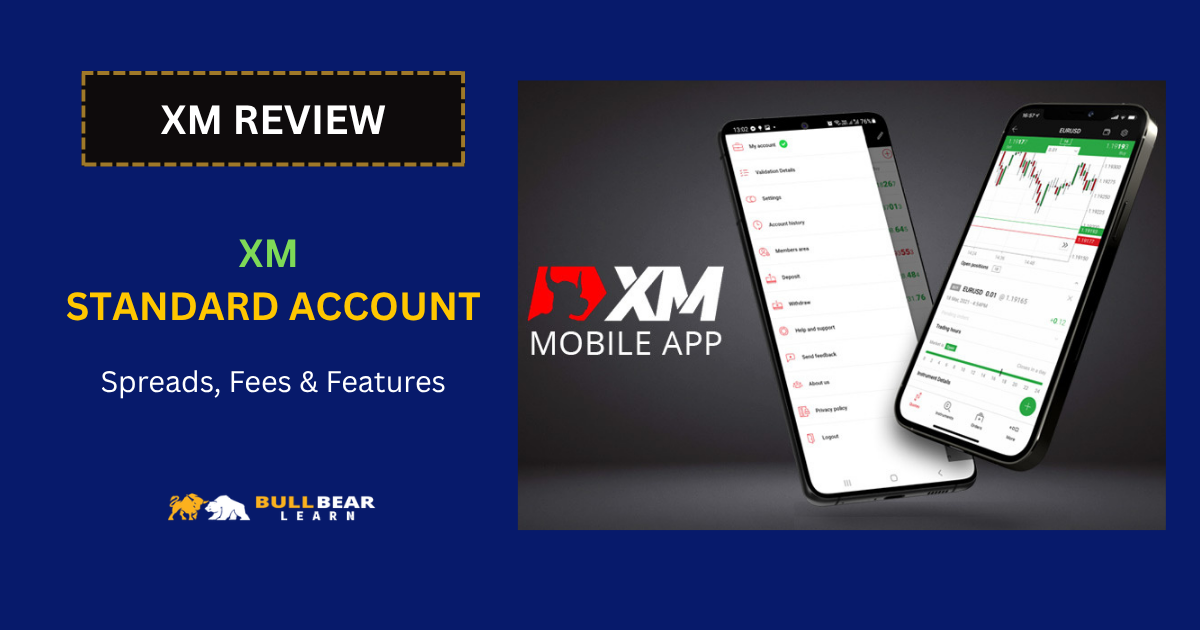
The XM Standard Account is designed for traders who want a straightforward trading experience without dealing with a complex commission-based pricing structure.
For many traders, especially beginners, simplicity matters.
A trading account can have attractive spreads or advanced pricing conditions, but if you do not understand how commissions, spreads, leverage, and position sizing affect your trades, choosing the most complicated account is not always the best decision.
The XM Standard Account is generally positioned as a more accessible account option for traders who prefer spread-based pricing and a familiar trading environment.
In this guide, we’ll examine how the XM Standard Account works, who it may be suitable for, and how it compares with XM’s Ultra Low and Zero account structures.
If you’re evaluating XM as a broker before choosing an account, start with our complete XM Review.
XM Standard Account at a Glance
| Feature | XM Standard Account |
|---|---|
| Account Type | Standard |
| Main Pricing Structure | Spread-based |
| Separate Commission | Depends on the applicable trading conditions |
| Best For | General and beginner traders |
| Trading Style | Manual and general trading |
| Scalping | Possible |
| Beginners | Generally suitable |
| Platforms | Subject to regional availability |
Important: Account availability, spreads, leverage, minimum deposits, instruments, and other trading conditions can vary depending on the XM entity and the trader’s jurisdiction. Always check the current conditions available to your account before depositing funds.
For a broader comparison of all available options, see our XM Account Types guide.
What Is the XM Standard Account?
The XM Standard Account is designed as a general-purpose trading account.
Its main advantage is simplicity.
Instead of choosing an account primarily based on extremely tight spreads or a specialized commission structure, traders can use a more traditional spread-based pricing model.
This can make the account easier to understand.
When you open a trade, the spread represents one of the main transaction costs you need to consider.
For a beginner, this can be easier than calculating separate commissions for every trade.
The Standard Account may therefore be a practical option for traders who want to focus on learning:
- How the forex market works
- How to place trades
- Position sizing
- Stop Loss placement
- Risk management
- Technical analysis
before trying to optimize every aspect of transaction costs.
XM Standard Account Spreads
Spreads are an important part of the cost of trading with a Standard Account.
However, traders should remember that spreads are not fixed in all market conditions.
They can change depending on:
- Market liquidity
- Trading session
- Economic news
- Market volatility
- The instrument being traded
A major forex pair may have very different trading conditions from gold, indices, or other instruments.
For this reason, you should evaluate the actual spreads on the markets you plan to trade.
A trader who mainly trades EUR/USD may have different priorities from someone who focuses on XAU/USD or volatile currency pairs.
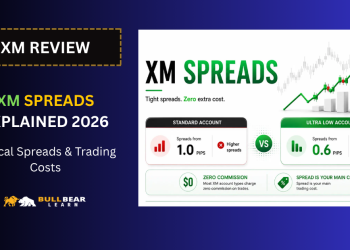
For a more detailed explanation of spread pricing, see our XM Spreads Explained guide.
Does the XM Standard Account Charge Commission?
The exact trading costs applicable to an XM Standard Account should always be checked under the current terms available to your account.
Rather than looking at one cost in isolation, traders should think about the total cost of trading.
A useful framework is:
Total Trading Cost = Spread Cost + Commission + Swap + Other Applicable Charges
For many traders, the Standard Account is attractive because of its relatively straightforward pricing structure.
However, whether it is cheaper than another account depends on how frequently you trade and which instruments you trade.
A trader who opens a few positions per month may not benefit significantly from a more specialized low-spread account.
An active trader executing dozens of trades every week may reach a different conclusion.
For a complete breakdown of trading costs, see our XM Fees Explained guide.
XM Standard Account Minimum Deposit
The minimum deposit requirement can vary depending on the XM entity and the region where the account is opened.
This is important because conditions published for one jurisdiction may not apply to every trader.
Before funding your account, check the current requirements shown during the registration process or inside the XM Member Area.
You should also avoid choosing an initial deposit amount based only on the broker’s minimum requirement.
A minimum deposit tells you how much is required to open or fund an account. It does not necessarily tell you how much capital is appropriate for your trading strategy.
For a detailed guide, see XM Minimum Deposit.
XM Standard Account Leverage
Leverage can significantly affect the amount of margin required to open a position.
However, leverage should not be confused with risk.
Higher leverage can allow you to control a larger position with a smaller amount of margin, but losses are still based on the size of your position.
For example, excessive leverage can encourage traders to open positions that are too large relative to their account balance.
This is particularly dangerous for beginners.
When using the XM Standard Account, focus on:
- Position size
- Stop Loss distance
- Percentage of capital at risk
- Margin requirements
rather than simply trying to use the maximum leverage available.
The best risk-management approach is generally based on controlling potential losses, not maximizing buying power.
XM Standard Account Trading Platforms
XM account availability across trading platforms can vary depending on the current conditions applicable to your region.
XM has traditionally supported MetaTrader platforms, including MT4 and MT5 in applicable markets.
Both platforms are widely used by forex traders.
MT4
MT4 remains popular because of its familiar interface and extensive support for forex trading and Expert Advisors.
MT5
MT5 provides additional functionality and supports a broader multi-asset trading environment.
If you’re not sure which platform is more suitable for you, read our detailed XM MT4 vs MT5 comparison.
XM Standard Account vs Ultra Low
This is one of the most useful comparisons for traders choosing between XM account types.
XM Standard Account
The Standard Account focuses on simplicity.
It may be more suitable for:
- Beginners
- Casual traders
- Traders who prefer straightforward pricing
- Traders who do not trade at extremely high frequency
XM Ultra Low Account
The Ultra Low Account focuses more heavily on competitive spread conditions.
It may be more attractive for:
- Active traders
- Day traders
- Frequent traders
- Scalpers
The important question is not:
Which account has the lowest advertised spread?
The better question is:
Which account produces the most suitable total trading cost for my strategy?
For a trader placing only a few trades each month, the difference may be relatively small.
For a trader executing many positions every day, small differences can become much more important.
For a deeper analysis, see our XM Ultra Low Account Review.
XM Standard Account vs Zero Account
The Standard and Zero accounts generally appeal to different types of traders.
The Standard Account is built around a simpler pricing approach.
The Zero Account is more relevant to traders who specifically focus on very tight spreads and are comfortable evaluating commission-based costs.
This means the Zero Account may appeal more to:
- Scalpers
- High-frequency traders
- Experienced traders
- Traders with large trading volumes
The Standard Account may be a better fit if you want to keep the trading environment simple.
Again, the correct comparison is based on total trading costs rather than spreads alone.
Is the XM Standard Account Good for Beginners?
For many beginners, the XM Standard Account can be a sensible starting point.
The biggest advantage is simplicity.
A new trader already has many things to learn:
- How markets move
- How to read charts
- How to calculate position size
- How to use Stop Loss orders
- How leverage works
- How emotions affect trading
Adding a complicated pricing comparison may not be necessary at the beginning.
However, beginners should remember that choosing a Standard Account does not make trading safer.
The account type affects trading conditions.
Risk management still depends on the trader.
A small account can still lose money quickly if positions are too large.
Is the XM Standard Account Good for Scalping?
Scalping is possible depending on the trading conditions applicable to your account.
However, scalpers are generally more sensitive to spreads and transaction costs than longer-term traders.
If your strategy targets small price movements, every additional trading cost becomes more important.
For this reason, active scalpers may also want to compare the Standard Account with Ultra Low and Zero structures.
The Standard Account may still be suitable for some trading approaches, but it may not always provide the most cost-efficient structure for a high-frequency strategy.
Scalpers should evaluate:
- Actual spreads
- Commission
- Execution
- Slippage
- Market liquidity
- Trading frequency
before deciding which account is most suitable.
Is the XM Standard Account Good for Gold Trading?
The Standard Account can be used for traders interested in gold if XAU/USD and the relevant conditions are available to their account.
However, gold trading should be evaluated separately from forex trading.
Gold can experience significant volatility around:
- US inflation data
- Federal Reserve announcements
- Employment reports
- Changes in interest-rate expectations
- Major geopolitical events
Before trading gold, check the current:
- Spread
- Contract specifications
- Margin requirements
- Swap conditions
- Trading hours
Do not assume that the account that works best for major forex pairs will automatically be the best choice for gold trading.
XM Standard Account: Pros and Cons
Pros
- Straightforward account structure
- Generally easier for beginners to understand
- Suitable for general trading
- Can work well for traders who trade less frequently
- Compatible with XM’s supported platforms, subject to availability
Cons
- May not be the most cost-efficient option for high-frequency trading
- Spreads can widen during volatile market conditions
- Specialized traders may prefer tighter-spread account structures
- Trading conditions can vary depending on jurisdiction
Who Should Choose the XM Standard Account?
The XM Standard Account may be worth considering if you:
- Are new to forex trading
- Prefer simple pricing
- Trade manually
- Do not trade at extremely high frequency
- Want a general-purpose trading account
- Are still learning how trading costs affect performance
It may be less suitable if you:
- Execute a large number of trades
- Use a high-frequency scalping strategy
- Focus heavily on minimizing every transaction cost
- Prefer a specialized commission-based pricing model
How to Choose Between XM Standard and Ultra Low
A simple decision framework can help.
Choose Standard if:
- Simplicity is your priority.
- You’re relatively new to trading.
- You trade occasionally.
- You prefer a traditional spread-based structure.
Consider Ultra Low if:
- You trade frequently.
- Spread costs significantly affect your strategy.
- You are an active trader.
- You are comfortable comparing trading costs.
The most important factor is not the account’s marketing label.
It is whether the account structure fits the way you actually trade.
Final Verdict
The XM Standard Account is primarily designed for traders who value simplicity and a straightforward trading environment.
It can be particularly suitable for beginners and general traders who do not need a specialized account structure.
For active traders and scalpers, however, it is worth comparing the Standard Account with XM’s Ultra Low and Zero options.
The best account is not necessarily the one with the lowest advertised spread.
It is the account that provides the most suitable combination of:
Trading Costs + Trading Style + Platform + Risk Management.
Before opening an account, always check the current conditions available to your region and compare the account structures based on your actual trading requirements.
Frequently Asked Questions
What is the XM Standard Account?
The XM Standard Account is a general-purpose trading account designed around a straightforward trading structure. Exact conditions can vary depending on the XM entity and jurisdiction.
Is the XM Standard Account good for beginners?
It can be suitable for beginners because its pricing structure is generally easier to understand than more specialized commission-based accounts.
What is the minimum deposit for the XM Standard Account?
The minimum deposit can vary depending on the XM entity and jurisdiction. Check the current requirements during registration or in the XM Member Area.
Does the XM Standard Account charge commission?
Applicable trading costs depend on the specific conditions available to your account. Traders should review current terms and calculate total trading costs rather than evaluating the spread alone.
Is XM Standard better than Ultra Low?
Not necessarily. Standard may be more suitable for traders who prioritize simplicity, while Ultra Low may be more attractive to active traders focused on spread costs.
Can I use the XM Standard Account for scalping?
Scalping may be possible depending on the applicable trading conditions. However, frequent traders should compare spreads and total transaction costs with other available XM account types.
Is the XM Standard Account good for gold trading?
It may be suitable depending on the XAU/USD conditions available to your account. Gold traders should compare spreads, contract specifications, margin requirements, and swap conditions.
Ready to Choose an XM Account?
The XM Standard Account can be a practical option if you prefer a straightforward trading structure.
Before opening an account, compare the available conditions for Standard, Ultra Low, and other XM account options in your region.
Check XM’s current account conditions and choose the structure that best matches your trading style and risk-management approach.