


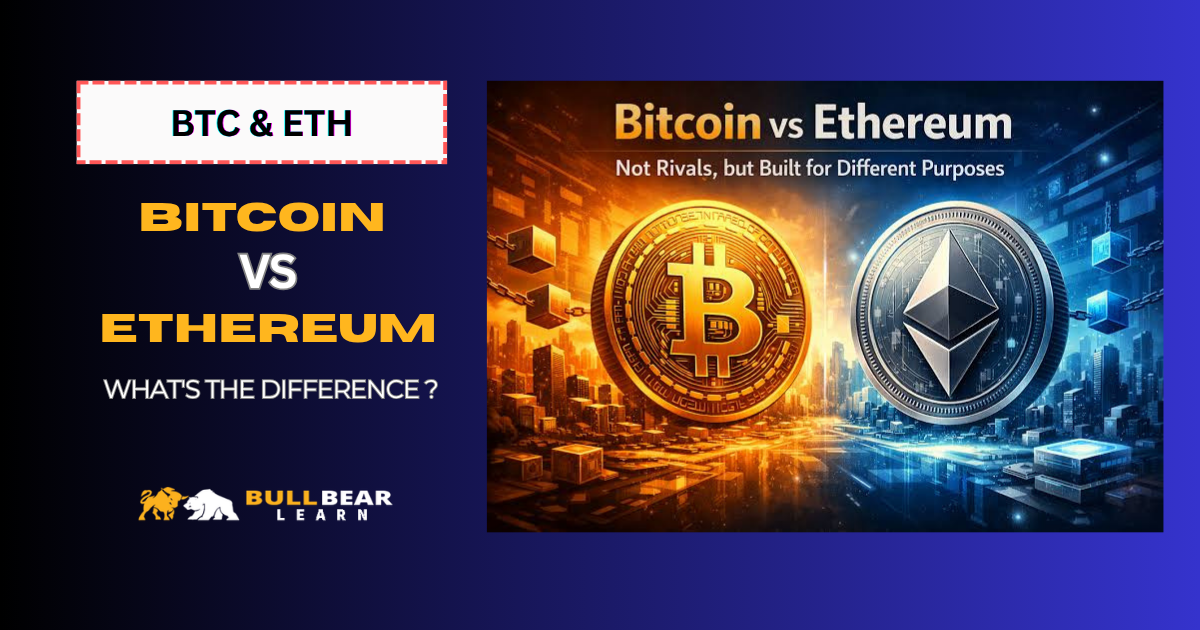
If you’ve spent any time researching cryptocurrency, you’ve likely noticed that two names dominate almost every discussion:
Bitcoin (BTC) and Ethereum (ETH).
These are the two largest cryptocurrencies in the world by market capitalization and are often considered the foundation of the entire crypto industry.
For beginners, however, the relationship between Bitcoin and Ethereum can be confusing.
Are they competitors?
Do they solve the same problem?
Should investors choose Bitcoin or Ethereum?
The answer is that while both assets operate on blockchain technology, they were created for different purposes and serve different roles within the cryptocurrency ecosystem.
In this guide, we’ll compare Bitcoin and Ethereum in detail so you can better understand their strengths, weaknesses, and potential use cases.
Understanding the Core Difference
The easiest way to understand Bitcoin and Ethereum is to focus on their primary purpose.
Bitcoin’s Goal
Bitcoin was created to become decentralized digital money.
Its mission is relatively simple:
- Store value
- Transfer value
- Operate independently of governments and banks
Bitcoin prioritizes:
- Security
- Stability
- Scarcity
- Decentralization
Because of these characteristics, Bitcoin is often called:
Digital Gold
Ethereum’s Goal
Ethereum was created to be a programmable blockchain platform.
Its mission is broader.
Ethereum enables developers to build:
- Smart contracts
- Decentralized applications
- Financial protocols
- NFT platforms
- Web3 services
Ethereum prioritizes:
- Utility
- Flexibility
- Innovation
- Developer adoption
In simple terms:
Bitcoin aims to be money.
Ethereum aims to be infrastructure.
A Brief History of Bitcoin and Ethereum
Bitcoin
Bitcoin was launched in 2009 by the pseudonymous creator:
Satoshi Nakamoto
It introduced the world’s first successful decentralized cryptocurrency.
Bitcoin solved a major challenge:
How can value be transferred online without relying on a trusted intermediary?
This breakthrough laid the foundation for the entire cryptocurrency industry.
Ethereum
Ethereum was proposed in 2013 by Vitalik Buterin and launched in 2015.
Rather than focusing solely on payments, Ethereum expanded blockchain functionality through smart contracts.
This innovation eventually led to:
- DeFi
- NFTs
- Web3
- Decentralized exchanges
- Blockchain gaming
Many of today’s crypto applications exist because Ethereum introduced programmable blockchain technology.
Bitcoin vs Ethereum: Quick Comparison
| Feature | Bitcoin | Ethereum |
|---|---|---|
| Launch Year | 2009 | 2015 |
| Creator | Satoshi Nakamoto | Vitalik Buterin |
| Native Coin | BTC | ETH |
| Primary Purpose | Digital money | Smart contract platform |
| Supply Cap | 21 Million | No fixed cap |
| Consensus | Proof of Work | Proof of Stake |
| Smart Contracts | Limited | Extensive |
| Main Narrative | Digital Gold | Blockchain Infrastructure |
Although these differences appear simple, they significantly affect how each network operates.
Technology Comparison
Bitcoin Technology
Bitcoin intentionally remains relatively simple.
The network focuses on:
- Security
- Reliability
- Decentralization
Major changes are introduced cautiously.
This conservative approach helps maintain stability.
Supporters argue that Bitcoin’s simplicity is one of its greatest strengths.
Ethereum Technology
Ethereum is far more flexible.
Developers can create complex applications directly on the blockchain.
Examples include:
- Lending platforms
- Trading protocols
- Stablecoins
- NFT marketplaces
Ethereum evolves more rapidly than Bitcoin and frequently undergoes upgrades designed to improve scalability and functionality.
Supply and Scarcity
Supply is one of the most important differences between BTC and ETH.
Bitcoin Supply
Bitcoin has a fixed maximum supply:
21 million BTC
No additional Bitcoin can ever be created.
This scarcity is central to Bitcoin’s investment thesis.
Many investors compare Bitcoin to gold because both assets are limited in supply.
Ethereum Supply
Ethereum does not have a strict maximum supply.
However, Ethereum’s monetary policy changed significantly after the network moved to Proof of Stake.
Depending on network activity, ETH issuance may decrease substantially and in some periods portions of transaction fees are removed from circulation.
As a result, Ethereum’s supply dynamics are more complex than Bitcoin’s.
Consensus Mechanisms
Consensus mechanisms help blockchain networks validate transactions.
Bitcoin: Proof of Work
Bitcoin uses:
Proof of Work (PoW)
Miners compete to solve mathematical puzzles.
Benefits include:
- Proven security
- Long operational history
- Strong decentralization
Challenges include:
- High energy consumption
- Slower scalability
Ethereum: Proof of Stake
Ethereum uses:
Proof of Stake (PoS)
Validators secure the network by staking ETH.
Benefits include:
- Lower energy consumption
- Faster efficiency
- Improved scalability potential
Challenges include:
- More complex governance
- Ongoing debates regarding decentralization
Bitcoin vs Ethereum as Investments
Many investors view BTC and ETH differently.
Why Investors Buy Bitcoin
Common reasons include:
- Store of value
- Long-term wealth preservation
- Scarcity
- Institutional adoption
Bitcoin is often considered the most conservative cryptocurrency investment.
Why Investors Buy Ethereum
Common reasons include:
- Smart contract adoption
- DeFi growth
- Web3 expansion
- Developer activity
Ethereum is often viewed as a growth-oriented blockchain investment.
Institutional Adoption
Institutional participation has become an important factor in cryptocurrency markets.
Bitcoin Adoption
Bitcoin currently enjoys the strongest institutional recognition.
Examples include:
- Corporate treasury holdings
- Investment funds
- Pension fund exposure
- Spot Bitcoin ETFs
Many institutions view Bitcoin as a digital commodity or store-of-value asset.
Ethereum Adoption
Ethereum has also attracted significant institutional interest.
Key drivers include:
- Smart contract utility
- Tokenization
- Stablecoins
- Decentralized finance
As blockchain adoption expands, Ethereum may benefit from increasing enterprise use cases.
Use Cases
Bitcoin Use Cases
Bitcoin is commonly used for:
- Long-term investment
- Wealth preservation
- International transfers
- Portfolio diversification
Bitcoin’s primary value proposition remains relatively focused.
Ethereum Use Cases
Ethereum supports a much wider ecosystem.
Applications include:
- Decentralized Finance (DeFi)
- NFTs
- Stablecoins
- Web3 applications
- Blockchain gaming
- Token issuance
Ethereum’s broader utility creates additional sources of demand.
Volatility Comparison
Both assets can experience substantial price swings.
However, Ethereum is generally more volatile than Bitcoin.
Bitcoin
Typically exhibits:
- Lower volatility
- Greater institutional ownership
- More mature market behavior
Ethereum
Typically exhibits:
- Higher volatility
- Greater growth potential
- Stronger reaction to ecosystem developments
Higher volatility can increase both potential gains and potential losses.
Risks of Bitcoin
Potential Bitcoin risks include:
Regulatory Risk
Government policies can influence adoption.
Competition
Alternative technologies may emerge.
Market Cycles
Bitcoin has historically experienced significant bear markets.
Slow Innovation
Some critics argue Bitcoin evolves too slowly.
Risks of Ethereum
Potential Ethereum risks include:
Smart Contract Risk
Applications built on Ethereum can contain vulnerabilities.
Competition
Ethereum competes with:
- Solana
- Avalanche
- Cardano
- BNB Chain
Network Congestion
Heavy usage may increase transaction fees.
Technical Complexity
Ethereum’s ecosystem is more difficult for beginners to understand.
Which Is Better for Beginners?
There is no universal answer.
The choice depends on goals and risk tolerance.
Bitcoin May Be Better If You:
- Want simplicity
- Prefer long-term investing
- Value scarcity
- Seek lower volatility
Ethereum May Be Better If You:
- Want exposure to blockchain innovation
- Believe in DeFi and Web3
- Accept higher risk
- Prefer growth opportunities
Many investors ultimately choose both.
Should You Own Bitcoin and Ethereum Together?
A common approach is holding both BTC and ETH.
This provides exposure to:
Bitcoin
The leading store-of-value cryptocurrency.
Ethereum
The leading smart contract ecosystem.
Because they serve different purposes, many portfolios include allocations to both assets.
Diversification may help reduce reliance on a single investment thesis.
Final Thoughts
Bitcoin and Ethereum are the two most important cryptocurrencies in the market today, but they are designed for different objectives.
Bitcoin focuses on scarcity, security, and serving as decentralized digital money.
Ethereum focuses on smart contracts, decentralized applications, and blockchain innovation.
Rather than viewing them as direct competitors, it is often more accurate to view them as complementary components of the broader cryptocurrency ecosystem.
For beginners, understanding both Bitcoin and Ethereum provides a strong foundation for exploring the rest of the crypto market.
🚀 Ready to Start Your Crypto Journey?
Many beginners choose to start by buying small amounts of Bitcoin or Ethereum through reputable exchanges.
👉 Binance — https://bullbearlearn.com/go/binance
⚡ OKX — https://bullbearlearn.com/go/okx
🔥 Bybit — https://bullbearlearn.com/go/bybit
Start small, focus on learning, and prioritize long-term risk management over short-term speculation.
Related Articles
📘 What Is Cryptocurrency? A Beginner’s Guide to Digital Assets
🔗 Blockchain Explained for Beginners
₿ What Is Bitcoin? A Beginner’s Guide to the World’s First Cryptocurrency
⟠ What Is Ethereum? A Beginner’s Guide to the Leading Smart Contract Platform
⚖️ Cryptocurrency vs Forex Trading: What’s the Difference?
Frequently Asked Questions
Is Ethereum better than Bitcoin?
Neither is inherently better. Bitcoin focuses on digital money and store-of-value characteristics, while Ethereum focuses on smart contracts and decentralized applications.
Should beginners buy Bitcoin or Ethereum?
Both are commonly considered entry-level cryptocurrencies. The best choice depends on individual goals and risk tolerance.
Is Ethereum riskier than Bitcoin?
Ethereum is generally considered more volatile and complex, which may result in higher risk but also higher potential growth.
Why is Bitcoin called digital gold?
Bitcoin has a fixed supply and is often used as a long-term store of value, similar to gold.
Can I invest in both Bitcoin and Ethereum?
Yes. Many investors hold both assets to gain exposure to different segments of the cryptocurrency market.