

Financial markets do not always move in strong trends. In many situations, the market enters a phase of low volatility, where price movements become smaller and the market trades within a narrow range. During these periods, traditional trend-following strategies often perform poorly because there is not enough momentum to sustain large price movements.
Understanding low volatility market trading strategies is essential for traders who want to remain profitable even when markets appear slow or stagnant. Instead of relying on large trends, these strategies focus on range-bound price behavior, mean reversion, and small fluctuations.
In this article, we will explore several effective methods traders use to navigate low volatility environments, including range trading, mean reversion strategies, Bollinger Band squeeze setups, scalping techniques, and grid trading systems.
Understanding Low Volatility Markets
What Is a Low Volatility Market?
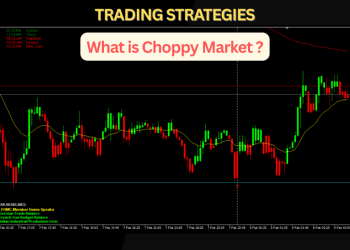
A low volatility market refers to a market environment where price fluctuations are relatively small compared to normal conditions. Instead of strong directional movements, the price tends to move sideways between support and resistance levels.
Some common characteristics of low volatility markets include:
-
Narrow price ranges
-
Decreased trading volume
-
Reduced market momentum
-
Frequent price reversals
Low volatility periods often occur during market consolidation phases, when traders are waiting for new information or major economic events.
Why Trading Strategies Must Change
Many beginner traders struggle in low volatility environments because they continue to apply trend-following strategies that work better in highly volatile markets.
However, when volatility is low:
-
Breakouts are less reliable
-
Trends rarely last long
-
Price frequently reverses direction
As a result, traders must use strategies designed specifically for sideways market conditions.
Range Trading Strategy
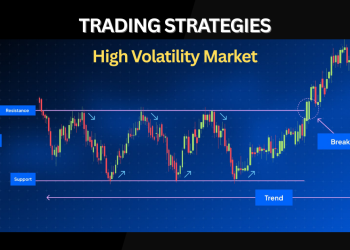
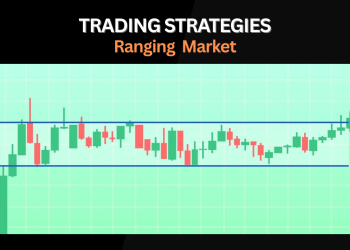
One of the most popular low volatility market trading strategies is range trading. This method is based on the idea that price tends to bounce between clearly defined support and resistance levels.
How Range Trading Works
Traders first identify a range where the market repeatedly reverses direction.
The typical approach is:
-
Buy near the support level
-
Sell near the resistance level
-
Place stop-loss orders slightly outside the range
For example, if a currency pair trades between 1.1000 and 1.1100, traders may buy near the lower boundary and sell near the upper boundary.
Indicators Used in Range Trading
Several technical indicators can help confirm range trading setups:
-
Relative Strength Index (RSI)
-
Stochastic Oscillator
-
Moving averages
-
Volume analysis
These tools help traders identify overbought and oversold conditions within the range.
Mean Reversion Strategy
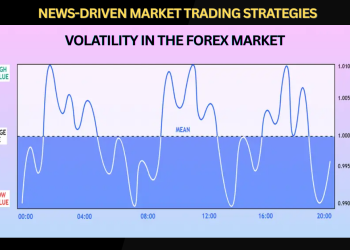
Another powerful approach for trading low volatility markets is the mean reversion strategy. This strategy is based on the principle that prices tend to return to their average level after moving too far away from it.
Why Mean Reversion Works
In quiet markets, price movements are often temporary. When the price moves too far in one direction, it tends to revert back toward its average value.
This behavior makes mean reversion strategies particularly effective during sideways market conditions.
Common Tools for Mean Reversion
Traders often use the following indicators:
-
Bollinger Bands
-
Moving averages
-
RSI
A typical setup might involve:
-
Buying when price touches the lower Bollinger Band
-
Selling when price reaches the upper Bollinger Band
The take-profit target is usually placed near the middle band, which represents the moving average.
Bollinger Band Squeeze Strategy
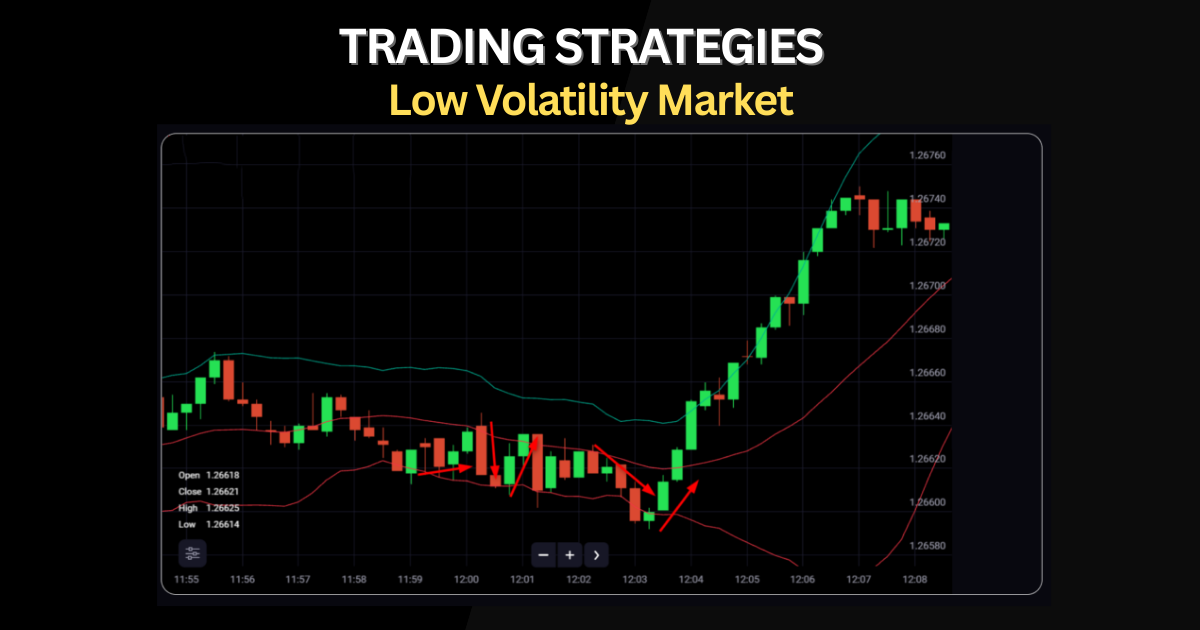
The Bollinger Band Squeeze is another popular method used in low volatility environments. This strategy focuses on identifying periods when volatility becomes extremely low before a potential breakout.
What Is a Bollinger Band Squeeze?
Bollinger Bands expand when volatility increases and contract when volatility decreases. When the bands become unusually narrow, the market is experiencing low volatility.
This condition is known as a Bollinger Band squeeze.
Historically, periods of extremely low volatility are often followed by large price movements.
How Traders Use This Strategy
Traders monitor the market for narrowing Bollinger Bands. Once the squeeze occurs, they prepare for a potential breakout.
Typical entry signals include:
-
Buying when price breaks above the upper band
-
Selling when price breaks below the lower band
This strategy attempts to capture the first strong movement after a consolidation phase.
Scalping in Low Volatility Markets
Scalping is another strategy well suited for low volatility conditions. Instead of waiting for large price movements, scalpers aim to capture many small profits from minor price fluctuations.
Characteristics of Scalping
Scalping strategies usually involve:
-
Short holding periods
-
Small profit targets
-
High trade frequency
Traders often operate on lower timeframes such as:
-
1-minute charts
-
5-minute charts
-
15-minute charts
Indicators Used by Scalpers
Some commonly used indicators include:
-
Exponential Moving Average (EMA)
-
VWAP (Volume Weighted Average Price)
-
RSI
Scalpers rely on precision timing and tight risk management to maintain consistent profitability.
Grid Trading Strategy
Grid trading is another method that performs well in range-bound markets. The strategy involves placing multiple buy and sell orders at predetermined intervals.
How Grid Trading Works
Traders create a grid of orders above and below the current market price.
For example:
Buy orders:
-
100
-
98
-
96
-
94
Sell orders:
-
102
-
104
-
106
-
108
As price moves up and down within the grid, trades are automatically executed, allowing traders to profit from small oscillations in the market.
Risks of Grid Trading
While grid trading can be highly effective in sideways markets, it carries risk if a strong trend suddenly develops. In such cases, the market may move continuously in one direction, causing multiple losing positions.
Proper risk management and grid spacing are essential for this strategy.
Risk Management in Low Volatility Markets
Even though price movements are smaller in low volatility markets, risk management remains crucial.
Some key principles include:
-
Use tight stop-loss orders
-
Avoid overtrading
-
Monitor potential breakout signals
-
Adjust position sizes appropriately
Low volatility environments can sometimes lead to sudden volatility expansions, especially after major economic announcements or unexpected news events.
Conclusion
Low volatility markets are a common part of financial trading, and understanding how to adapt to them is essential for long-term success. Instead of relying on trend-following techniques, traders should focus on strategies designed for range-bound price behavior and small fluctuations.
Some of the most effective low volatility market trading strategies include:
-
Range trading
-
Mean reversion trading
-
Bollinger Band squeeze strategy
-
Scalping techniques
-
Grid trading systems
By combining these strategies with proper risk management, traders can continue to find profitable opportunities even when the market appears quiet.
The key is recognizing market conditions and adjusting trading methods accordingly. Traders who master low volatility environments gain a significant advantage because they are able to generate consistent profits regardless of market activity.