

1. What Is a Pullback Trading Strategy?
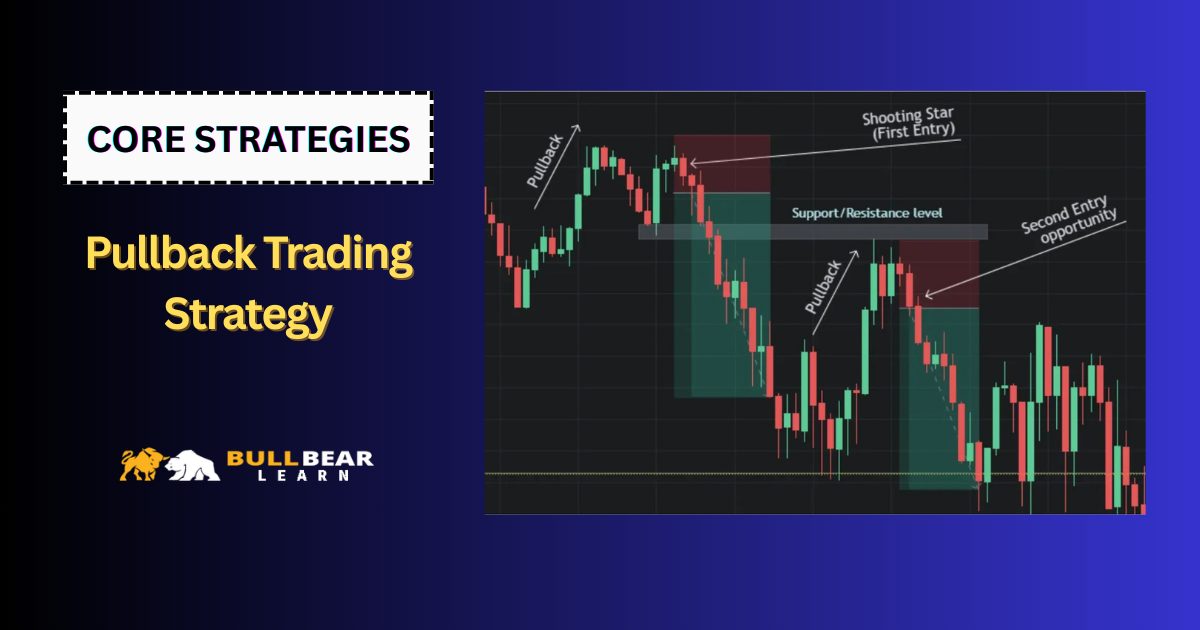
A pullback trading strategy focuses on entering trades after price temporarily retraces against the main trend, instead of chasing breakouts or entering at extreme levels.
In trending markets, price rarely moves in a straight line. It advances, pauses, retraces, and then continues. Pullback traders aim to enter during these temporary corrections, aligning with the dominant trend while reducing entry risk.
This makes pullback trading one of the most sustainable and professional trading strategies when executed correctly.
2. Why Pullback Trading Works
Pullback trading works because it aligns with how markets naturally move.
Key reasons:
-
Trends persist longer than most traders expect
-
Institutions often enter on retracements, not breakouts
-
Pullbacks offer better risk–reward than late entries
-
Emotional traders exit during pullbacks, creating opportunity
Instead of buying highs or selling lows, pullback traders wait for price to come back to value.
3. Who Should Use Pullback Trading?
Pullback trading is suitable for traders who:
-
Prefer structured and patient strategies
-
Value higher win rates over frequent trades
-
Trade trends rather than ranges
-
Want clearer stop-loss placement
It is not ideal for traders who:
-
Struggle with patience
-
Need constant action
-
Prefer ultra-short timeframes
Pullback trading rewards discipline more than speed.
4. Pullback Trading vs Breakout Trading
Understanding this distinction prevents strategy confusion.
| Aspect | Pullback Trading | Breakout Trading |
|---|---|---|
| Entry | After retracement | At expansion |
| Risk | Lower | Higher |
| Win Rate | Higher | Lower |
| Patience Required | High | Medium |
Pullback strategies prioritize confirmation and structure, while breakout strategies prioritize momentum.
5. Market Conditions Suitable for Pullback Trading
Pullback trading performs best in:
-
Clear trending markets
-
Higher-timeframe directional bias
-
Healthy momentum (not exhausted trends)
Avoid pullback trading when:
-
Market is ranging
-
Trend is weak or choppy
-
Volatility is extremely low
-
Major news is imminent
Pullbacks are meaningful only within trends.
6. Core Structure of a Professional Pullback Trading Strategy
A high-quality pullback trading strategy consists of five components:
1. Trend Identification
-
Clear bullish or bearish direction
-
Confirmed on higher timeframes (H1–H4)
-
Avoid counter-trend pullbacks
2. Pullback Zone
-
Area where price retraces temporarily
-
Should show slowing momentum
-
Not a full trend reversal
3. Entry Trigger
-
Confirmation that pullback is ending
-
Avoid blind limit orders
-
No chasing price
4. Risk Management
-
Defined stop-loss
-
Fixed percentage risk
-
Consistent position sizing
5. Exit Logic
-
Target aligned with trend continuation
-
Partial profits optional
-
Exit if structure fails
7. Example: Forex Pullback Trading Strategy (Framework)
This is a strategy framework, not a signal system.
Market:
-
EUR/USD, GBP/USD, XAU/USD
Timeframes:
-
Trend bias: H4
-
Setup: H1
-
Entry: M15
Conditions:
-
Clear directional trend
-
Higher highs and higher lows (uptrend) or vice versa
-
Pullback shows reduced momentum
Entry:
-
Enter after confirmation that trend resumes
-
Avoid entering during deep or aggressive retracements
Stop-Loss:
-
Below recent structure in uptrend
-
Above recent structure in downtrend
Take-Profit:
-
Minimum Risk–Reward: 1:2
-
Scale out if momentum weakens
8. Risk Management in Pullback Trading
Pullback strategies are powerful only with strict risk control.
Best Practices:
-
Risk per trade: 0.5%–1%
-
Limit trades per session
-
Do not widen stop-loss
-
Accept missed trades calmly
Pullback trading is a probability game, not certainty.
9. Common Pullback Trading Mistakes
Many traders fail by:
-
Entering pullbacks in ranging markets
-
Confusing reversals with pullbacks
-
Entering too early without confirmation
-
Over-optimizing indicators
-
Increasing risk after losses
Patience is the edge most traders lack.
10. Psychology of Pullback Trading
Pullback trading challenges traders emotionally because:
-
Price moves against your bias temporarily
-
Entries feel “late” compared to bottoms
-
You must trust the trend
Successful pullback traders:
-
Accept imperfect entries
-
Focus on structure, not emotions
-
Follow rules consistently
The ability to wait is a competitive advantage.
11. Is Pullback Trading Profitable?
Yes—when applied correctly.
Pullback trading offers:
-
Higher consistency
-
Cleaner entries
-
Better capital protection
-
Sustainable long-term performance
Many professional traders rely primarily on pullback setups rather than constant breakout trades.
12. Final Thoughts
A solid pullback trading strategy is built on patience, structure, and discipline—not indicators or prediction.
If you wait for price to return to value, manage risk properly, and respect trend direction, pullback trading becomes one of the most reliable approaches in trading.