

Most traders treat risk management as a mathematical exercise.
Professional traders treat it as an execution-sensitive system.
Position sizing, stop placement, and risk-per-trade rules only work under one condition:
they must reflect how trades are actually executed in live markets, not how they appear in backtests.
Slippage, spread expansion, liquidity variation, and market volatility continuously reshape real risk. When risk management ignores these variables, even a profitable strategy can slowly lose its edge.
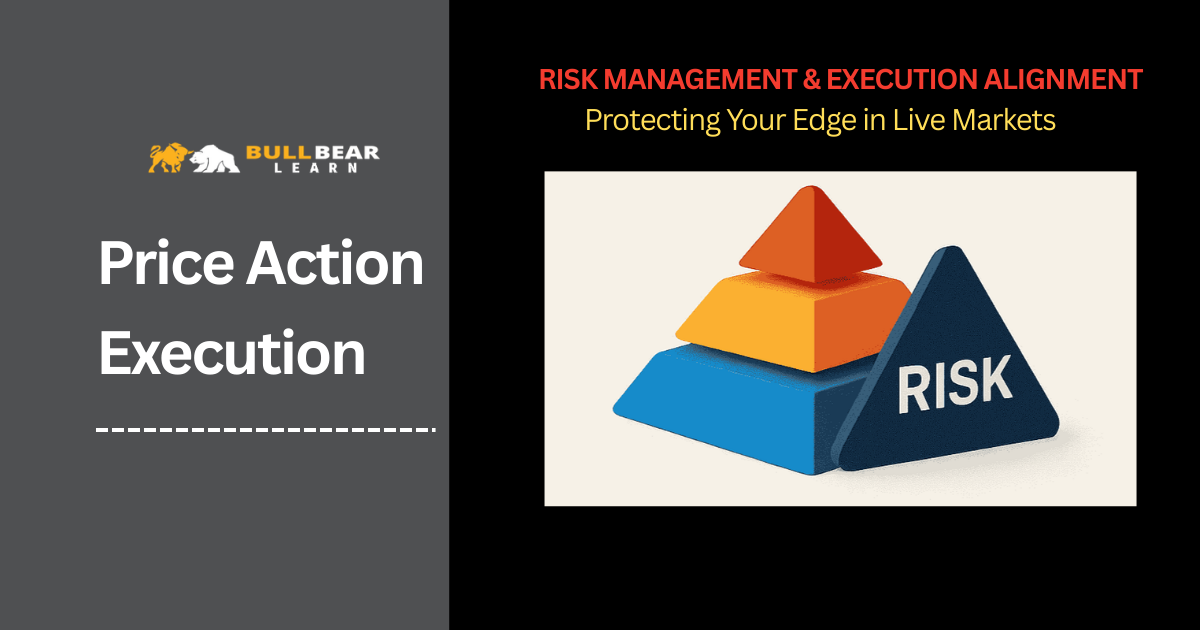
This article explains how execution-aware risk management works — and why aligning risk with execution is essential for long-term survival in price action trading.
1. Why Traditional Risk Models Break Down in Live Trading
Most retail risk models assume:
-
Fixed spreads
-
Instant order fills
-
No execution delay
-
Predictable stop-loss behavior
Live markets violate all of these assumptions.
During volatile or illiquid conditions:
-
Stops are filled beyond expected levels
-
Entries occur at worse prices
-
Risk per trade becomes inconsistent
When this happens repeatedly, the trader experiences risk drift — a gradual increase in actual risk that is not reflected in their rules.
Execution-aware traders design risk models that accept imperfection instead of denying it.
2. Risk Is Dynamic, Not Static
Retail traders define risk as a fixed percentage.
Professional traders define risk as a range of possible outcomes.
Execution variables that expand real risk include:
-
Entry slippage
-
Exit slippage
-
Spread spikes
-
Partial fills
A trade planned at 1R may realistically fluctuate between 1R and 1.3R depending on conditions. Risk models must incorporate this uncertainty rather than assume ideal fills.
This mindset shift is critical for protecting capital over long sample sizes.
3. Position Sizing Under Execution Constraints
Position size determines how much execution noise a trader can tolerate.
In execution-sensitive environments:
-
Smaller position sizes reduce emotional pressure
-
Slippage has less impact on account equity
-
Risk remains controllable even when fills deteriorate
Professional traders adjust size based on:
-
Market volatility
-
Session liquidity
-
Proximity to high-impact news
Reducing size is often a more effective risk response than widening stops.
4. Stop-Loss Placement in Real Market Conditions
Stops are not abstract technical levels — they are market orders waiting to be triggered.
Poor stop placement fails when:
-
Stops sit too close to structure
-
Spread expansion triggers premature exits
-
Slippage pushes exits beyond invalidation zones
Execution-aligned stop placement considers:
-
Structural price levels
-
Typical spread behavior
-
Volatility regime
The goal is not to avoid losses, but to ensure that losses occur only when the trade idea is invalidated, not because of execution noise.
5. Adjusting Risk Across Market Regimes
Market conditions are not uniform.
Execution-aware traders reduce risk during:
-
Major news releases
-
Session opens
-
Thin-liquidity periods
They increase exposure only when:
-
Liquidity is stable
-
Volatility is orderly
-
Execution behavior is predictable
Consistency does not come from trading every setup.
It comes from trading the right setups under the right conditions.
🔗 Execution conditions change across market regimes, requiring continuous risk adjustment.
6. Protecting Expectancy Through Execution Alignment
Trading expectancy depends on:
-
Win rate
-
Average reward
-
Average loss
Execution issues quietly distort all three.
Slippage reduces rewards.
Spread expansion increases losses.
Poor fills reduce win probability.
By aligning risk with execution realities, traders preserve expectancy and prevent strategy decay.
7. Execution Quality and Trading Environment Differences
Execution behavior varies across trading environments.
Differences in:
-
Liquidity access
-
Order routing
-
Spread control
can materially affect real risk outcomes.
Understanding how execution conditions differ across environments allows traders to apply realistic risk limits rather than theoretical ones.
(Internal direction – neutral, educational)
Reviewing execution-focused trading environment analysis can help traders understand how execution behavior impacts risk under live market conditions.
8. Risk Management as a Feedback System
Professional traders do not “set and forget” risk rules.
They continuously evaluate:
-
Slippage frequency
-
Average execution deviation
-
Risk behavior during volatility
Risk management evolves based on execution feedback, not assumptions.
This adaptive approach is what allows professional traders to survive across market cycles.
Conclusion
Risk management without execution awareness is incomplete.
Live markets introduce variability that cannot be eliminated, only managed. By aligning risk models with execution behavior, traders protect their edge, control drawdowns, and maintain long-term consistency.
Price action trading is not just about analysis accuracy — it is about risk control under real execution conditions.
Execution-aware risk management is part of a complete trading decision framework that connects analysis, execution, and risk into a single process.