
• About
  • Crypto Exchange
Bullbearlearn
Advertisement
  • Home
  • Learn Forex
    • Forex Basic
    • Trading Strategies
    • Price Action
  • Learn Crypto
  • Broker Reviews
  • Tools FREE
  • Blog
Start
No Result
View All Result
  • Home
  • Learn Forex
    • Forex Basic
    • Trading Strategies
    • Price Action
  • Learn Crypto
  • Broker Reviews
  • Tools FREE
  • Blog
No Result
View All Result
Bullbearlearn
No Result
View All Result
Home Price Action Execution

Execution #1: Types of Forex Orders: Market, Limit, and Stop Explained

Baby Bull by Baby Bull
January 12, 2026
in Execution, Price Action
57 1
0
189
SHARES
1.5k
VIEWS
Share on FacebookShare on Twitter

Once you understand when to execute a trade, the next critical question is how you enter the market.

In the previous article, Price Action Execution: A Professional Framework for Decision-Making, we focused on market context, trend strength, and timing. However, even the best setup can fail if the wrong order type is used.

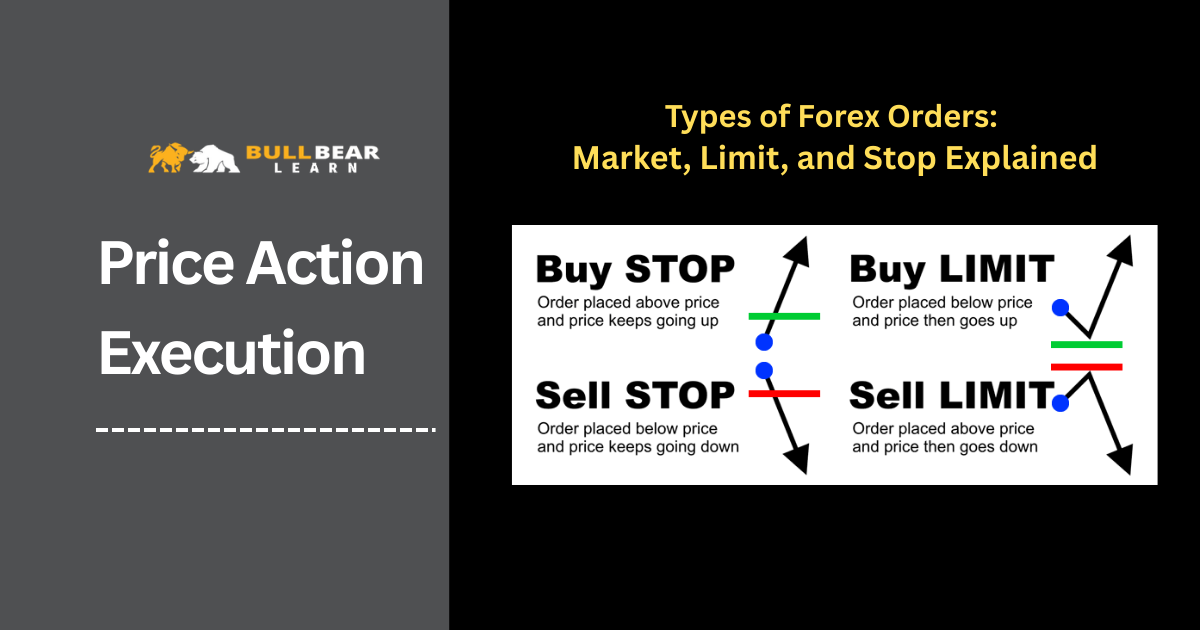
This article breaks down the three fundamental forex order types—Market, Limit, and Stop—and explains how professional traders match each one to specific price action scenarios.


Table of Contents

Toggle
  • What Is a Forex Order?
  • Market Orders
    • 1. What Is a Market Order?
    • 2. When Market Orders Are Used
    • 3. Pros and Cons
  • Limit Orders
    • 1. What Is a Limit Order?
    • 2. When Limit Orders Are Used
    • 3. Pros and Cons
  • Stop Orders
    • 1. What Is a Stop Order?
    • 2. When Stop Orders Are Used
    • 3. Pros and Cons
  • Matching Order Types to Price Action Context
  • Market Conditions and Order Selection
    • High-Volatility Markets
    • Low-Volatility Markets
  • Order Types and Risk Management
  • Retail vs Professional Order Usage
  • Common Questions About Forex Order Types
    • Is a limit order always better than a market order?
    • Are stop orders dangerous?
    • Which forex order type is best for beginners?
  • How Order Types Fit into the Execution Silo
  • What Comes Next: Order Execution and Slippage

What Is a Forex Order?

A forex order is an instruction sent to your broker that defines how and when you want to enter or exit a trade.

Every order answers three questions:

  1. At what price should the trade be executed?

  2. Under what condition should execution occur?

  3. How much control do you want over execution versus speed?

Understanding these differences is essential before moving on to execution mechanics and trading costs.


Market Orders

1. What Is a Market Order?

A market order executes immediately at the best available price in the market.

You accept the current price in exchange for speed and certainty of execution.

2. When Market Orders Are Used

Market orders are typically used when:

  • Speed is more important than precision

  • You are entering during strong momentum

  • You want immediate exposure

Common use cases include:

  • Trend continuation entries

  • Breakouts with strong volume

  • News-driven momentum moves

3. Pros and Cons

Advantages

  • Guaranteed execution

  • Instant market entry

Disadvantages

  • No price control

  • Exposure to slippage, especially in volatile conditions

Market orders should always be evaluated within the broader execution framework discussed in Execution #0.


Limit Orders

1. What Is a Limit Order?

A limit order allows you to specify the exact price at which you want to enter or exit a trade.

The order will only execute if the market reaches your price.

2. When Limit Orders Are Used

Limit orders are commonly used for:

  • Pullback entries in trending markets

  • Range-bound trading

  • Precision-based entries at key levels

They are particularly effective when combined with:

  • Support and resistance

  • Supply and demand zones

  • Previous structure levels

3. Pros and Cons

Advantages

  • Full price control

  • Reduced trading costs

  • No negative slippage

Disadvantages

  • No guarantee of execution

  • Missed trades if price does not retrace

Professional traders often prefer limit orders when patience and precision outweigh the need for immediate execution.


Stop Orders

1. What Is a Stop Order?

A stop order becomes a market order only after price reaches a specified level.

It is designed to execute in the direction of momentum, not against it.

2. When Stop Orders Are Used

Stop orders are commonly used for:

  • Breakout trading

  • Continuation patterns

  • Momentum-based entries

Typical scenarios include:

  • Highs/lows breakouts

  • Consolidation range expansions

  • Volatility expansions

3. Pros and Cons

Advantages

  • Captures strong directional moves

  • Ideal for momentum strategies

Disadvantages

  • Vulnerable to false breakouts

  • Can experience slippage during fast markets

Stop orders should always be evaluated in terms of execution quality, which will be covered in the next article.


Matching Order Types to Price Action Context

Order types should never be chosen in isolation.

Professional execution means aligning:

  • Market context (trend, range, volatility)

  • Entry logic (pullback vs breakout)

  • Execution tool (order type)

For example:

  • Strong trend + pullback → Limit Order

  • Explosive breakout → Stop Order

  • Momentum continuation → Market Order

This alignment is what separates random entries from structured execution.


Market Conditions and Order Selection

Not all order types perform equally under different market conditions.

Professional traders adjust their execution method based on:

  • Volatility

  • Liquidity

  • Time of day

  • Market structure

High-Volatility Markets

During high volatility (news releases, session opens):

  • Market orders may suffer from slippage

  • Stop orders may trigger at poor prices

  • Limit orders may be skipped entirely

In these conditions, execution risk increases significantly and must be accounted for in position sizing and risk management.

Low-Volatility Markets

In slow, ranging markets:

  • Limit orders are often more effective

  • Market orders offer little advantage

  • Stop orders are prone to false breakouts

Understanding volatility helps traders avoid forcing the wrong order type into the wrong environment.


Order Types and Risk Management

Order selection directly impacts risk.

While stop-loss placement controls maximum loss, the order type controls execution quality.

Examples:

  • Market orders increase execution certainty but reduce price control

  • Limit orders improve entry price but introduce missed-trade risk

  • Stop orders expose traders to momentum risk and slippage

Execution is not separate from risk management—it is a core component of it.

(This concept will be expanded further in the Risk Management silo.)


Retail vs Professional Order Usage

Retail traders often:

  • Default to market orders

  • Ignore execution conditions

  • Focus only on entry signals

Professional traders:

  • Choose order types deliberately

  • Anticipate liquidity behavior

  • Understand how orders interact with market structure

The difference is not strategy—it is execution discipline.


Common Questions About Forex Order Types

Is a limit order always better than a market order?

No. A limit order offers price control but no execution guarantee. In fast markets, a missed trade can be worse than a slightly worse entry.

Are stop orders dangerous?

Stop orders are not dangerous by default, but they are sensitive to:

  • Volatility spikes

  • Low liquidity

  • False breakouts

They must be used with context, not mechanically.

Which forex order type is best for beginners?

Beginners should understand all three, but start by learning:

  • Limit orders for structure-based trading

  • Market orders for simple momentum entries


How Order Types Fit into the Execution Silo

This article focuses on what tools you use to enter the market.

However:

  • Order types do not guarantee good execution

  • Slippage, requotes, and spreads still apply

To understand what happens after an order is placed, execution mechanics must be studied next.


What Comes Next: Order Execution and Slippage

In the next article, we move from order selection to execution reality.

You will learn:

  • Why your entry price is not always what you expect

  • How slippage and requotes occur

  • Why execution quality impacts long-term profitability

👉 Next:
Order Execution in Forex: Slippage, Requotes & Why It Affects Your Results

Tags: Executionprice action
Share76Tweet47
Previous Post

Execution #2: Order Execution in Forex – Slippage, Requotes & Why It Affects Your Results
Next Post

Execution #3: Trading Costs in Forex: Spread, Slippage, and Execution Risk

Related Posts

Psychology #1: Trading Psychology Basics: Why Most Traders Fail Despite Good Strategies

by Baby Bear
January 27, 2026
0

Why Strategy Is Not the Real Problem Most beginner traders believe that failure in trading is caused by a bad...

Risk Management #6: Scaling Risk, Drawdown Control & When to Reduce Size

by Baby Bull
January 5, 2026
0

Why Advanced Traders Fail Not Because of Strategy — But Because of Risk Scaling Most traders do not blow accounts...

Risk Management #5: Drawdown, Losing Streaks & Capital Survival

by Baby Bull
January 5, 2026
0

Every trader experiences losses.Very few traders prepare for them. Most accounts do not fail because of one bad trade. They...

Risk Management #1: Why Risk Management Matters More Than Your Trading Strategy?

by Baby Bull
January 5, 2026
0

Most beginner traders spend months—sometimes years—searching for the “perfect” trading strategy.They jump from indicators to price action patterns, from one...

Risk Management #4: Risk-Reward Ratio: The Math Behind Long-Term Profitability

by Baby Bull
January 5, 2026
0

Many traders believe that a high risk-reward ratio (R:R) guarantees profitability.They aim for 1:3, 1:5, or even higher, assuming bigger...

Load More
  • Trending
  • Comments
  • Latest
Market Structure in Price Action

Market Structure in Price Action: Higher Highs, Lower Lows Explained

February 27, 2026
OKX Review

OKX Review 2026 — Is OKX a Safe, Legit and Reliable Crypto Exchange?

December 29, 2025

Pepperstone Review 2026: Spreads, Fees, Trading Platforms & Reliability

January 30, 2026

XTB vs Exness: Which Forex Broker Is Better for Retail Traders in 2026?

February 22, 2026

XTB vs Exness: Which Forex Broker Is Better for Retail Traders in 2026?

0

XM vs Exness: Which Forex Broker Is Better for Retail Traders in 2026?

0

Pepperstone vs Exness: Which Forex Broker Is Better in 2026?

0

Pepperstone Review 2026: Spreads, Fees, Trading Platforms & Reliability

0

XTB vs Exness: Which Forex Broker Is Better for Retail Traders in 2026?

February 22, 2026

XM vs Exness: Which Forex Broker Is Better for Retail Traders in 2026?

February 11, 2026

Pepperstone vs Exness: Which Forex Broker Is Better in 2026?

February 2, 2026

Pepperstone Review 2026: Spreads, Fees, Trading Platforms & Reliability

January 30, 2026

BullBearLearn.com is an independent educational website on Forex and financial trading, offering knowledge, strategies, and tools to help traders understand and navigate markets—whether bullish or bearish.

Categories
  • Broker Reviews
  • Core Concepts
  • Core Strategies
  • Crypto Exchange
  • Execution
  • Forex Basic
  • Learn Forex
  • Market Condition
  • Price Action
  • Psychology
  • Risk Management
  • Tools
  • Trading Strategies
Tags
Beginner Binance Review breakout Broker Reviews Bybit review calculator Core Concepts cost crypto exchange Execution Exness Review fees forex basic guide Leverage lot Margin mistake OKX review pip position size price action Psychology risk risk reward Spread swap Swing XM Review xtb review

Disclaimer: Content on BullBearLearn.com is for educational purposes only and not intended as financial advice. Trading involves risk.​

  • About
  • Privacy Policy
  • Terms of Service
  • Disclaimer
  • Cookie Policy
  • Affiliate Disclosure
  • Contact Us

© 2025 BullBearLearn.com — Learn to Trade, Bull or Bear.

Welcome Back!

Login to your account below

Forgotten Password?

Retrieve your password

Please enter your username or email address to reset your password.

Log In

Session expired

Please log in again. The login page will open in a new tab. After logging in you can close it and return to this page.

Add New Playlist

>

Table of Contents

×
  • What Is a Forex Order?
  • Market Orders
    • 1. What Is a Market Order?
    • 2. When Market Orders Are Used
    • 3. Pros and Cons
  • Limit Orders
    • 1. What Is a Limit Order?
    • 2. When Limit Orders Are Used
    • 3. Pros and Cons
  • Stop Orders
    • 1. What Is a Stop Order?
    • 2. When Stop Orders Are Used
    • 3. Pros and Cons
  • Matching Order Types to Price Action Context
  • Market Conditions and Order Selection
    • High-Volatility Markets
    • Low-Volatility Markets
  • Order Types and Risk Management
  • Retail vs Professional Order Usage
  • Common Questions About Forex Order Types
    • Is a limit order always better than a market order?
    • Are stop orders dangerous?
    • Which forex order type is best for beginners?
  • How Order Types Fit into the Execution Silo
  • What Comes Next: Order Execution and Slippage
→ Index
No Result
View All Result
  • Home
  • Learn Forex
    • Forex Basic
    • Trading Strategies
    • Price Action
  • Learn Crypto
  • Broker Reviews
  • Tools FREE
  • Blog
START

© 2025 BullBearLearn.com — Learn to Trade, Bull or Bear.