

In the previous article, we explained how Forex orders are placed, from the moment a trader clicks Buy or Sell to the order being sent to the broker’s server.
However, placing an order is only the first step. What truly determines your real entry price — and ultimately your profitability — is how that order is executed.
This article focuses on order execution, a critical but often overlooked factor in Forex trading.
1. What Is Order Execution in Forex?
Order execution is the process that happens between the moment a trader places an order and the moment the trade is filled in the market.
Although it seems instantaneous, execution involves:
-
Price availability
-
Liquidity conditions
-
Broker routing
-
Server response time
Even a small difference in execution quality can significantly impact:
-
Entry precision
-
Risk-to-reward ratio
-
Long-term profitability
For traders using Price Action, execution quality becomes even more important during trend continuation and pullback entries, where precision and timing directly affect risk-to-reward ratios.
👉 If you are new to order types, read:
Foundation #4 – Trend Strength, Pullbacks, and Continuation
2. How Forex Orders Are Executed Behind the Scenes
When you click Buy or Sell, the order follows this path:
-
Order sent from MT4/MT5
-
Broker server receives the request
-
Order is:
-
Filled internally (Market Maker), or
-
Routed to liquidity providers (STP/ECN)
-
-
Final execution price is returned
Execution delays as small as 100–300 milliseconds can cause price changes, especially during volatile conditions.
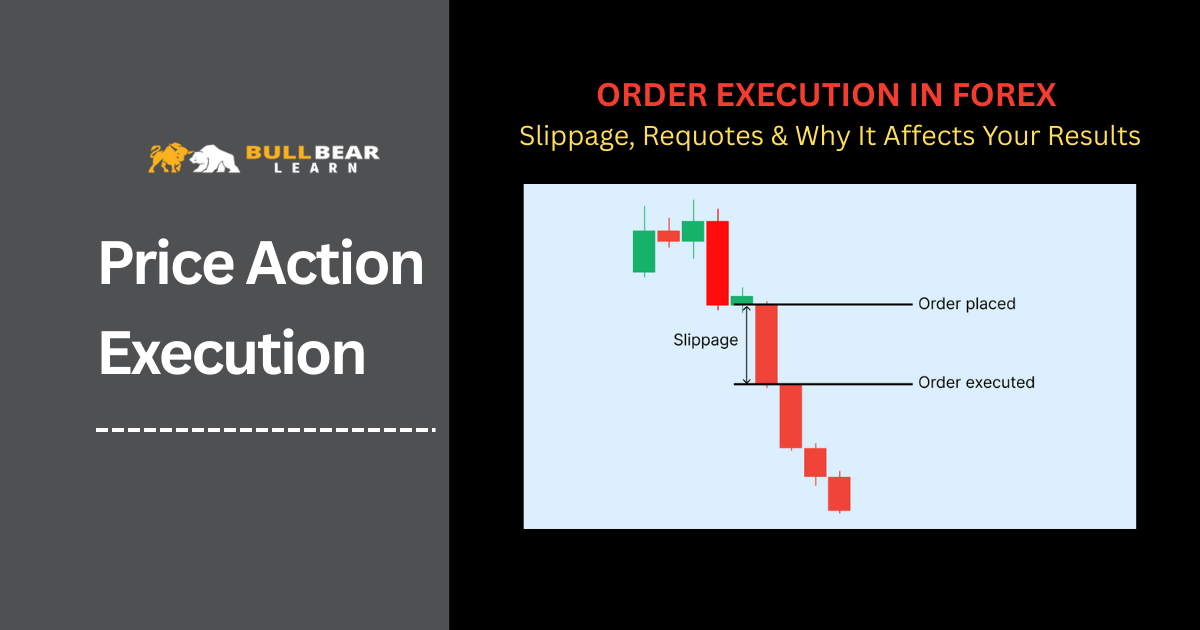
3. What Is Slippage?
Slippage occurs when a trade is filled at a different price than requested.
Example:
-
Buy EUR/USD at 1.1000
-
Filled at 1.1004
→ Slippage: 4 pips
Slippage can be:
-
Negative (worse price)
-
Positive (better price)
A fair execution model allows both positive and negative slippage, reflecting real market conditions.
4. When Slippage Happens Most Often
Slippage is common during:
-
High-impact news events (NFP, CPI, FOMC)
-
Low-liquidity sessions
-
Strong breakouts
-
Market orders during fast price movement
If your strategy relies on:
-
Breakout entries
-
Scalping
-
Intraday momentum
execution quality matters more than raw spread size.
5. What Is a Requote?
A requote happens when the broker rejects your requested price and offers a new one.
This is common with:
-
Instant Execution
-
Dealing Desk brokers
Requotes are problematic because:
-
You miss optimal entries
-
Trades are delayed
-
Price often moves against you
Professional traders generally prefer market execution, even with possible slippage, over requotes.
6. Market Execution vs Instant Execution
Instant Execution
-
Fixed quoted price
-
Requotes possible
-
Less suitable for active traders
Market Execution (Preferred)
-
Executed at best available price
-
No requotes
-
Slippage possible
-
Reflects real market conditions
Most Price Action traders use market execution.
7. How Poor Execution Damages Trading Performance
Poor execution leads to:
-
Worse entries than planned
-
Stop losses hit prematurely
-
Reduced reward-to-risk ratios
Over dozens or hundreds of trades, this creates:
-
Strategy distortion
-
False performance analysis
-
Psychological frustration
Many traders blame their strategy when the real issue is execution quality.
8. How to Evaluate a Broker’s Execution Quality
You can assess execution by:
-
Comparing demo vs live fills
-
Monitoring slippage during volatility
-
Checking execution speed
-
Reviewing execution model transparency
👉 Traders who prioritize execution often choose brokers that:
-
Use multiple liquidity providers
-
Support market execution
-
Allow scalping and news trading
(Example: brokers with ECN/STP execution and low average slippage)
🔗 Related: Broker Review – Execution Speed & Slippage Analysis
(In-depth review based on real trading conditions)
9. What Beginners Should Focus On
Beginner traders should:
-
Avoid choosing brokers based only on bonuses
-
Look beyond advertised spreads
-
Prioritize execution transparency
Good execution allows you to:
-
Follow your Price Action plan accurately
-
Reduce emotional decision-making
-
Measure real strategy performance
10. Conclusion
Order execution is not a minor technical detail — it is a core performance factor.
A solid Price Action strategy
-
poor execution
= inconsistent results.
Next article in this silo:
👉 Execution #3 – Spread, Commission & Hidden Trading Costs Explained