

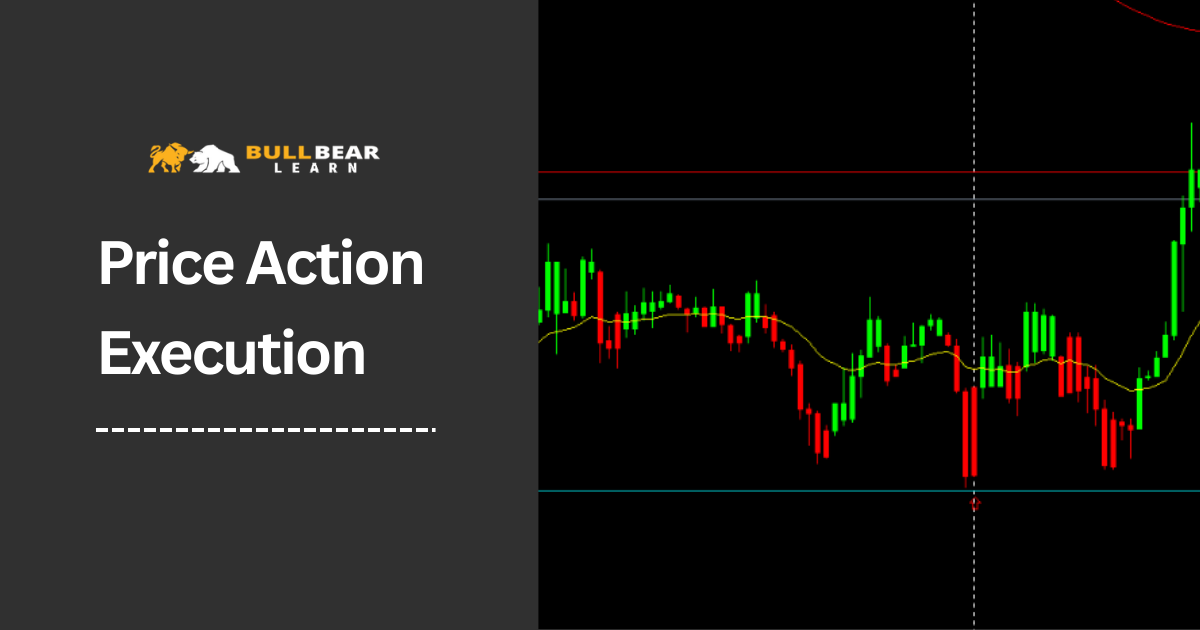
Most traders fail not because they lack knowledge—but because they lack a clear execution framework.
They understand market structure, trends, and support and resistance, yet still hesitate, overtrade, or act emotionally. The missing piece is execution logic: a structured way to convert analysis into decisions.
This article introduces a professional Price Action execution framework that answers one question:
When price reaches a meaningful area, what should I do—and what should I avoid doing?
Before learning setups, entries, or risk rules, you must understand the execution mindset.
What Is Price Action Execution?
Price Action execution is not a signal or a pattern.
It is the process of:
-
Observing price behavior in context
-
Filtering opportunities
-
Deciding whether to act or stay out
Execution answers how to engage the market—not where price might go.
Good execution reduces randomness. Poor execution turns good analysis into bad trades.
Why Analysis Alone Is Not Enough
Many traders:
-
Analyze correctly
-
Identify structure and levels
-
Recognize trends
Yet still lose money.
Why?
Because analysis without execution leads to:
-
Hesitation
-
Late entries
-
Emotional decisions
-
Inconsistent behavior
Execution provides rules for engagement, not predictions.
The Core Principle of Price Action Execution
Professional traders follow one guiding principle:
Price Action execution is context-first, reaction-based, and probability-driven.
This means:
-
Context defines opportunity
-
Price reaction confirms intent
-
Execution accepts uncertainty
There is no certainty—only alignment.
The Execution Framework: From Context to Decision
A robust Price Action execution framework has four layers:
-
Market Context
-
Location
-
Price Behavior
-
Risk Acceptance
All four must align before execution is considered.
Layer 1: Market Context
Context answers:
-
Is the market trending or ranging?
-
Who is in control?
-
What is the higher timeframe bias?
This layer filters most trades.
Trading against dominant context dramatically lowers probability.
→ Timeframes & Top-Down Analysis
Layer 2: Location
Location answers:
-
Where is price relative to structure?
-
Is price near key support or resistance?
-
Is price extended or balanced?
Good execution only happens at meaningful locations.
Trading in the middle of nowhere is gambling.
→ Support and Resistance in Price Action
Layer 3: Price Behavior
Behavior answers:
-
How does price react at this location?
-
Is momentum increasing or stalling?
-
Are buyers or sellers showing intent?
This is where many traders rush.
Professionals wait for confirmation of behavior, not assumptions.
Layer 4: Risk Acceptance
Risk acceptance answers:
-
Is the risk defined and acceptable?
-
Can this trade fail without emotional damage?
-
Is the outcome worth the uncertainty?
If risk is unclear, execution stops—regardless of how good the setup looks.
Execution is not about being right—it is about managing loss.
Why Execution Is About Filtering, Not Finding Trades
Retail traders search for trades.
Professional traders filter them out.
Most market conditions are:
-
Choppy
-
Low-quality
-
Unclear
A good execution framework produces fewer trades, not more.
Consistency comes from patience.
Common Execution Mistakes
Avoid these errors:
-
Executing without higher timeframe context
-
Forcing trades at weak locations
-
Acting before price shows intent
-
Ignoring risk clarity
-
Chasing missed moves
Execution errors compound faster than analysis errors.
Execution vs Strategy
A strategy is a repeatable model.
Execution is the human process of applying that model under uncertainty.
Two traders using the same strategy can have vastly different results—because execution quality differs.
Execution is a skill, not a rule set.
Why Price Action Execution Feels Subjective (But Isn’t)
Execution feels subjective because:
-
Markets are dynamic
-
Context shifts
-
Behavior changes
However, subjectivity decreases when:
-
Context rules are clear
-
Locations are predefined
-
Behavior criteria are respected
Clarity reduces emotion.
How Execution Fits Into the Price Action System
Execution integrates:
-
Market structure
-
Trends
-
Supply and demand
-
Support and resistance
-
Timeframes
Without execution, these concepts remain theoretical.
Execution turns knowledge into decisions.
How to Practice Price Action Execution
To develop execution skill:
-
Review historical charts
-
Pause at key locations
-
Ask: “Should I engage or stay out?”
-
Justify decisions in writing
-
Focus on process, not outcome
The goal is discipline—not perfection.
Final Thoughts
Price Action execution is not about finding perfect entries.
It is about:
-
Waiting for alignment
-
Acting decisively
-
Accepting uncertainty
-
Managing risk
This framework creates consistency—even when outcomes vary.
In the next article, we will move from framework to application by breaking down Price Action Entries: Timing Without Chasing, showing how traders engage price after context and location are defined.
→ Price Action Entries: Timing Without Chasing