

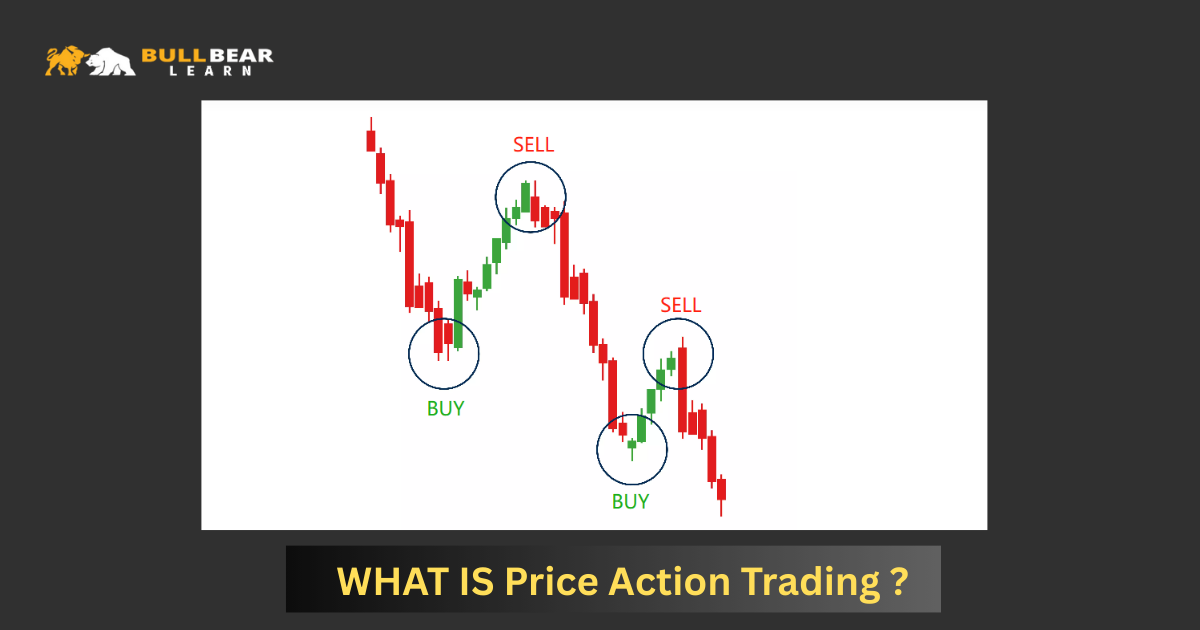
Price Action trading is one of the most fundamental and widely used approaches in financial markets. From Forex and cryptocurrency to stocks and commodities, many professional traders rely on Price Action as the core of their decision-making process.
However, despite its popularity, Price Action is often misunderstood. Beginners frequently associate it with a few candlestick patterns or simple support and resistance lines. In reality, Price Action is not a collection of patterns—it is a method of understanding how the market behaves.
This article explains what Price Action trading truly is, why it works, and how beginners should approach learning it correctly.
What Is Price Action Trading?
Price Action trading is the practice of analyzing the market by observing raw price movement, without relying heavily on technical indicators.
Instead of asking:
“What does the indicator signal?”
Price Action traders ask:
“What is price doing, and what does that reveal about buyers and sellers?”
At its core, Price Action focuses on:
-
How price moves from one level to another
-
How price reacts at important areas
-
The structure of the market (trends, ranges, breakouts)
-
The behavior of market participants reflected in candles
Because all indicators are derived from price, Price Action provides the most direct form of market information.
Why Price Action Matters for Traders
Markets move because of imbalances between supply and demand. When buyers are more aggressive than sellers, price rises. When sellers dominate, price falls. Price Action allows traders to observe these dynamics in real time.
Key reasons traders use Price Action include:
1. It Reflects Real Market Behavior
Price Action shows what market participants are actually doing—not what a formula calculates after the fact.
2. It Reduces Noise
Charts based on Price Action are usually clean and simple, helping traders focus on meaningful movements instead of conflicting signals.
3. It Works Across All Markets
Price Action applies to:
-
Forex
-
Crypto
-
Stocks
-
Indices
-
Commodities
Because it is based on human behavior, not instruments.
Price Action vs Indicator-Based Trading
Many beginners start trading with indicators such as RSI, MACD, or stochastic oscillators. While indicators can be useful, they have limitations.
Indicators:
-
Are derived from price (lagging by nature)
-
Can give conflicting signals
-
Often encourage over-analysis
Price Action:
-
Uses price itself as the primary data
-
Reacts faster to market changes
-
Emphasizes context over signals
This does not mean indicators are useless. However, Price Action should come first. Indicators, if used, should support Price Action—not replace it.
What Price Action Trading Is NOT
Understanding misconceptions is critical for beginners.
Price Action trading is NOT:
-
❌ Memorizing candlestick patterns
-
❌ Drawing endless support and resistance lines
-
❌ A strategy with guaranteed profits
-
❌ A shortcut to quick wealth
Price Action is a skill, developed through observation, experience, and discipline.
Many traders fail because they expect Price Action to provide certainty. In reality, it provides probabilities, not predictions.
How Price Action Traders Read the Market
Price Action traders do not look for “signals” in isolation. Instead, they analyze context.
They focus on:
-
Where price is relative to key levels
-
Whether the market is trending or ranging
-
How price behaves during pullbacks
-
The strength or weakness of momentum
Every candle is viewed as a result of decision-making by buyers and sellers.
This mindset shift—from prediction to interpretation—is what separates beginners from experienced traders.
The Role of Market Structure in Price Action
Market structure is a core component of Price Action trading. It describes how price forms:
-
Higher highs and higher lows (uptrend)
-
Lower highs and lower lows (downtrend)
-
Sideways ranges (consolidation)
Understanding structure helps traders:
-
Align with the dominant direction
-
Avoid trading against momentum
-
Recognize potential changes in behavior
Market structure will be covered in detail later in this learning path, but it is important to recognize that Price Action always starts with structure, not patterns.
Why Beginners Struggle With Price Action
Most beginners struggle not because Price Action is ineffective, but because they learn it incorrectly.
Common mistakes include:
-
Jumping straight into candlestick setups
-
Ignoring higher timeframes
-
Trading without understanding context
-
Expecting high win rates
Without a solid foundation, even “perfect” setups fail.
This is why Price Action must be learned step by step, starting with how markets move, not how to enter trades.
Who Should Learn Price Action Trading?
Price Action is suitable for:
-
Beginners who want a strong foundation
-
Traders overwhelmed by indicators
-
Forex and crypto traders
-
Swing traders and day traders
Price Action may not suit traders who:
-
Expect guaranteed outcomes
-
Avoid losses completely
-
Refuse to review and improve
Successful Price Action traders accept uncertainty and focus on risk control, not perfection.
Is Price Action Trading Profitable?
Price Action itself does not generate profits.
Profitability comes from:
-
Proper risk management
-
Consistent execution
-
Emotional discipline
-
Realistic expectations
Many professional traders use simple Price Action principles combined with strict risk rules. They do not aim to win every trade—they aim to survive and compound over time.
How to Start Learning Price Action Correctly
If you are new to Price Action, follow this order:
-
Understand how markets move (supply, demand, psychology)
-
Learn timeframes and top-down analysis
-
Study trends and market direction
-
Master support and resistance correctly
-
Only then move to structure and execution
This learning path prevents confusion and builds confidence gradually.
[→ How the Market Moves: Supply and Demand]
Final Thoughts
Price Action trading is not complicated—but it is not easy.
It requires:
-
Patience
-
Observation
-
Discipline
-
A structured learning process
This article is the first step in your Price Action journey. Before thinking about entries or strategies, focus on understanding how and why price moves.
In the next article, we will explore how markets move based on supply, demand, and trader psychology, which forms the true foundation of Price Action trading.
[→ How the Market Moves: Supply, Demand & Psychology]