

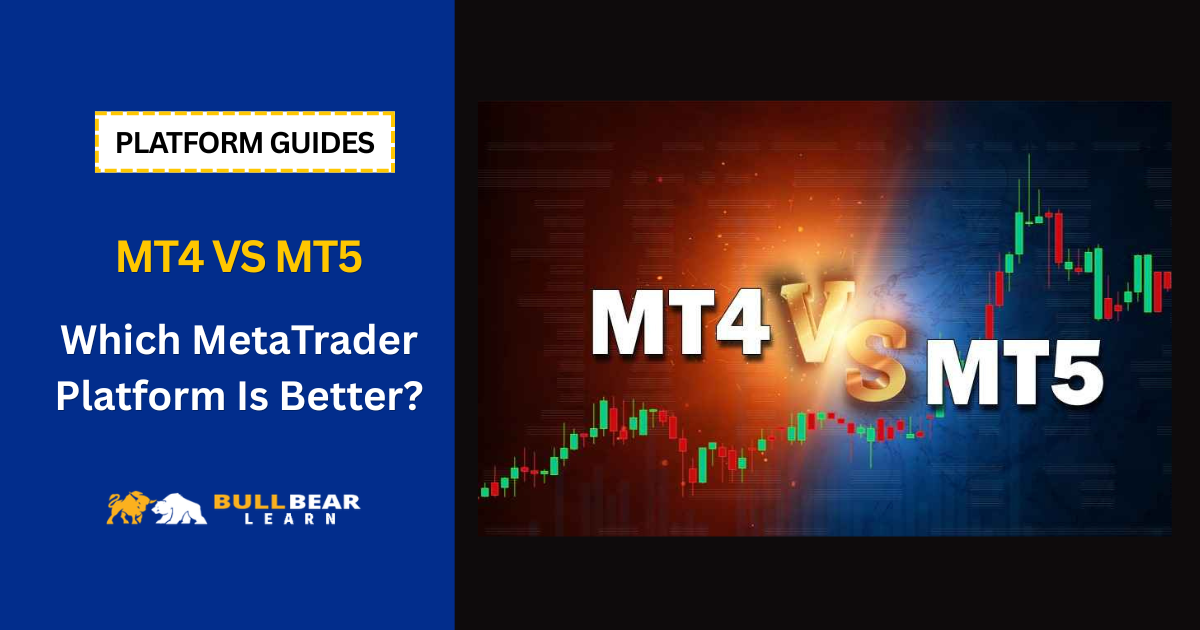
MetaTrader 4 and MetaTrader 5 are two of the most widely recognized trading platforms in the Forex industry.
For beginners, however, choosing between them can be confusing.
Both platforms are developed by MetaQuotes, both support technical analysis, automated trading, and trade execution, and many brokers offer one or both platforms.
So, what is the actual difference between MT4 and MT5?
Is MT5 really better than MT4?
Or is MT4 still the better choice for Forex traders?
The answer depends on how you trade, which markets you want to access, and which features are important to you.
This guide compares MT4 vs MT5 in detail so you can decide which platform is more suitable for your trading needs.
MT4 vs MT5 at a Glance
Before looking at the details, here is a quick comparison.
| Feature | MT4 | MT5 |
|---|---|---|
| Release | 2005 | 2010 |
| Main focus | Forex trading | Multi-asset trading |
| Timeframes | 9 | 21 |
| Pending order types | 4 | 6 |
| Technical indicators | Yes | Yes |
| Expert Advisors | Yes | Yes |
| Strategy testing | Yes | More advanced |
| Market Depth | Limited | Yes |
| Economic Calendar | Limited | Built-in |
| Hedging | Supported | Supported |
| Netting | No | Supported |
| Multi-asset support | More limited | Broader |
The important point is that MT5 is not simply an upgraded version of MT4.
The two platforms were designed with somewhat different purposes in mind.
What Is MT4?
MetaTrader 4, commonly called MT4, was released in 2005.
It became extremely popular among retail Forex traders because it provided a relatively simple way to:
- Analyze currency pairs
- Place trades
- Use technical indicators
- Create automated strategies
- Install Expert Advisors
- Manage trading accounts
MT4 was primarily designed around the Forex market.
Its simplicity and enormous ecosystem helped it become one of the most influential retail trading platforms ever developed.
What Is MT5?
MetaTrader 5 was released in 2010 as a newer multi-asset trading platform.
MT5 was designed to support a broader range of financial instruments and provide additional functionality.
Depending on the broker, MT5 can provide access to:
- Forex
- Stocks
- Indices
- Commodities
- Futures
- Cryptocurrencies
The exact instruments available depend on the broker and the account type.
If you want to learn the platform from the beginning, see our MetaTrader 5 guide.
MT4 vs MT5: Main Differences
Although the interfaces look similar, several important differences exist.
1. Market Coverage
This is one of the biggest differences.
MT4
MT4 was primarily built for Forex and CFD trading.
Many brokers still use it mainly for:
- Forex
- Metals
- Indices
- Energy products
MT5
MT5 was designed as a broader multi-asset platform.
Depending on the broker, it can support:
- Forex
- Stocks
- Futures
- Indices
- Commodities
- Crypto
If you plan to trade several asset classes from one platform, MT5 may be more convenient.
2. Timeframes
MT5 provides more built-in timeframes than MT4.
MT4 traditionally provides nine standard timeframes:
- M1
- M5
- M15
- M30
- H1
- H4
- D1
- W1
- MN
MT5 expands this selection with additional intermediate timeframes.
This can be useful for traders who want more precise multi-timeframe analysis.
For example, an intraday trader may want to analyze a market using a timeframe between M15 and H1.
3. Technical Indicators
Both platforms provide a wide range of built-in technical indicators.
Common examples include:
- Moving Average
- RSI
- MACD
- Bollinger Bands
- Stochastic
- ATR
For traditional technical analysis, both MT4 and MT5 are capable platforms.
The difference is not necessarily that one has “good indicators” while the other has “bad indicators.”
MT5 generally provides a broader analytical environment, while MT4 remains sufficient for many conventional Forex strategies.
4. Drawing and Analytical Tools
Both platforms allow traders to use graphical objects such as:
- Trendlines
- Horizontal lines
- Channels
- Fibonacci tools
- Shapes
- Text labels
MT5 generally provides more advanced analytical functionality.
For beginners, however, the difference may not be significant.
If your trading strategy is based mainly on:
- Support and resistance
- Trendlines
- Candlestick patterns
- Moving averages
either platform can work well.
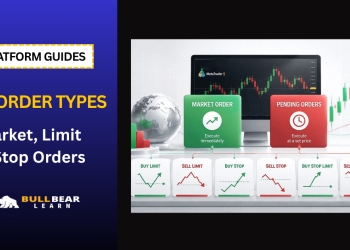
5. Order Types
MT5 supports more pending order types than MT4.
MT4 commonly provides:
- Buy Limit
- Sell Limit
- Buy Stop
- Sell Stop
MT5 also supports additional order functionality, including:
- Buy Stop Limit
- Sell Stop Limit
These additional order types can be useful for traders who use more sophisticated entry strategies.
We will cover the different MT5 order types in a dedicated guide.
6. Strategy Tester
This is another important difference.
Both platforms support strategy testing, but MT5 provides a more advanced testing environment.
MT5’s strategy testing capabilities are designed to support more sophisticated analysis and can make it easier to test automated strategies under different conditions.
This can be particularly useful for:
- Algorithmic traders
- Expert Advisor developers
- Quantitative traders
- Traders optimizing automated systems
If you only trade manually, this difference may be less important.
7. Expert Advisors and Automated Trading
Both MT4 and MT5 support automated trading through Expert Advisors, commonly called EAs.
However, the programming environments are different.
MT4 primarily uses MQL4.
MT5 uses MQL5.
This means that an EA designed specifically for MT4 may not work directly on MT5 without modification.
This is an important consideration if you already own or use automated trading systems.
8. MT4 EAs vs MT5 EAs
The difference between MQL4 and MQL5 means that the software ecosystem is not completely interchangeable.
For example:
MT4 EA → MT4
MT5 EA → MT5
You should not assume that an Expert Advisor purchased for MT4 will automatically work on MT5.
If automated trading is an important part of your strategy, check platform compatibility before choosing a broker or platform.
9. Market Depth
MT5 includes Market Depth functionality.
Market Depth can provide information about available liquidity and orders around different price levels, depending on the broker and market.
This can be particularly useful for traders who work with markets where order book information is meaningful.
For a basic retail Forex trader, however, Market Depth may not be a deciding factor.
10. Economic Calendar
MT5 includes an integrated economic calendar.
This allows traders to monitor important economic events without necessarily relying on a separate website.
Economic events can include:
- Interest rate decisions
- Inflation releases
- Employment data
- GDP releases
- Central bank events
This is particularly useful for traders who incorporate fundamental analysis into their strategies.
You can also use our Forex Economic Calendar to monitor market-moving events.
MT4 vs MT5 for Forex Trading
If you trade Forex exclusively, the decision becomes more nuanced.
MT4 remains fully capable of handling many Forex strategies.
For example, a trader using:
- Price action
- Moving averages
- RSI
- Support and resistance
- Basic Expert Advisors
may not need the additional features of MT5.
However, MT5 provides a more modern environment and broader functionality.
Therefore, new Forex traders may prefer MT5 if their broker provides both platforms.
MT4 vs MT5 for Beginners
MT4 Advantages for Beginners
MT4 is relatively simple.
It has:
- A familiar interface
- A huge educational ecosystem
- Many existing indicators
- Large numbers of Expert Advisors
- Extensive community support
If you are learning Forex and want a straightforward platform, MT4 can still be a good choice.
MT5 Advantages for Beginners
MT5 provides:
- More timeframes
- More order types
- Broader asset support
- More advanced strategy testing
- Built-in economic calendar
- Modern functionality
For someone starting from scratch, MT5 may provide more room to grow.
MT4 vs MT5 for Experienced Traders
Experienced traders should focus less on which platform is “better” and more on whether the platform supports their strategy.
Choose MT4 if you:
- Primarily trade Forex
- Already have MT4 indicators
- Use MT4 Expert Advisors
- Prefer the traditional interface
- Do not need advanced MT5 functionality
Choose MT5 if you:
- Trade multiple asset classes
- Need more timeframes
- Use advanced strategy testing
- Want additional order types
- Prefer a newer platform
- Want integrated economic data
MT4 vs MT5 for Algorithmic Trading
Automated traders need to consider compatibility carefully.
If your strategy depends heavily on Expert Advisors, switching platforms may require more than simply installing new software.
You may need:
- New EA versions
- Code conversion
- New indicator versions
- Strategy re-testing
Therefore, do not switch from MT4 to MT5 simply because MT5 is newer.
First verify that your trading systems are compatible.
MT4 vs MT5: Which Has Better Performance?
MT5 was designed with a more modern architecture and broader functionality.
In general, MT5 is better suited to more advanced multi-asset environments.
However, actual execution performance also depends heavily on:
- Broker infrastructure
- Server location
- Liquidity
- Execution model
- Internet connection
- Market conditions
The platform itself is only one part of execution quality.
Therefore, do not assume that switching from MT4 to MT5 will automatically produce better trading results.
Does MT5 Replace MT4?
Not completely.
MT4 remains widely used across the Forex industry.
Many brokers continue to support it, and traders continue to use thousands of existing indicators and Expert Advisors built around the MT4 ecosystem.
At the same time, MT5 has become increasingly important because of its broader capabilities.
Both platforms continue to have their own user bases.
Can You Use MT4 and MT5 at the Same Time?
Yes.
You can install both platforms on the same computer.
Some traders use MT4 for one account and MT5 for another.
This can be useful if:
- One broker offers better conditions on MT4
- Another broker offers better MT5 access
- You have different Expert Advisors
- You want to compare execution environments
However, running multiple platforms can also make account management more complicated.
For beginners, one platform is usually enough.
MT4 vs MT5 and Broker Selection
Your broker can influence which platform you should choose.
Some brokers offer:
- MT4 only
- MT5 only
- Both MT4 and MT5
- MT4/MT5 plus proprietary platforms
Before opening an account, check:
- Which platform is available
- Which instruments are supported
- Spreads
- Commissions
- Leverage
- Execution conditions
- Regulation
- Account types
If you are comparing brokers, it is better to evaluate the overall trading environment rather than choosing a broker solely because it supports MT4 or MT5.
MT4 vs MT5 and Risk Management
Your platform does not determine your risk.
Whether you use MT4 or MT5, you still need to calculate:
- Position size
- Pip value
- Margin
- Potential profit
- Maximum loss
Before placing an order, use our Position Size Calculator to determine an appropriate trade size.
You can also use the Pip Calculator to understand the monetary value of price movements.
The platform executes the trade.
Your risk management system determines how much capital you put at risk.
Which Is Better: MT4 or MT5?
There is no universal answer.
MT4 is probably better if:
- You only trade Forex
- You already use MT4 EAs
- You prefer a simpler environment
- Your trading system was built around MT4
MT5 is probably better if:
- You are a new trader
- You want broader market access
- You want more timeframes
- You need advanced strategy testing
- You want more order functionality
- You prefer a modern multi-asset platform
For a new trader starting today, MT5 is generally the platform I would recommend considering first, assuming your preferred broker offers the trading conditions and instruments you need.
But there is no reason to abandon MT4 if it already meets your requirements.
MT4 vs MT5: Final Comparison
| Category | Better Choice |
|---|---|
| Simple Forex trading | MT4 |
| Multi-asset trading | MT5 |
| More timeframes | MT5 |
| Advanced strategy testing | MT5 |
| Existing MT4 EAs | MT4 |
| Broader order functionality | MT5 |
| Beginner starting from scratch | MT5 |
| Mature Forex ecosystem | MT4 |
| Modern platform functionality | MT5 |
Final Thoughts
The MT4 vs MT5 debate is not really about finding one platform that is universally superior.
Both platforms can provide everything many traders need to analyze markets and execute trades.
MT4 remains an excellent choice for traders who value its simplicity, established ecosystem, and compatibility with existing Forex tools.
MT5 is generally more attractive for traders who want broader market access, additional analytical features, more order types, and a more modern multi-asset environment.
If you are completely new to trading and have no existing MT4-specific tools or Expert Advisors, MT5 is usually the more future-oriented choice.
But remember:
A better platform does not automatically create better trading results.
Your strategy, risk management, broker, execution conditions, and discipline matter far more than whether you click Buy or Sell from MT4 or MT5.
Before choosing a platform, compare brokers that support the platform you prefer and evaluate their overall trading conditions rather than focusing on the software alone.