

The XM Ultra Low Account is designed for traders who want more competitive trading conditions while maintaining a relatively straightforward account structure.
Compared with a traditional spread-based account, the main attraction of the Ultra Low Account is its focus on lower spreads.
This can be particularly important for active traders because even small differences in transaction costs can become significant when a strategy generates many trades.
However, a lower advertised spread does not automatically mean that the account is the cheapest option for every trader.
Trading costs can also depend on:
- Commission
- Instrument
- Trading volume
- Spread conditions
- Overnight charges
- Market volatility
- Execution
In this guide, we’ll examine the XM Ultra Low Account, explain how it works, compare it with the Standard Account, and determine which type of trader may benefit most from it.
If you’re evaluating XM as a broker more broadly, start with our complete XM Review.
XM Ultra Low Account at a Glance
| Feature | XM Ultra Low Account |
|---|---|
| Account Type | Ultra Low |
| Pricing Focus | Lower spreads |
| Commission | Depends on current account conditions |
| Trading Platforms | MT4 / MT5, where available |
| Instruments | Depends on XM entity and jurisdiction |
| Best For | Active and cost-conscious traders |
| Scalping | Potentially suitable |
| Beginners | Possible, but not necessarily necessary |
Important: XM account availability, spreads, commissions, leverage, minimum deposits, instruments, and other trading conditions can vary according to the XM entity and jurisdiction. Always check the current conditions available to your account before trading.
What Is the XM Ultra Low Account?
The Ultra Low Account is an XM account designed around more competitive spread conditions.
The basic idea is straightforward:
Lower spreads can reduce the cost of entering and exiting trades.
This can be particularly useful for traders who execute frequently.
For example, a trader who opens only a handful of positions each month may see relatively little difference between two spread structures.
A scalper executing dozens or hundreds of trades can experience a much larger cumulative effect.
That makes the Ultra Low Account more relevant to active traders than to someone who simply wants the easiest possible account structure.
XM Ultra Low Spreads
Spreads are one of the main reasons traders consider the Ultra Low Account.
However, traders should distinguish between:
Minimum advertised spread
and
Actual spread during your trading session.
Forex spreads are variable and can change depending on:
- Liquidity
- Market volatility
- Economic news
- Trading session
- Instrument
- Market conditions
A spread that looks attractive during normal market conditions may widen during major news events.
For this reason, traders should evaluate the spreads on the instruments they actually trade rather than choosing an account based solely on its minimum advertised spread.
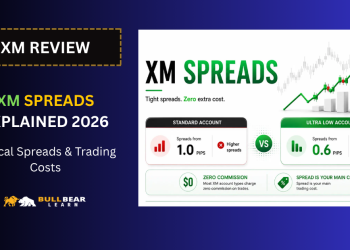
For a broader explanation, see our XM Spreads Explained guide.
Does XM Ultra Low Charge Commission?
The answer depends on the specific Ultra Low account conditions applicable to your XM entity.
This is important because traders should never assume that a lower spread means there are no other trading costs.
When comparing accounts, calculate:
Total Trading Cost = Spread Cost + Commission + Overnight Costs
For a complete breakdown of XM trading costs, see our XM Fees Explained guide.
This is more useful than comparing the spread alone.
For active traders, the difference between two accounts should ideally be evaluated using their expected trading volume.
XM Ultra Low Minimum Deposit
The minimum deposit required for an XM Ultra Low Account can depend on the applicable XM entity and account conditions.
This means that information displayed on one XM website or for one country may not necessarily apply to every trader.
Before funding an account, check the current minimum deposit shown during registration or in your XM Member Area.
If you’re specifically comparing XM’s entry requirements, see our XM Minimum Deposit guide.
XM Ultra Low Leverage
Leverage availability depends on the XM entity, jurisdiction, instrument, and regulatory restrictions applicable to the trader.
While higher leverage can reduce the amount of margin required to open a position, it does not reduce the underlying market risk.
For example, using excessive leverage can allow a relatively small price movement to create a substantial loss relative to your account balance.
Therefore, the Ultra Low Account should not be selected simply because it allows high leverage.
The account’s pricing structure should be considered separately from your risk-management approach.
XM Ultra Low Trading Platforms
The Ultra Low Account can be used with XM’s supported trading platforms, subject to current availability.
These may include:
- MetaTrader 4
- MetaTrader 5
MT4 remains popular among forex traders and users of Expert Advisors, while MT5 provides a newer platform environment with additional functionality.
If you’re deciding which platform to use, see our XM MT4 vs MT5 comparison.
XM Ultra Low vs Standard Account
This is one of the most important comparisons for traders considering XM.
| Feature | Ultra Low | Standard |
|---|---|---|
| Main Advantage | Lower-spread focus | Simplicity |
| Pricing | More competitive spread structure | Standard spread-based structure |
| Beginners | Suitable | Very suitable |
| Active Traders | Strong candidate | Possible |
| Scalping | Worth considering | May be less cost-efficient |
| Cost Comparison | Depends on actual conditions | Depends on actual conditions |
The Ultra Low Account is not automatically better.
If you trade only occasionally, the difference in spreads may have little practical impact.
If you trade frequently, however, even a small reduction in spread can become meaningful over time.
Is XM Ultra Low Good for Scalping?
The Ultra Low Account can be a strong candidate for scalpers because scalping strategies are particularly sensitive to transaction costs.
A scalper may enter and exit a position within minutes.
That means the spread becomes an immediate hurdle that the trade must overcome before becoming profitable.
Lower spreads can therefore be beneficial.
However, successful scalping depends on much more than the account type.
Scalpers should also consider:
- Execution speed
- Slippage
- Spread stability
- News-time conditions
- Liquidity
- Commission
- Position sizing
- Risk management
A low spread alone does not make a broker or account suitable for scalping.
Is XM Ultra Low Good for Beginners?
Yes, it can be.
But beginners should not assume that a lower spread automatically makes an account better.
If you’re still learning:
- Market structure
- Technical analysis
- Position sizing
- Stop Loss management
- Risk/reward
- Leverage
then keeping your trading setup simple may be more valuable than optimizing every fraction of a pip.
The Ultra Low Account becomes more attractive once a trader understands how transaction costs affect their strategy.
Is XM Ultra Low Good for Gold Trading?
Gold traders may also be interested in the Ultra Low Account.
XAU/USD can experience significant price movements and spread changes during periods of high volatility.
Because gold positions can be larger in value than many beginner traders realize, transaction costs should be evaluated carefully.
Before trading XAU/USD, check:
- Current spread
- Contract specifications
- Margin requirements
- Swap
- Trading hours
- Volatility
Do not assume that an account offering competitive forex spreads will necessarily provide the same advantage on gold.
XM Ultra Low Account: Pros and Cons
Pros
- Designed around more competitive spreads
- Potentially useful for active traders
- Can be attractive for scalping
- Suitable for traders who pay close attention to transaction costs
- Compatible with XM’s supported trading platforms
Cons
- Lower spread does not necessarily mean lower total cost
- Conditions can vary by jurisdiction
- Variable spreads can widen during volatile markets
- May offer little practical advantage for very infrequent traders
- Traders still need to consider swap and other applicable costs
Who Should Choose XM Ultra Low?
The account is most worth considering if you:
- Trade frequently
- Scalp forex
- Execute multiple positions per session
- Pay close attention to spreads
- Want to reduce spread-related costs
- Already understand how spreads affect profitability
It may be less important if you:
- Trade only occasionally
- Hold positions for long periods
- Are completely new to trading
- Don’t generate enough trading volume for small spread differences to matter
XM Ultra Low vs Zero Account
The Ultra Low Account should also be compared with XM’s Zero Account if both are available to you.
The key difference is the pricing structure.
Ultra Low focuses on competitive spreads, while Zero uses a very tight-spread and commission-based structure.
For an active trader, the correct comparison is not:
Which account has the lowest spread?
Instead, ask:
Which account gives me the lowest all-in cost for my actual trading volume?
This distinction is especially important for scalpers and high-frequency traders.
For a broader comparison of XM account structures, see our XM Account Types guide.
How to Choose Between XM Ultra Low and Standard
A simple rule can help.
Choose Standard if:
- You are new to forex.
- You trade infrequently.
- You prefer simple pricing.
- Your strategy doesn’t generate many trades.
Consider Ultra Low if:
- You trade frequently.
- You scalp.
- Spreads have a meaningful impact on your strategy.
- You want to optimize transaction costs.
There is no requirement to choose the more advanced option simply because it appears cheaper.
Your trading frequency should determine how much the spread difference matters.
Final Verdict
The XM Ultra Low Account is primarily attractive because of its focus on competitive spread conditions.
That makes it worth considering for active traders, scalpers, and traders who monitor transaction costs closely.
However, lower spreads should never be evaluated in isolation.
Commission, swap, execution, instrument-specific costs, and trading volume can all affect the final cost of trading.
For beginners and occasional traders, the Standard Account may still be simpler.
For active traders, however, the Ultra Low Account deserves a closer comparison.
The best choice ultimately depends on the all-in trading cost for your particular strategy, not simply the lowest advertised spread.
Frequently Asked Questions
What is the XM Ultra Low Account?
The XM Ultra Low Account is an account structure designed around more competitive spread conditions. Availability and exact trading conditions depend on the XM entity and jurisdiction.
Is XM Ultra Low good for scalping?
It can be suitable for scalping because transaction costs are especially important for high-frequency strategies. However, traders should also evaluate execution, slippage, commission, and spread stability.
Is XM Ultra Low better than Standard?
Not necessarily. Ultra Low may be more attractive to active traders, while Standard can be more suitable for beginners and traders who prioritize simplicity.
Does XM Ultra Low have commission?
Commission depends on the specific account conditions applicable to your XM entity. Traders should check the current terms rather than assuming that a lower spread means zero commission.
What is the minimum deposit for XM Ultra Low?
The applicable minimum deposit can vary according to the XM entity and jurisdiction. Check the current amount displayed during registration or in your XM Member Area.
Can I use MT4 with XM Ultra Low?
MT4 availability depends on the current account and regional conditions. XM also supports MT5 in applicable markets.
Is XM Ultra Low good for gold?
It can be considered by gold traders, but XAU/USD should be evaluated separately because gold has its own spread, contract, margin, swap, and volatility characteristics.
Ready to Compare XM Account Options?
The XM Ultra Low Account can be attractive if your trading strategy is sensitive to spreads.
Before opening an account, compare the Ultra Low, Standard, and Zero structures based on your expected trading frequency and total trading costs.
Check the current XM account conditions for your region and choose the structure that best matches your trading strategy.