

If you’ve ever opened the Spot Trading interface on a cryptocurrency exchange, you’ve probably seen a panel filled with constantly changing numbers.
This panel is called the Order Book.
At first glance, it may look confusing.
Rows of prices, quantities, and colors update every second, making it seem like a tool designed only for professional traders.
In reality, every crypto trade passes through the order book.
Understanding how it works helps explain why prices move, how orders are matched, and why market conditions can change so quickly.
In this guide, we’ll break down the crypto order book in simple terms and explain how beginners can use it without becoming overwhelmed.
What Is an Order Book?
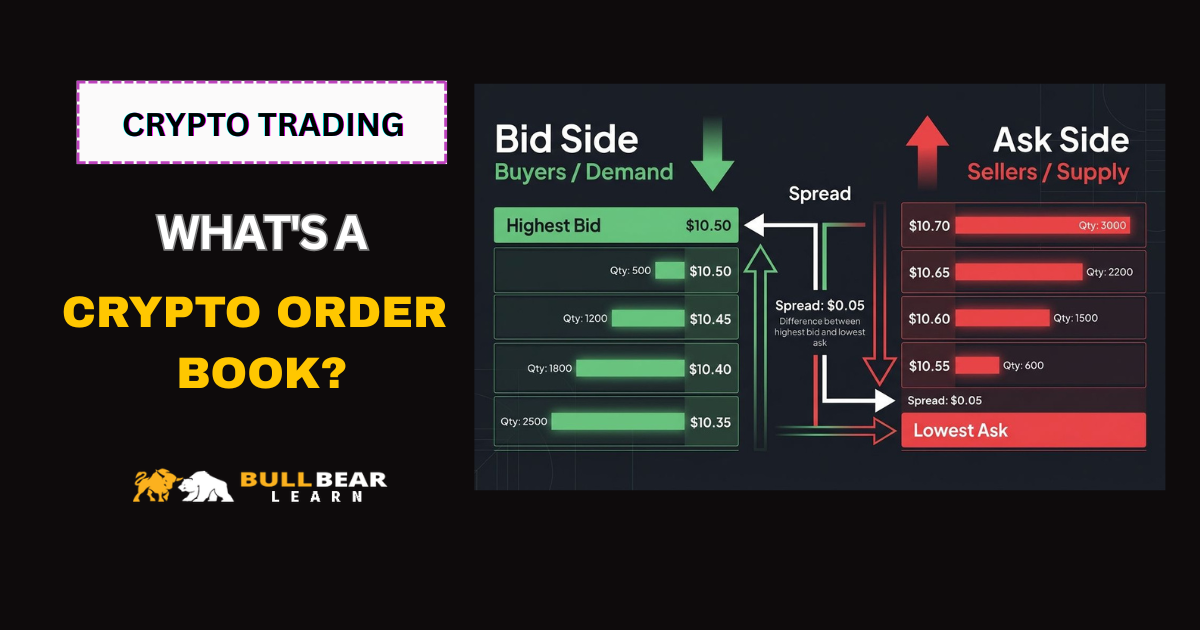
An order book is a real-time list of buy and sell orders placed by market participants.
It shows:
- Prices buyers are willing to pay.
- Prices sellers are willing to accept.
- The amount of cryptocurrency available at each price.
Every major cryptocurrency exchange uses an order book to match buyers and sellers.
Whenever someone places a market or limit order, it interacts with the orders already listed in the book.
Why Does an Order Book Matter?
The order book provides insight into market activity.
It helps traders understand:
- Current buying interest
- Current selling interest
- Available liquidity
- Potential support and resistance levels
Although beginners don’t need to analyze every detail, understanding the basics makes trading screens much easier to interpret.
The Two Sides of an Order Book
An order book has two main sections.
Buy Orders (Bids)
The buy side lists all outstanding buy orders.
Each buyer specifies:
- The price they are willing to pay.
- The quantity they want to purchase.
The highest bid appears at the top because it has the best chance of being matched.
Sell Orders (Asks)
The sell side lists outstanding sell orders.
Each seller specifies:
- The price they want to receive.
- The quantity they wish to sell.
The lowest ask appears at the top because it offers the best available selling price.
Together, these two sides create the market.
Understanding the Information Displayed
Most order books display three key columns.
Price
The price at which someone wants to buy or sell.
Amount
The quantity of cryptocurrency available at that price.
Total
The cumulative value or quantity of orders at that price level, depending on the exchange.
These numbers update continuously as new orders are placed, modified, executed, or canceled.
How Orders Are Matched
The exchange continuously compares incoming orders with existing orders in the book.
Example 1: Market Buy Order
Suppose the lowest ask for Bitcoin is $100,000.
You place a market order to buy Bitcoin.
Your order is matched with the lowest available seller.
The trade executes immediately.
Example 2: Limit Buy Order
Bitcoin is trading at $100,000.
You want to buy only if the price falls to $98,000.
You place a limit order at $98,000.
Instead of executing immediately, your order waits in the order book until a seller agrees to that price.
What Is the Best Bid?
The best bid is the highest price currently offered by buyers.
If you’re selling with a market order, this is generally the price you’ll receive.
What Is the Best Ask?
The best ask is the lowest price currently offered by sellers.
If you’re buying with a market order, this is generally the price you’ll pay.
The difference between these two prices is known as the bid-ask spread.
Why Do Prices Move?
Prices change because new orders constantly enter the order book.
For example:
- More aggressive buyers may submit higher bids.
- Sellers may lower their asking prices.
- Large market orders may consume multiple price levels.
As orders are filled or canceled, the visible market changes.
What Are Buy Walls?
Sometimes you’ll notice an unusually large buy order at a specific price.
This is commonly called a buy wall.
Example:
Bitcoin is trading near $100,000, and there’s a very large buy order waiting at $99,000.
This may suggest strong buying interest around that level.
However, buy walls can disappear if traders cancel their orders.
They should not be treated as guarantees.
What Are Sell Walls?
A sell wall is the opposite.
It refers to a large concentration of sell orders at a particular price.
This may temporarily slow upward price movement because many coins must be purchased before the price can move higher.
Like buy walls, sell walls can change or disappear quickly.
Can the Order Book Predict the Future?
Not reliably.
Some traders try to use the order book to predict short-term price movements.
While it can provide useful information about current market conditions, it cannot guarantee what will happen next.
Orders may be:
- Filled
- Modified
- Canceled
within seconds.
The order book should be viewed as a snapshot of current market activity rather than a prediction tool.
Order Book vs Price Chart
Many beginners confuse these two tools.
Price Chart
Shows what has already happened.
Order Book
Shows current buy and sell interest.
The chart reflects historical transactions.
The order book reflects orders waiting to be executed.
Both provide valuable—but different—information.
Common Beginner Mistakes
Watching Every Number
The order book updates rapidly.
Trying to follow every change usually creates confusion rather than insight.
Focus on understanding the overall structure first.
Assuming Buy Walls Guarantee Support
Large buy orders may disappear before the market reaches them.
Always remember that unfilled orders can be canceled.
Ignoring Liquidity
An order book with very few orders may lead to larger price swings and higher slippage.
Liquidity matters just as much as price.
Should Beginners Use the Order Book?
Yes—but with realistic expectations.
For long-term investors, simply understanding:
- Best bid
- Best ask
- Spread
- Liquidity
is usually enough.
More advanced analysis can come later as your trading experience grows.
A Practical Tip
The next time you log into your exchange:
- Open the Spot Trading page.
- Choose the BTC/USDT trading pair.
- Watch the order book for a few minutes.
- Observe how bids, asks, and prices change together.
You’ll quickly see how the market continuously balances supply and demand.
Final Thoughts
The order book is the engine behind every cryptocurrency trade.
Although it may look intimidating at first, its purpose is straightforward:
It connects buyers and sellers.
By understanding how buy orders, sell orders, best bids, best asks, and market orders interact, you’ll gain a much clearer picture of how crypto markets function.
You don’t need to become an expert order-flow trader overnight.
Simply recognizing what you’re looking at is already a major step toward becoming a more informed investor.
🚀 Explore a Live Crypto Order Book
The easiest way to understand an order book is by watching one in real time.
👉 Binance — https://bullbearlearn.com/go/binance
⚡ OKX — https://bullbearlearn.com/go/okx
🔥 Bybit — https://bullbearlearn.com/go/bybit
Open the BTC/USDT market and spend a few minutes observing how orders appear, disappear, and execute throughout the day.
Related Articles
📈 What Is Spot Trading? A Beginner’s Guide to Crypto Spot Markets
📑 Market Order vs Limit Order: What’s the Difference?
💧 What Is Liquidity in Crypto? (coming soon)
💰 How to Buy Cryptocurrency: A Beginner’s Step-by-Step Guide
Frequently Asked Questions
What is a crypto order book?
A crypto order book is a real-time list of buy and sell orders placed on an exchange. It helps match buyers with sellers and determines how trades are executed.
Do I need to understand the order book to buy Bitcoin?
No. Beginners can buy Bitcoin using simple market orders without analyzing the order book. However, understanding it helps explain how prices are formed.
What is the difference between the order book and a price chart?
A price chart shows completed trades from the past, while an order book shows active buy and sell orders waiting to be executed.
What are buy walls and sell walls?
Buy walls are large groups of buy orders at a specific price, while sell walls are large groups of sell orders. They may influence short-term market behavior but can change or disappear at any time.
Can the order book predict price movements?
Not with certainty. The order book reflects current market interest, but orders can be added, changed, or canceled at any moment, so it should not be treated as a reliable prediction tool.