
• About
  • Crypto Exchange
Bullbearlearn
Advertisement
  • Home
  • Learn Forex
    • Forex Basic
    • Trading Strategies
    • Price Action
  • Learn Crypto
  • Broker Reviews
  • Tools FREE
  • Blog
Start
No Result
View All Result
  • Home
  • Learn Forex
    • Forex Basic
    • Trading Strategies
    • Price Action
  • Learn Crypto
  • Broker Reviews
  • Tools FREE
  • Blog
No Result
View All Result
Bullbearlearn
No Result
View All Result
Home Price Action

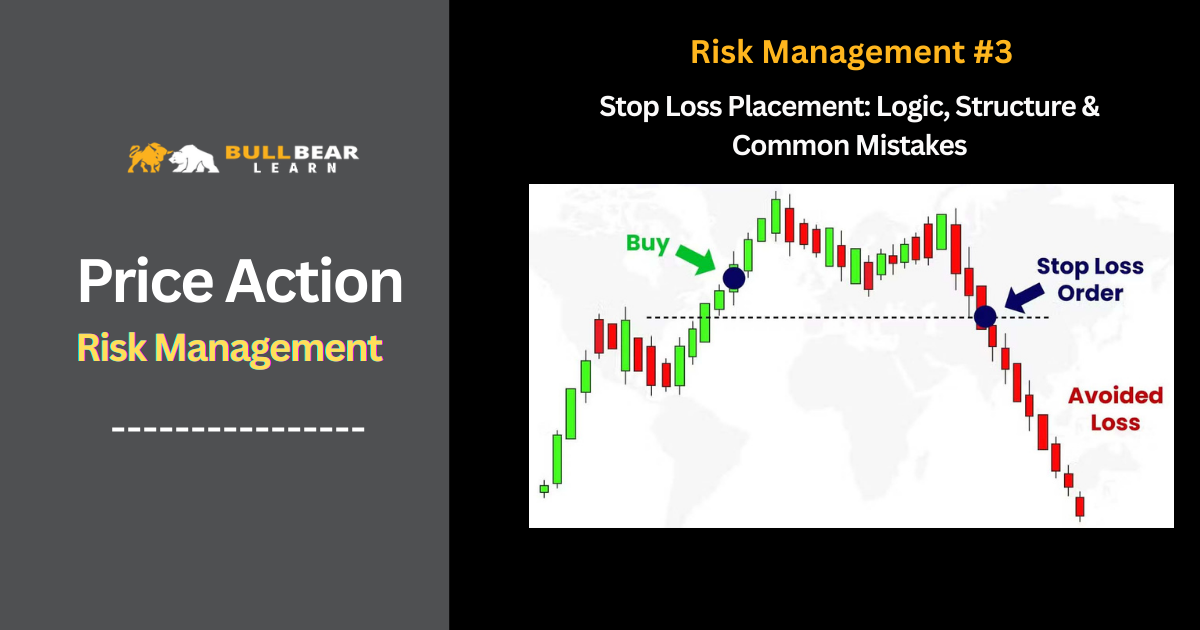
Risk Management #3: Stop Loss Placement: Logic, Structure & Common Mistakes

Baby Bull by Baby Bull
January 5, 2026
in Price Action, Risk Management
58 0
0
189
SHARES
1.5k
VIEWS
Share on FacebookShare on Twitter

Most traders use a stop loss.
Few traders place it correctly.

A stop loss is often treated as a number of pips chosen arbitrarily—10 pips, 20 pips, or “just below the last candle.” This approach creates a dangerous illusion of risk control while ignoring how markets actually move.

In this article, you will learn how to place stop losses logically, based on structure and volatility, and why improper stop placement is one of the main reasons traders with decent strategies still lose money.

This article builds directly on:

  • Risk Management #2: Position Sizing Explained

Because without correct stop placement, position sizing cannot function properly.


Table of Contents

Toggle
  • What a Stop Loss Is (and What It Is Not)
  • Stop Loss Placement Must Be Logical, Not Emotional
  • Structure-Based Stop Loss Placement
    • Using Market Structure
  • Volatility-Based Stop Loss Placement
  • The Stop Loss–Position Size Connection
  • Common Stop Loss Mistakes That Kill Accounts
    • 1. Placing Stops at Obvious Levels
    • 2. Using the Same Stop Distance for Every Trade
    • 3. Moving Stops Emotionally
  • Stop Loss Placement and Losing Streaks
  • Stop Losses Protect Capital, Not Ego
  • What Comes Next
  • Final Thoughts

What a Stop Loss Is (and What It Is Not)

A stop loss is not:

  • A random pip distance

  • A pain tolerance threshold

  • A place to “hope the market doesn’t reach”

A stop loss is:

  • A point where your trade idea is proven wrong

  • A structural invalidation level

  • A predefined exit for capital protection

Professionals place stops where the market logic breaks, not where losses feel uncomfortable.


Stop Loss Placement Must Be Logical, Not Emotional

The market does not know where you entered.

It only responds to:

  • Structure

  • Liquidity

  • Volatility

When a stop is placed emotionally:

  • It is usually too tight

  • It sits near obvious levels

  • It gets triggered during normal price noise

When placed logically:

  • It aligns with structure

  • It allows normal fluctuation

  • It invalidates the trade idea decisively


Structure-Based Stop Loss Placement

Using Market Structure

Structure-based stops rely on:

  • Swing highs and lows

  • Support and resistance zones

  • Breaks of structure (BOS)

Example:

  • In an uptrend, a long trade is invalidated only if price breaks below the most recent higher low

  • A stop placed above that level lacks structural meaning

This approach filters out noise and ensures that stops represent idea failure, not random volatility.

Structure is introduced in the Foundation/Core Concepts silo and becomes practical here.


Volatility-Based Stop Loss Placement

Structure alone is not enough.

Markets expand and contract.
Stops must adapt.

Volatility-based placement uses:

  • Average True Range (ATR)

  • Recent candle ranges

  • Session-based volatility

In high volatility conditions:

  • Stops must be wider

  • Position size must be reduced

In low volatility conditions:

  • Stops can be tighter

  • Position size can increase safely

This relationship connects directly to:

  • Execution #4: Liquidity, Volatility & Market Conditions in Execution

Ignoring volatility is a common cause of repeated stop-outs during news or session opens.


The Stop Loss–Position Size Connection

A stop loss does not control risk by itself.

Risk is controlled by:

Stop loss distance × position size

A tighter stop does not reduce risk unless position size is adjusted accordingly.

This is why traders who tighten stops without recalculating position size often experience:

  • Frequent stop-outs

  • Inconsistent losses

  • Psychological frustration

This reinforces the role of:

  • Risk Management #2: Position Sizing Explained


Common Stop Loss Mistakes That Kill Accounts

1. Placing Stops at Obvious Levels

Retail stops cluster around:

  • Round numbers

  • Exact highs/lows

  • Obvious support/resistance

These areas attract liquidity.

The market often trades through these levels before moving in the intended direction.


2. Using the Same Stop Distance for Every Trade

Markets change.
Volatility changes.

A fixed 15-pip stop across all conditions guarantees inconsistent results.


3. Moving Stops Emotionally

Common behaviors:

  • Moving stops further “to give the trade room”

  • Removing stops entirely

  • Tightening stops prematurely to avoid loss

These actions destroy the integrity of the risk plan and turn trading into gambling.


Stop Loss Placement and Losing Streaks

Poor stop placement amplifies losing streaks.

When stops are:

  • Too tight → frequent small losses accumulate rapidly

  • Too wide without sizing adjustment → large losses accelerate drawdowns

Correct stop logic:

  • Smooths equity curves

  • Keeps losses proportional

  • Improves psychological resilience

This prepares traders for:

  • Risk Management #5: Drawdown, Losing Streaks & Capital Survival


Stop Losses Protect Capital, Not Ego

A stopped-out trade does not mean you were wrong as a trader.
It means the market invalidated a specific idea.

Professionals accept stops as operational costs, not personal failures.

When stop loss logic is respected:

  • Risk remains consistent

  • Confidence remains intact

  • Long-term performance improves


What Comes Next

Once you understand:

  • How much to risk (Position Sizing)

  • Where risk is invalidated (Stop Loss Placement)

The next question becomes:

Is the potential reward worth the risk?

That is the role of:

  • Risk Management #4: Risk-Reward Ratio – The Math Behind Long-Term Profitability


Final Thoughts

Stop losses are not optional.
They are not negotiable.

They are the boundary between controlled trading and financial chaos.

Placed logically, a stop loss becomes a professional tool—not a source of fear.

Tags: price actionrisk
Share76Tweet47
Previous Post

Risk Management #2: Position Sizing Explained: How Much Should You Risk Per Trade?

Next Post

Risk Management #4: Risk-Reward Ratio: The Math Behind Long-Term Profitability

Related Posts

Risk Management #6: Scaling Risk, Drawdown Control & When to Reduce Size

by Baby Bull
January 5, 2026
0

Why Advanced Traders Fail Not Because of Strategy — But Because of Risk Scaling Most traders do not blow accounts...

Risk Management #5: Drawdown, Losing Streaks & Capital Survival

by Baby Bull
January 5, 2026
0

Every trader experiences losses.Very few traders prepare for them. Most accounts do not fail because of one bad trade. They...

Risk Management #1: Why Risk Management Matters More Than Your Trading Strategy?

by Baby Bull
January 5, 2026
0

Most beginner traders spend months—sometimes years—searching for the “perfect” trading strategy.They jump from indicators to price action patterns, from one...

Risk Management #4: Risk-Reward Ratio: The Math Behind Long-Term Profitability

by Baby Bull
January 5, 2026
0

Many traders believe that a high risk-reward ratio (R:R) guarantees profitability.They aim for 1:3, 1:5, or even higher, assuming bigger...

Risk Management #2: Position Sizing Explained: How Much Should You Risk Per Trade?

by Baby Bull
January 3, 2026
0

Most traders believe risk management starts with a stop loss. That belief is incomplete. In reality, position sizing is the...

Load More
  • Trending
  • Comments
  • Latest
Forex Trading Styles

Forex Trading Styles Explained: Scalping, Day Trading, Swing Trading, and Position Trading

December 20, 2025
forex account types

Forex Account Types Explained: Standard, Raw, ECN & More

December 15, 2025

Execution #2: Order Execution in Forex – Slippage, Requotes & Why It Affects Your Results

January 12, 2026
OKX Review

OKX Review 2026 — Is OKX a Safe, Legit and Reliable Crypto Exchange?

December 29, 2025

Swing Trading Strategy: A Practical Approach for Consistent Traders

0

Risk–Reward Strategy: The Foundation of All Profitable Trading

0

Risk Management #6: Scaling Risk, Drawdown Control & When to Reduce Size

0

Risk Management #5: Drawdown, Losing Streaks & Capital Survival

0

Swing Trading Strategy: A Practical Approach for Consistent Traders

January 12, 2026

Risk–Reward Strategy: The Foundation of All Profitable Trading

January 7, 2026

Risk Management #6: Scaling Risk, Drawdown Control & When to Reduce Size

January 5, 2026

Risk Management #5: Drawdown, Losing Streaks & Capital Survival

January 5, 2026

BullBearLearn.com is an independent educational website on Forex and financial trading, offering knowledge, strategies, and tools to help traders understand and navigate markets—whether bullish or bearish.

Categories
  • Broker Reviews
  • Core Concepts
  • Core Strategies
  • Crypto Exchange
  • Execution
  • Forex Basic
  • Learn Forex
  • Market Condition
  • Price Action
  • Risk Management
  • Trading Strategies
Tags
Beginner Binance Review breakout Broker Reviews Bybit review Core Concepts cost crypto exchange Execution Exness Review fees forex basic guide Leverage lot Margin mistake OKX review pip price action risk risk reward Spread swap Swing XM Review xtb review

Disclaimer: Content on BullBearLearn.com is for educational purposes only and not intended as financial advice. Trading involves risk.​

  • About
  • Privacy Policy
  • Terms of Service
  • Disclaimer
  • Cookie Policy
  • Affiliate Disclosure
  • Contact Us

© 2025 BullBearLearn.com — Learn to Trade, Bull or Bear.

Welcome Back!

Login to your account below

Forgotten Password?

Retrieve your password

Please enter your username or email address to reset your password.

Log In

Session expired

Please log in again. The login page will open in a new tab. After logging in you can close it and return to this page.

Add New Playlist

>

Table of Contents

×
  • What a Stop Loss Is (and What It Is Not)
  • Stop Loss Placement Must Be Logical, Not Emotional
  • Structure-Based Stop Loss Placement
    • Using Market Structure
  • Volatility-Based Stop Loss Placement
  • The Stop Loss–Position Size Connection
  • Common Stop Loss Mistakes That Kill Accounts
    • 1. Placing Stops at Obvious Levels
    • 2. Using the Same Stop Distance for Every Trade
    • 3. Moving Stops Emotionally
  • Stop Loss Placement and Losing Streaks
  • Stop Losses Protect Capital, Not Ego
  • What Comes Next
  • Final Thoughts
→ Index
No Result
View All Result
  • Home
  • Learn Forex
    • Forex Basic
    • Trading Strategies
    • Price Action
  • Learn Crypto
  • Broker Reviews
  • Tools FREE
  • Blog
START

© 2025 BullBearLearn.com — Learn to Trade, Bull or Bear.