

Most retail traders believe that profitability comes from finding better trade setups.
Professional traders know that long-term performance is largely determined by execution efficiency and cost control.
Even with strong price action analysis, correct timing, and proper order selection, hidden trading costs can quietly erode results over time. These costs are not always visible, but they are always present.
In the previous article, Order Execution in Forex: Slippage, Requotes & Why It Affects Your Results, we explored how forex orders are filled in real market conditions. This article completes the execution framework by breaking down trading costs and execution risk, and explaining why they matter more than most traders realize.
What Are Trading Costs in Forex?
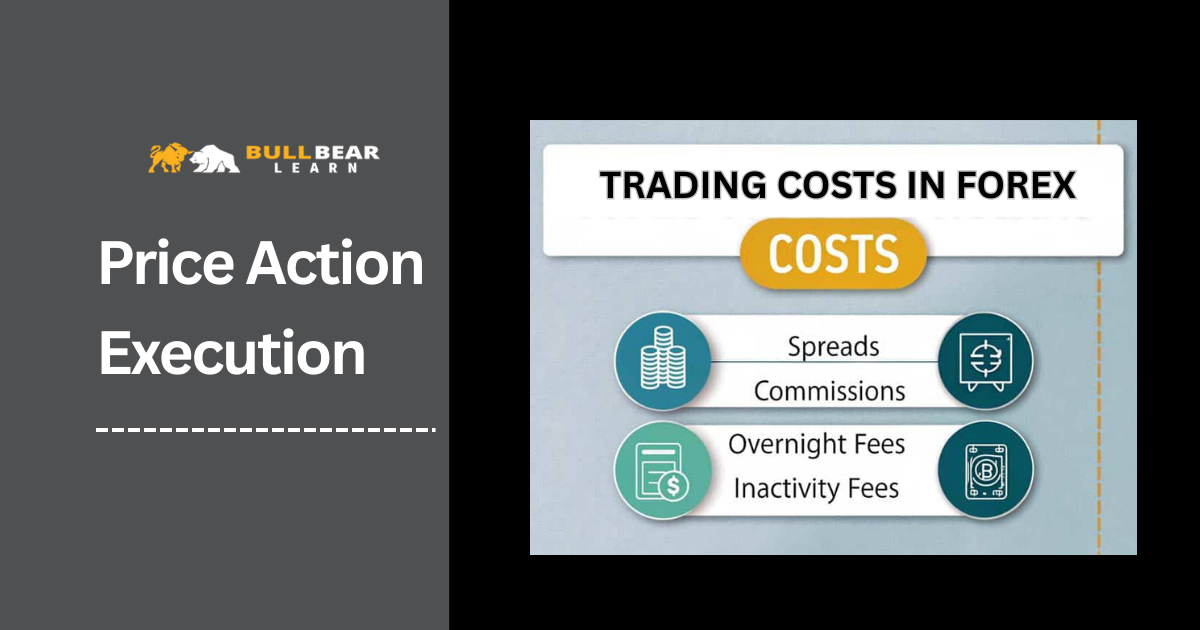
Trading costs are any factors that reduce your net outcome after a trade is executed.
They include:
-
Spread
-
Slippage
-
Commission
-
Execution risk during volatility
Unlike strategy errors, trading costs affect every single trade, whether it wins or loses. Over hundreds of trades, they become one of the most decisive variables in overall performance.
The Spread: The Cost You Always Pay
What Is the Spread?
The spread is the difference between the bid and ask price.
It represents the immediate cost of entering a position. From the moment a trade is opened, it starts at a small loss equal to the spread.
This cost exists regardless of:
-
Timeframe
-
Strategy
-
Market direction
Fixed vs Variable Spreads
-
Fixed spreads
-
Stable during normal conditions
-
Often widen dramatically during news or low liquidity
-
-
Variable spreads
-
Tighter during liquid sessions
-
Expand quickly during volatility
-
Professional traders understand that spreads are dynamic, not static. The same broker can offer very different spreads depending on market conditions.
Slippage: The Invisible Execution Cost
What Is Slippage?
Slippage occurs when an order is executed at a price different from the requested one.
Slippage can be:
-
Negative (worse price)
-
Positive (better price, less frequent)
Slippage is most common during:
-
High-impact news releases
-
Session opens
-
Breakouts and momentum moves
-
Thin liquidity periods
Why Slippage Matters
Slippage compounds over time.
A few tenths of a pip may seem insignificant, but across dozens or hundreds of trades, it can:
-
Destroy otherwise profitable strategies
-
Skew backtest expectations
-
Increase emotional pressure
This is why execution-aware traders treat slippage as a structural cost, not a random accident.
Commission: The Explicit Cost
Some brokers offer:
-
Tight spreads
-
Plus a fixed commission per trade
Others embed all costs directly into the spread.
Neither pricing model is inherently superior.
What matters is:
-
Total cost per round turn
-
Consistency during volatility
-
Transparency in execution behavior
Commission should always be evaluated together with spread and slippage, not in isolation.
Execution Risk: The Cost Most Traders Ignore
Execution risk refers to the probability that trades are filled:
-
At worse prices than expected
-
With delays
-
Under unfavorable market conditions
Execution risk increases during:
-
High volatility
-
Low liquidity
-
News-driven markets
-
Rapid directional moves
Execution risk is not a broker-specific issue alone—it is a market reality that must be managed.
How Trading Costs Differ by Order Type
Trading costs are not uniform across execution methods.
Each order type interacts with the market differently, resulting in distinct cost profiles.
Market Orders
-
Guaranteed execution
-
Highest exposure to spread and slippage
-
Most sensitive to volatility
Limit Orders
-
Full price control
-
No negative slippage
-
Risk of missed execution and opportunity cost
Stop Orders
-
Momentum-driven execution
-
Highly sensitive to volatility spikes
-
Often experience slippage during breakouts
Professional execution means selecting order types not only for entry logic, but also for cost efficiency.
How Trading Costs Affect Different Trading Styles
Trading costs impact traders differently depending on timeframe and frequency.
Scalpers
-
Extremely sensitive to spread and commission
-
Small inefficiencies destroy edge
-
Execution speed is critical
Day Traders
-
Balanced exposure to spread and slippage
-
Session timing significantly affects cost
-
Execution discipline determines consistency
Swing Traders
-
Less affected by spread
-
Still vulnerable to slippage during entries and exits
-
Overnight gaps introduce execution risk
This explains why many strategies fail when copied across timeframes without adjusting execution assumptions.
Why Broker Execution Quality Matters
Execution costs are not determined by strategy alone.
Broker infrastructure influences:
-
Spread stability
-
Slippage frequency
-
Requote behavior
-
Order fill consistency during stress
Two traders using the same setup can experience very different results depending on execution quality.
Professional traders evaluate brokers not only by advertised spreads, but by real-world execution performance across varying market conditions.
To better understand how execution quality differs between brokers, you can explore our detailed broker reviews focused on spreads, slippage, and execution models.
How Trading Costs Distort Backtesting Results
Many strategies appear profitable in backtests because:
-
Fixed spreads are assumed
-
Slippage is ignored
-
Execution delays are absent
In live trading:
-
Spread varies
-
Slippage occurs unpredictably
-
Execution risk increases during volatility
This gap between simulated and real execution explains why many traders struggle to reproduce backtest results.
Reducing Trading Costs: A Professional Approach
Professionals do not eliminate trading costs—they manage and adapt to them.
Common practices include:
-
Trading during high-liquidity sessions
-
Avoiding market orders during news
-
Using limit orders where precision matters
-
Reducing position size during volatility
-
Selecting brokers with consistent execution quality
Execution discipline is a skill developed through awareness, not a setting adjusted once.
Execution Costs and Risk Management
Trading costs directly influence:
-
Effective risk per trade
-
Stop-loss viability
-
Position sizing accuracy
-
Drawdown behavior
Ignoring execution costs leads to:
-
Over-leveraging
-
Miscalculated risk
-
Faster capital erosion
This is the natural transition from execution into structured risk management.
How Trading Costs Complete the Execution Silo
Execution is not just about entering trades.
It is about:
-
Understanding market context (Execution #0)
-
Choosing the right order type (Execution #1)
-
Knowing how orders are filled (Execution #2)
-
Accounting for all costs and risks (this article)
Together, these elements form a complete execution framework.
What Comes Next
With execution fully covered, the next step is Risk Management.
Understanding how much to risk, where to place stops, and how to size positions only makes sense after execution costs are fully understood.
👉 Next Silo:
Risk Management in Forex: Protecting Capital Before Profits