

Trading costs can have a major impact on your results, especially if you trade frequently. A broker may advertise low spreads, but the actual cost of trading can also include commissions, overnight financing, currency conversion, and other account-related charges.
XM uses different pricing structures depending on the account type, instrument, and entity serving the client. Its current account offering in some markets focuses primarily on Standard and Ultra Low accounts, while Zero Account availability and commission structures can differ by jurisdiction.
In this guide, we explain XM fees in 2026, including spreads, commissions, swaps, deposits, withdrawals, inactivity-related charges, and the factors that determine your actual cost of trading.
The goal is not simply to list fees, but to help you understand how much trading with XM may really cost.
For a broader evaluation of the broker, read our [XM Review 2026].
What Fees Does XM Charge?
XM trading costs can generally be divided into several categories:
| Cost | What It Means |
|---|---|
| Spread | Difference between the bid and ask price |
| Commission | Separate trading charge on applicable account types |
| Swap | Financing cost or credit for positions held overnight |
| Deposit fee | Depends on payment method and conditions |
| Withdrawal fee | Depends on payment method and conditions |
| Currency conversion | May apply when transaction currencies differ |
| Inactivity-related charges | May apply depending on account/entity terms |
These costs can vary considerably depending on which [XM Account Types] you choose.
Not every XM client will pay every type of fee.
For example, a trader using a spread-based account may not pay a separate trading commission, while an applicable commission-based account can have a separate commission in addition to the spread.
The exact conditions should therefore be checked against the XM entity and account available to you.
XM Spreads
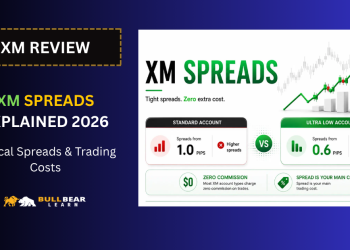
For most XM traders, the spread is one of the most important trading costs.
The spread is the difference between the price at which you can buy and the price at which you can sell an instrument.
For example, if EUR/USD is quoted at:
- Bid: 1.1000
- Ask: 1.1002
the spread is 0.0002, or 2 pips.
When you open a position, the spread represents an immediate trading cost because a buy position opens at the ask price while a sell position opens at the bid price.
XM states that its spreads are variable rather than fixed. This means they can change according to market liquidity and volatility. Spreads can become wider during major news announcements, unusual market conditions, market closures, and periods of lower liquidity.
This is why traders should not evaluate XM solely by its minimum advertised spread.
A more useful approach is to consider the typical spread during the hours when you actually trade.
For a detailed breakdown, see our XM Spreads Explained guide.
XM Commission
Whether you pay a separate commission depends on the account type and the applicable XM entity.
XM’s current account pages in some markets prominently offer Standard and Ultra Low accounts, where the pricing is primarily built around spreads.
Commission-based pricing is different.
The XM Zero Account, for example, historically used a combination of tighter spreads and a separate commission. However, XM’s official documentation indicates that some entities have ceased offering new Zero Accounts, meaning traders should not assume that the same commission structure is available everywhere.
This is an important distinction when comparing older XM reviews with current account conditions.
If you are evaluating a commission-based account, calculate:
Total trading cost = spread cost + commission
rather than comparing spreads alone.
For active traders and scalpers, this calculation can make a significant difference.
XM Swap Fees
Swap, also known as an overnight financing charge or rollover fee, can apply when you keep certain leveraged positions open overnight.
Unlike the spread, which is generally associated with entering and exiting a trade, swap is related to the cost of maintaining an open position beyond the relevant trading day.
Depending on the instrument and position:
- You may pay a swap charge.
- You may receive a swap credit.
- The swap amount can differ between long and short positions.
- The applicable rate can change over time.
XM’s documentation describes swap/rollover as the financing adjustment associated with carrying an open position into the next day.
This cost is particularly important for:
- Swing traders
- Position traders
- Traders holding gold overnight
- Traders holding positions for several days
- Strategies that rely on leveraged positions
A scalper who closes all positions before the relevant rollover period may be less affected by swap than a trader who holds positions for weeks.
Are XM Swap Fees High?
There is no single answer because swap rates depend on the instrument, direction of the trade, account conditions, and applicable entity.
Two positions on the same instrument can also have different financing outcomes depending on whether you are long or short.
Therefore, traders should check the current swap information for the specific instrument before opening a position they intend to hold overnight.
This is especially important when comparing brokers.
A broker with a slightly wider spread but more favorable overnight financing could potentially be cheaper for a swing trader than a broker with a tighter spread and expensive financing.
This is one reason why trading style matters when evaluating broker fees.
XM Deposit Fees
XM’s current website promotes deposits and withdrawals as part of its funding service, but the actual cost can depend on the payment method, currency, region, and applicable terms.
Before depositing funds, traders should check:
- Available payment methods
- Supported currencies
- Minimum transaction amount
- Processing time
- Whether the payment provider charges its own fee
- Whether currency conversion is involved
A broker may not charge a direct deposit fee while a bank, card issuer, e-wallet, or payment processor may still apply its own charges.
Therefore, “no broker deposit fee” does not necessarily mean “zero cost in every funding situation.”
XM Withdrawal Fees
XM also promotes low-cost or fee-free withdrawal options in some markets, but withdrawal conditions can vary according to the payment method and jurisdiction.
The potential cost of a withdrawal can come from:
- XM itself
- Your bank
- Your payment provider
- Currency conversion
- Intermediary banking charges
This distinction is particularly important for international traders.
For example, withdrawing funds in a currency different from your account’s base currency may create a conversion cost even if XM does not charge a separate withdrawal fee.
Always check the withdrawal method and the final amount you will receive rather than looking only for a line called “withdrawal fee.”
Does XM Have Hidden Fees?
XM markets its current offering with an emphasis on transparent pricing and no hidden costs. Its global website currently highlights tight spreads and zero commission for certain account offerings.
However, “no hidden fees” should not be interpreted as “there are no trading costs.”
You can still incur:
- Spread costs
- Swap or financing costs
- Applicable commissions
- Currency conversion costs
- Payment-provider charges
- Other charges specified in the applicable account terms
XM’s client agreement also states that commissions and charges can be published or notified through its trading facility and may be changed under the applicable terms.
The practical lesson is simple:
Always distinguish between “no hidden fees” and “no trading costs.”
Every leveraged trading account has some form of cost associated with execution, financing, or market access.
XM Fees by Account Type
The account type you choose can significantly change how your trading costs are structured.
XM Standard Account
The Standard Account is primarily a spread-based account.
This makes the cost structure relatively simple because traders generally focus on the spread rather than calculating a separate commission for each trade.
It can be suitable for:
- Beginners
- Casual traders
- General Forex trading
- Traders who prefer simple pricing
For a detailed analysis, read our XM Standard Account Review.
XM Ultra Low Account
The Ultra Low Account is designed around lower-cost trading conditions and is currently part of XM’s account offering in several markets. XM describes it as an option intended for higher-volume trading, with lower spreads and reduced swap costs compared with its standard structure.
It may therefore be particularly interesting to:
- Active traders
- Traders comparing transaction costs
- Traders who hold positions overnight
- Traders looking for a lower-spread account
See our XM Ultra Low Account Review for a detailed breakdown.
XM Zero Account
The Zero Account uses a different pricing model involving tighter spreads and a separate commission.
However, availability is an important consideration.
XM’s official documentation for certain entities states that new Zero Accounts have been discontinued, while existing accounts may continue to incur commission under their applicable terms.
For this reason, traders should check whether Zero is actually available in their jurisdiction before using older reviews or comparisons.
XM Fees for Forex Trading
Forex traders typically need to focus on three major costs:
Spread + commission + swap
For a short-term trader who opens and closes positions quickly, the spread and commission are usually the most important.
For a swing trader, swap can become much more significant.
For example:
Short-term trader
A trader opens and closes EUR/USD within a few minutes.
Main considerations:
- Spread
- Commission, if applicable
- Slippage
Swing trader
A trader holds EUR/USD for several days.
Main considerations:
- Spread
- Commission
- Overnight financing
- Potential weekend-related financing
This illustrates why there is no universally “cheapest” XM account.
The cheapest account depends on how you trade.
XM Fees for Gold Trading
Gold, usually represented as XAU/USD, deserves special consideration.
Gold can experience significant price movements, particularly around:
- U.S. economic releases
- Federal Reserve decisions
- Inflation data
- Employment reports
- Geopolitical events
The trading cost therefore depends not only on the normal spread but also on market volatility and execution conditions.
Gold traders should consider:
- XAU/USD spread
- Commission, if applicable
- Swap
- Position size
- Leverage
- Slippage
- Holding period
A trader who scalps gold may prioritize spread and execution.
A trader who holds gold for several days may care much more about financing costs.
Do not assume that the account with the lowest Forex spread will automatically be the cheapest option for gold.
How Much Does It Cost to Trade with XM?
There is no single number that represents the cost of trading with XM.
Your total cost depends on several variables:
Total cost = spread + commission + swap + other applicable charges
For example, imagine a trader opens and closes a position during the same trading session.
The simplified cost might be:
Trading cost = spread + commission
If the position remains open overnight:
Trading cost = spread + commission + financing
If the trader also needs to convert currencies or pay a payment-provider fee, the effective cost can be higher.
This is why comparing brokers based on a single spread number can produce misleading conclusions.
How to Reduce Your XM Trading Costs
There are several practical ways to control trading costs.
Choose the right account
Compare the Standard and Ultra Low structures based on your actual trading frequency and strategy.
Trade during liquid market hours
Spreads can be tighter when liquidity is high.
Major Forex sessions often provide more favorable conditions than periods of very low liquidity.
Avoid unnecessary overtrading
Even a low-cost trade is still a cost.
If you make dozens of unnecessary trades, transaction costs can accumulate quickly.
Consider swap before holding overnight
If your strategy involves holding positions for several days, check the applicable swap conditions before entering the trade.
Compare total cost, not just spread
This is especially important when comparing Standard, Ultra Low, and commission-based account structures.
Monitor high-impact news
Spreads can widen during volatile market conditions. Traders using short-term strategies should understand how major economic releases can affect execution costs.
XM Fees vs Other Forex Brokers
When comparing XM with another broker, avoid using only the advertised minimum spread.
A more useful comparison includes:
| Cost Factor | What to Compare |
|---|---|
| Spread | Typical spread on your main instruments |
| Commission | Cost per lot or equivalent |
| Swap | Long and short overnight rates |
| Deposit | Broker and payment-provider charges |
| Withdrawal | Broker and payment-provider charges |
| Conversion | Currency conversion costs |
| Execution | Slippage and spread behavior |
| Account requirements | Minimum deposit and account conditions |
For example, a broker advertising a 0.0-pip minimum spread may not necessarily be cheaper if its commission is high.
Similarly, a broker with a slightly wider spread may offer a lower total cost for a particular trading style.
The correct comparison is always all-in cost.
Are XM Fees Competitive?
XM’s current pricing structure is designed to provide relatively straightforward spread-based trading on its main account types, with Standard and Ultra Low accounts currently prominent in its account offering.
XM also advertises spreads from 0.8 pips on its current global site, although advertised minimum spreads should not be confused with the spread a trader will receive continuously under all market conditions.
Whether XM is competitive for you depends on:
- Your preferred instruments
- Trading frequency
- Average position size
- Holding period
- Account type
- Country and XM entity
- Use of leverage
- Sensitivity to swap
For beginners and general Forex traders, the simpler spread-based structure can be easy to understand.
For active traders, comparing the Ultra Low account against competing low-cost accounts may be more relevant.
Minimum funding requirements can also affect which account is practical for you, so see our [XM Minimum Deposit] guide before opening an account.
Pros and Cons of XM Fees
Pros
- Simple spread-based pricing on major account types
- Competitive advertised spreads
- Ultra Low account designed for lower trading costs
- No separate commission on certain spread-based accounts
- Transparent distinction between trading costs and financing costs
- Multiple account structures available depending on jurisdiction
Cons
- Actual spreads vary with market conditions
- Swap can become significant for longer-term positions
- Account availability differs by jurisdiction
- Older Zero Account information may no longer apply to new clients
- Payment-provider or currency-conversion costs may still occur
- Advertised minimum spreads do not represent every trading situation
Who Is XM Best For?
XM’s fee structure can work for several types of traders, but the most appropriate account depends on the strategy.
Beginners
Beginners may prefer the Standard Account because its spread-based pricing is relatively easy to understand.
Active traders
Active traders may want to compare the Standard and Ultra Low accounts based on actual spreads and trading frequency.
Scalpers
Scalpers should focus heavily on spread, execution, slippage, and any applicable commission because small transaction costs can accumulate across many trades.
Swing traders
Swing traders should pay particular attention to swap because positions may remain open for several days or longer.
Gold traders
Gold traders should compare XAU/USD trading costs separately rather than assuming that Forex pricing automatically applies to gold.
Final Verdict: Are XM Fees Worth It?
XM’s fee structure is relatively straightforward once you separate the major cost components.
The most important costs to understand are:
Spreads, commissions, and swap.
Deposit, withdrawal, and currency-conversion costs can also matter depending on how you fund and manage your account.
The biggest mistake is to judge a broker by its advertised minimum spread alone.
Instead, consider the complete cost of your normal trade.
For a beginner, a simple spread-based account such as XM Standard may be easier to understand. Active traders can compare XM Ultra Low against alternative low-cost accounts. Traders researching the older Zero structure should first verify whether that account is currently available to new clients in their jurisdiction.
Overall, XM can be competitive for traders who understand how its account-specific pricing works, but the best XM account depends on your trading style, instruments, and holding period.
Before opening an account, always check the latest fees and conditions for the XM entity serving your country.
Frequently Asked Questions
Does XM charge trading fees?
XM’s trading costs depend on the account type and instrument. Spread-based accounts primarily incorporate trading costs into the spread, while applicable commission-based accounts can charge a separate commission.
Does XM charge commission?
Commission depends on the account type and XM entity. Standard and Ultra Low accounts in the current offering are primarily spread-based, while Zero Account commission structures may apply to existing accounts in certain entities.
Does XM charge swap fees?
Swap or overnight financing can apply when eligible positions are held overnight. The amount depends on the instrument, direction, account conditions, and applicable entity.
Does XM charge deposit fees?
Deposit costs depend on the payment method, currency, region, and applicable terms. Even when XM does not charge a direct deposit fee, a payment provider or bank may impose its own charge.
Does XM charge withdrawal fees?
Withdrawal conditions vary by payment method and jurisdiction. Traders should check the applicable method before requesting a withdrawal.
What is the cheapest XM account?
There is no single cheapest account for every trader. Standard, Ultra Low, and other account structures have different pricing models. The best option depends on your spread, commission, swap, trade frequency, and instruments.
Are XM fees good for scalping?
They can be, but scalpers should focus on the total cost of each trade rather than the advertised minimum spread. Execution quality and slippage are also important.
Are XM fees good for beginners?
XM’s spread-based account structure can be relatively easy for beginners to understand. However, beginners should learn how spreads, leverage, margin, and swap affect trading costs before trading with real money.
Does XM have hidden fees?
XM advertises transparent pricing and no hidden costs on its current website. However, traders can still incur normal trading costs such as spreads, applicable commissions, swap charges, and potential payment-provider or currency-conversion costs.
Compare XM’s Current Trading Conditions
XM account types, spreads, commissions, and other trading conditions can vary by country and regulatory entity. Check the current conditions available for your jurisdiction before opening an account.
Related XM Guides
For a complete understanding of XM’s trading conditions, continue with:
- XM Review 2026
- XM Account Types 2026
- XM Standard Account Review
- XM Ultra Low Account Review
- XM Zero Account Review
- XM Spreads Explained
- XM Minimum Deposit
- XM MT4 vs MT5